
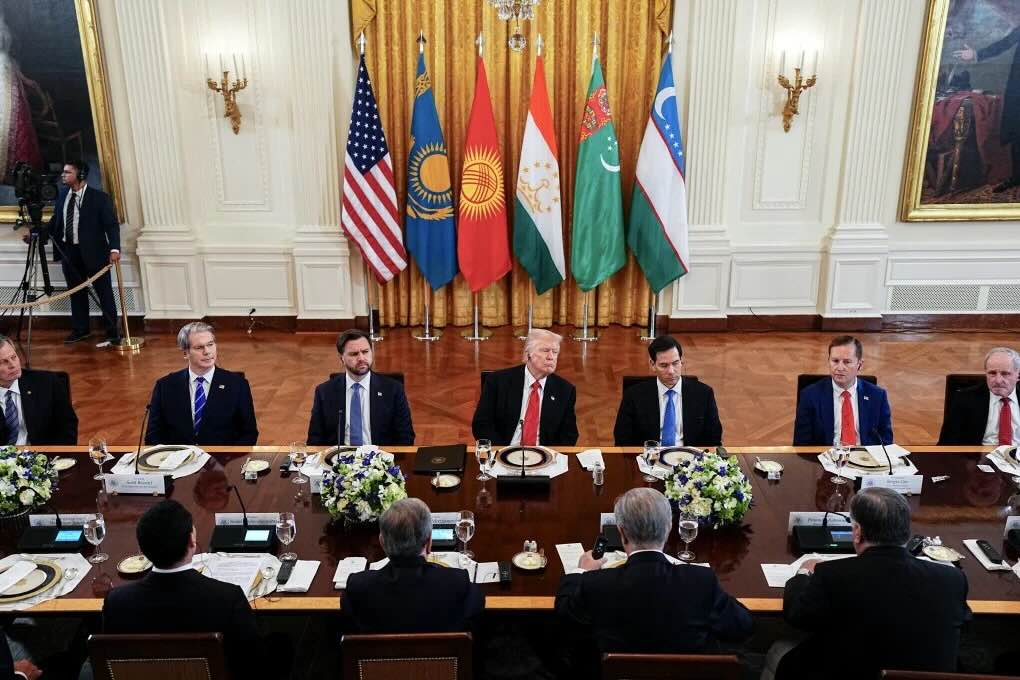
President Donald Trump hosted leaders of five Central Asian countries at the White House on Thursday as he intensifies his hunt for rare earth metals needed for high-tech devices, including smartphones, electric vehicles and fighter jets.
Trump and the officials from Kazakhstan, Kyrgyzstan, Tajikistan, Turkmenistan and Uzbekistan held bilateral meetings in the Oval Office before having a working dinner.
“These nations were once home to the ancient Silk Road connecting East and West,” Trump said, while noting that “sadly, previous American presidents neglected this region completely.”
He added, “I understand the importance of this region” but “a lot of people don’t know that.”
The White House visits followed Trump managing at least a temporary thaw with Chinese leader Xi Jinping on differences between the United States and China over the export of rare earth elements, a key point of friction in their trade negotiations.
Early last month, Beijing expanded export restrictions over vital rare earth elements and magnets before announcing, after Trump-Xi talks in South Korea last week, that China would delay its new restrictions by one year.
Washington is now looking for new ways to circumvent China on critical minerals. China accounts for nearly 70% of the world’s rare earth mining and controls roughly 90% of global rare earths processing.
What the region has and needs
Central Asia holds deep reserves of rare earth minerals and produces roughly half the world’s uranium, which is critical to nuclear power production. But the region badly needs investment to further develop the resources.
Central Asia’s critical mineral exports have long tilted toward China and Russia.Kazakhstan, for example, in 2023 sent $3.07 billion in critical minerals to China and $1.8 billion to Russia compared with $544 million to the U.S., according to country-level trade data compiled by the Observatory of Economic Complexity, an online data platform.
“In recent weeks, my administration has strengthened American economic security by forging agreements with allies and friends across the world to broaden our critical minerals supply chains,” Trump said.
He asked each of the visiting presidents to give remarks, and they praised his efforts to promote trade in their region and peace around the world.
Tajikistan President Emomali Rahmon said his country has “very rich, boundless” critical mineral resources. But he also offered a nod to being in a tough geopolitical neighborhood, situated between Russia and China.
That makes partnering with the U.S. all the more important, Rahmon said: “We are very keen to continue closely our cooperation on security items, which we are so concerned for.”
The White House meetings came after a bipartisan group of senators introduced legislation Wednesday to repeal Soviet-era trade restrictions that some lawmakers say are holding back American investment in the Central Asian nations, which became independent with the 1991 collapse of the Soviet Union.
“Today, it’s not too late to deepen our cooperation and ensure that these countries can decide their own destinies, as a volatile Russia and an increasingly aggressive China pursue their own national interests around the globe at the cost to their neighbors,” said Republican Sen. Jim Risch of Idaho, chairman of the Senate Foreign Relations Committee and a sponsor of the legislation. “The United States offers Central Asian nations the real opportunity to work with a willing partner, while lifting up each others’ economies.”
Building economic ties
The grouping of countries, referred to as the “C5+1,” has largely focused on regional security, particularly in light of the two-decade U.S. military presence and then withdrawal from neighboring Afghanistan, China’s treatment of ethnic Uyghur Muslims in Xinjiang and attempts by Russia to reassert power in the region.
Secretary of State Marco Rubio welcomed the Central Asian leaders at the State Department on Wednesday to mark the 10-year anniversary of the C5+1 and to plug the potential for expanding the countries’ economic ties to the U.S.
“We oftentimes spend so much time focused on crisis and problems — and they deserve attention — that sometimes we don’t spend enough time focused on exciting new opportunities,” Rubio said. “And that’s what exists here now: an exciting new opportunity in which the national interests of our respective countries are aligned.”
Deputy Secretary of State Christopher Landau and the U.S. ambassador to India, Sergio Gor, who also serves as Trump’s special envoy to South and Central Asia, recently visited Kazakhstan and Uzbekistan to prepare for the summit.
Administration officials say deepening the U.S. relationship with the countries is a priority, a point they have made clear to the Central Asian officials.
The president’s “commitment to this region is that you have a direct line to the White House, and that you will get the attention that this area very much deserves,” Gor told the Central Asian officials Wednesday.
Expanding the Abraham Accords
Also Thursday, Kazakhstan’s president, Kassym-Jomart Tokayev, agreed that his Muslim-majority country will join the Trump-led Abraham Accords. Trump posted word of the agreement shortly before Thursday’s dinner began.
The largely symbolic move is aimed at reviving an initiative that was the signature foreign policy achievement of Trump’s first term, when his administration forged diplomatic and commercial ties between Israel and the United Arab Emirates, Bahrain and Morocco.
Kazakhstan has had diplomatic relations with Israel since 1992.
With a fragile ceasefire holding in Gaza, Trump is hoping Saudi Arabia will soon join the accords, while the White House has said the same of Indonesia, the world’s most populous Muslim nation.
Saudi Arabian and Indonesian officials have maintained that they cannot move forward on normalizing relations with Israel until there is a clear path for a Palestinian state.
Trump said during the working dinner that he hoped to announce that more countries would join the expanded Abraham Accords, especially with Iran losing standing in the region.
“One of the reasons is, we are right now in negotiations, or talks, with many countries that really wanted to come in, but they couldn’t because of the status of Iran — where Iran had a possibility of nuclear weapons, which they do not have now,” Trump said.
He also rejected the idea that the Gaza ceasefire may not hold.
“It’s not tentative,” Trump said. “It’s very strong peace.”