
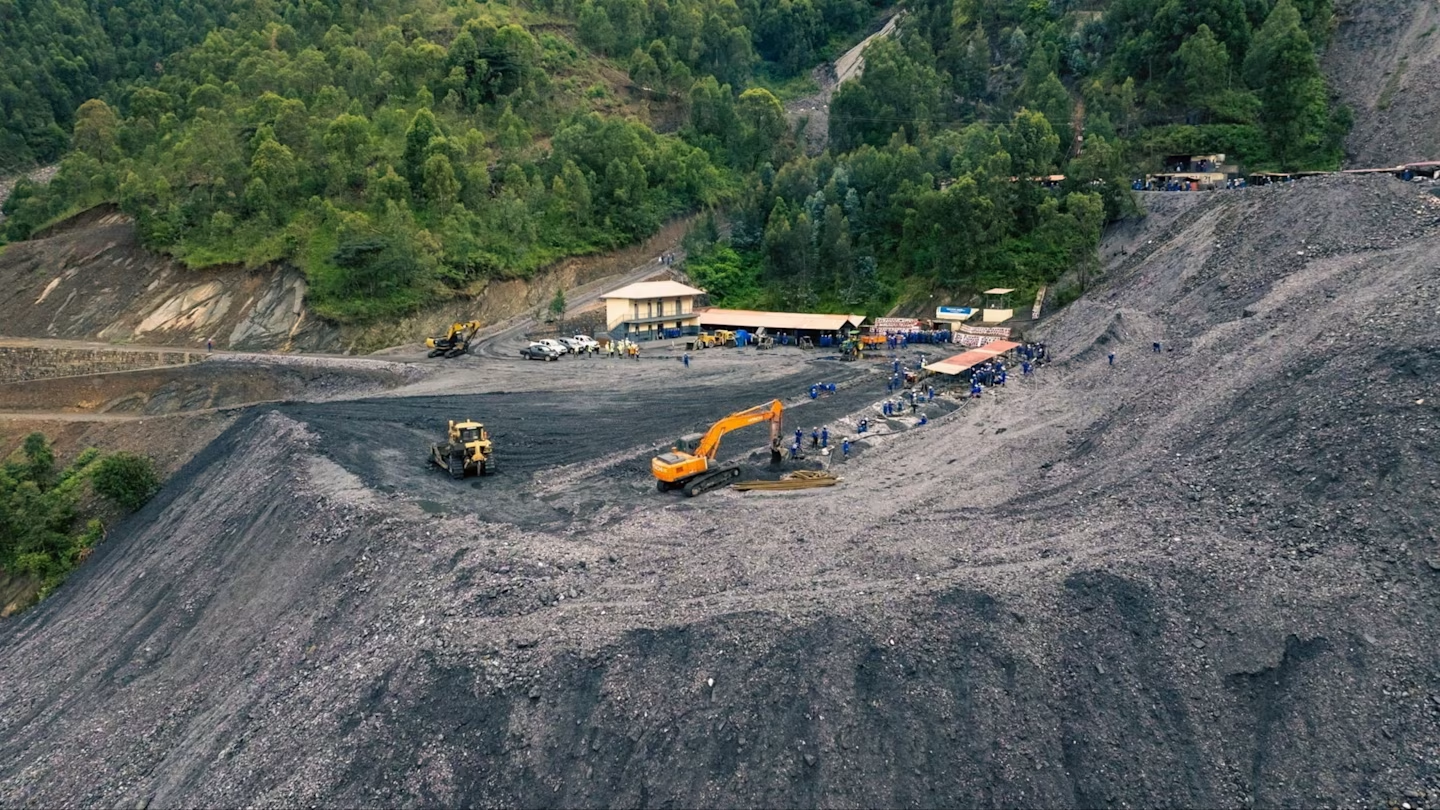
Accused of being a smokescreen for metals smuggled from DR Congo, the country now boasts Africa’s largest tungsten mine
Beneath the Rwandan hillside at Nyakabingo, hundreds of miners unearth daily a metal used in bombs and bullets that is central in the global race to control critical mineral supplies. The mine, which was acquired in 2022 by the Trinity Metals Group, has tripled production since to become the largest source of tungsten in Africa, producing more than 1,200 tonnes of high-grade concentrate a year. “It’s a relatively important piece of mining on a global scale,” said Shane Ryan, a seasoned Australian miner and chief operating officer of Trinity — which is backed by Dublin-based TechMet and the US Development Finance Corporation — from a tunnel deep inside the hill. Nyakabingo has become something of a national totem. It is emblematic of Rwanda’s efforts to increase domestic production of “3T” metals — tin, tungsten and tantalum — and counter its reputation as a conduit for smuggled riches from war-torn neighbour the Democratic Republic of Congo. Behind China, Russia and North Korea, Rwanda is now one of the top sources globally of tungsten, a metal prized by the defence and tech industries for its density, conductivity and high melting point. Last September Trinity sent the first shipment in a multiyear contract direct to Global Tungsten and Powders in Pennsylvania — the leading US processor and supplier — providing a symbolic if small victory in US ambitions to counter China’s stranglehold. “Rwanda is directly in the American defence supply chain now,” said Shawn McKormick, Trinity’s chair. He noted that, by restricting exports of the metal earlier in 2025, China — which controls more than 80 per cent of the tungsten market — had brought urgency to the US and European search for alternative sources.
But Trinity, like other companies investing in Rwandan mining as it transitions to mechanised, industrial scale, has had to go to great lengths to establish provenance of its product and comply with international traceability requirements meant to eliminate “conflict minerals”. At its mines, it operates a “closed pipe”, tracking every bag of ore from pit to end user and avoiding the temptation to build scale by acquiring additional ore produced by tens of thousands of artisanal miners. Rwanda began trading the coltan ore found in abundance in eastern Congo a quarter-century ago. In refined form, as tantalum, it is used in capacitors in most modern electronic devices. Kigali, which backed a rebellion against the Kinshasa government, used minerals taken from areas under proxy control to make the conflict “self-financing”, said Greg Mthembu-Salter, a consultant who has spent years studying conflict minerals. “They didn’t want the war on the books.” The continuation of this illicit trade is hard to disguise. M23 rebels allied to Rwanda have since January captured a huge swath of Congolese territory rich in coltan, tin and gold. UN experts monitoring the conflict say the rebels oversee mines and tax production. In their latest report in July, they said “the mixing of such minerals with Rwandan production . . . had reached unprecedented levels”. “Rwanda has a problem,” said a trader in Kigali. “There is way too much product coming through from [Congo] — all from mines under M23 control.”
The aggregated ore ends up in Chinese smelters, helped on its way by local, Chinese and European exporters, according to a host of people in the industry. Traceability schemes are losing credibility along the way. In November, the International Tin Supply Chain Initiative, which also tracks tungsten and tantalum, pointed to a 213 per cent annual surge in tantalum exports from Rwanda recorded in international trade databases. This coincided with the M23’s expanding control of mines in DR Congo. “You can’t say minerals are not smuggled to Rwanda,” said a spokesman for ITSCI in Rwanda. “We are not only dealing with conflict, we are dealing with the credibility of Rwandan minerals so we can access international markets.” Accused of using conflict minerals in its iPhones, Apple instructed its suppliers to stop sourcing any tantalum from Rwanda and DR Congo, which together account for about 60 per cent of global production. Alice Uwase, chief executive of the Rwanda Mines, Petroleum and Gas Board, which plans and regulates the sector, acknowledged that allegations around this illicit trade had “undermined our efforts as a government”. But she said Rwanda was making progress building on its history of small-scale co-operative mining to modernise and expand the sector. “We want to upgrade our game,” Uwase said. Companies in Rwanda, however, face significant hurdles establishing their bona fides as suppliers of minerals that are “conflict and child labour free”. “Everyone tries to drop that 100 kilos that didn’t originate from here,” said the director of a company in Kigali trading coltan.
Requesting anonymity, he explained the steps his company takes, visiting mine sites, doing lab tests and finding trusted suppliers to avoid contamination with Congolese ore. “We want to show there is a way to have a good supply in a business that has a lot of stink on it.” Should a fraught US-backed peace initiative succeed, foreign companies and some mining officials in DR Congo and Rwanda express some hope that cross-border trade in minerals could be formalised — with benefits flowing to both states. With that in mind, the Trump administration has made economic integration and the promise of billions of dollars in investment part of its strategy in negotiating between Rwanda and DR Congo. Rwanda has ambitions to use the processing of minerals to become a “value addition hub” for the region, driving broader industrialisation, Uwase said.
It has made some progress. Polish company Luna has built one of only two tin smelters in the region. Power Resources International, a UK-run company, has begun production at the sole tantalum refinery in Africa. Trinity is seeking $60mn to build a tungsten processing plant. “In a peaceful Great Lakes you could see the raw ore come to Rwanda and refined and sent to Europe and the US,” said Ray Power, the UK entrepreneur behind the tantalum refinery. “Everyone would get a piece of the pie.”
https://www.ft.com/content/efbf0c9b-cadd-4027-8878-37a7f6bc6126