Close Menu
Metals Weekly
    TRENDING -
    • A red flower found nowhere else loses ground as mining expands in Brazil’s Amazon
    • New Venezuelan Mining Law Obscures Old Corruption Problems
    • Rethinking Environmental Clearance for Critical Mineral Mining
    • Malawi government suspends coal miner’s license over river pollution
    • Environmental group sues US Interior for approving rare earth mining in Mojave Desert
    • US companies eye Congo mining assets, including Rubaya, State Dept official says
    • Seabed mining talks show key issues remain unresolved
    • Vancouver-based mining company confirms the deaths of 9 of 10 workers kidnapped in Mexico
    Metals Weekly
    • Home
    • Critical Materials
    • Environment
    • Global Policy
    • Mining
    Metals Weekly
    Home»Environment»Countries are negotiating rules to mine the deep sea. The U.S. is pushing ahead alone

    Countries are negotiating rules to mine the deep sea. The U.S. is pushing ahead alone

    Environment 8 Mins Read
    Facebook Twitter Pinterest LinkedIn Tumblr Reddit Telegram Email
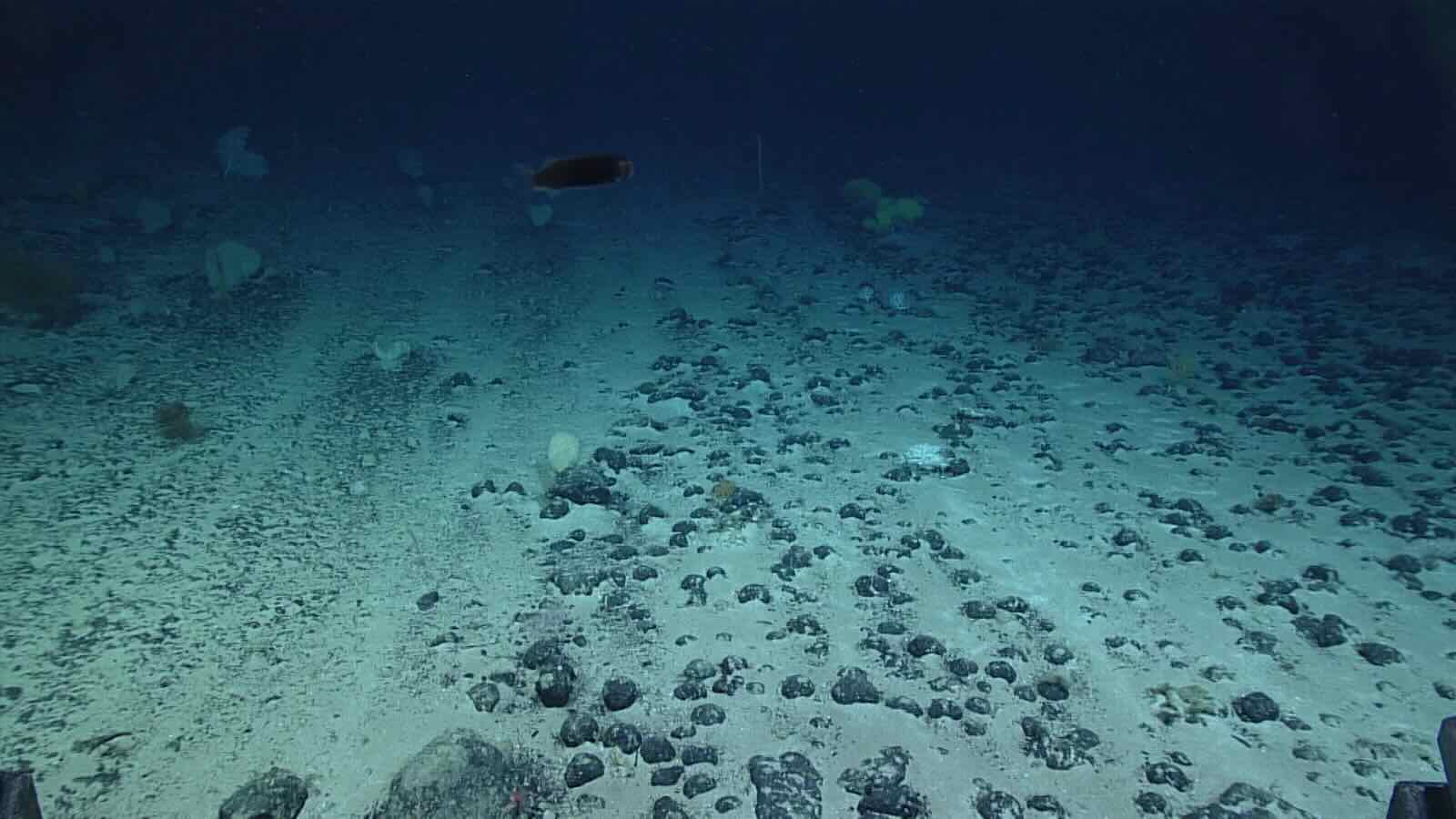
    An extensive field of ferromanganese nodules, often interspersed with wide patches of ripple-ornamented sediment, formed the bulk of the hard seafloor substrate for much of Dive 17 of the 2021 North Atlantic Stepping Stones expedition.
    Share
    Facebook Twitter LinkedIn Pinterest Email

    More than 10,000 feet deep in the ocean, the seafloor is covered with what look like dark, lumpy potatoes.

    These polymetallic nodules, as they’re known, take millions of years to form, slowly accumulating metals like nickel, cobalt and manganese. That’s made them a target for mining companies, looking to feed the world’s growing hunger for materials that go into advanced batteries and other technologies.

    On the seafloor, the nodules are vital habitat, part of a fragile ecosystem of marine species that are adapted to the dark, cold environment. With the majority of life in the deep sea still undiscovered by humans, many scientists say too little is known about damage that mining could cause.

    Interest in mining the deep sea is gaining momentum. This week, dozens of countries are meeting in Jamaica to develop rules that would govern the growing rush. The International Seabed Authority, created under a United Nations treaty, is overseeing the development of those rules for international waters, which are shared by all countries.

    The U.S. has opted out of the process and is moving ahead on its own in international waters. Last year, President Trump signed an executive order to develop the seabed mining industry “to counter China’s growing influence over seabed mineral resources.” The National Oceanic and Atmospheric Administration (NOAA) recently sped up the environmental review process, a move that alarmed conservation groups.

    “This is a brand new industry globally and yet, we’re cutting down all these procedures for really thinking it through and deciding whether it’s a good idea or not,” says Rebecca Loomis, staff attorney at the Natural Resources Defense Council.

    Vacuuming deep sea nodules

    All types of mining have an environmental impact. Deep-sea mining companies are trying to make the case that their methods do the least damage.

    “There’s always going to be risk – where is that minimized?” says Michael Clarke, environmental manager for The Metals Company. “My opinion is: that’s in the deep ocean.”

    The Metals Company is pushing to be the first to commercially harvest deep sea minerals at large-scale. While many countries have explored potential mining sites, the company has filed applications with U.S. regulators to bring up from 3 million to 20 million tons of polymetallic nodules per year over a 20-year lease. Its sights are on the Clarion-Clipperton Zone, a large stretch of the Pacific Ocean between Hawaii and Mexico.

    The Metals Company is pushing to be the first to commercially harvest deep sea minerals at large-scale. While many countries have explored potential mining sites, the company has filed applications with U.S. regulators to bring up from 3 million to 20 million tons of polymetallic nodules per year over a 20-year lease. Its sights are on the Clarion-Clipperton Zone, a large stretch of the Pacific Ocean between Hawaii and Mexico.

    “What we’re proposing is that we basically build a large vacuum cleaner that crawls along the seabed and picks these nodules up,” Clarke says. “It sucks these nodules up and sends them up a pipe vertically to a vessel that’s on the surface.”

    Securing a mining permit requires understanding the environmental impact, something that’s challenging for deep-sea mining companies given how little the depths of the ocean have been explored. The Metals Company asked scientists from research organizations like the University of Hawaii, the U.K.’s National Oceanography Centre and its Natural History Museum to study their sites both before and after test mining was conducted. The scientists analyzed and published their findings independently of the company.

    Removing nodules from the ocean floor disturbs the silty seabed that’s home to many organisms, like worms and small crustaceans, the scientists found. Researchers at the UK’s Natural History Museum and other institutions found that two months after mining, the abundance of species was reduced by 37 percent. The biodiversity also decreased by 32 percent. The company has not been able to study how those species recovered longer-term.

    Clarke says those numbers aren’t as severe as the impact from mining projects currently damaging ecosystems on land, like where he’s previously worked in the Indonesian rainforest.

    “Go and look at that and then compare that to what we’re proposing,” Clarke says. “There are still going to be impacts, but they’re nowhere near as significant as what’s happening at the moment.”

    Life in the deep sea

    Other scientists say the impact of deep-sea mining is far from understood.

    “It’s a bit of a fallacy that there’s not much down there, it’s not very important and our impact is going to be restricted to a small area,” says Steve Haddock, senior scientist at the Monterey Bay Aquarium Research Institute.

    Deep sea expeditions regularly come across creatures that haven’t been described by science. One study found that around 90 percent of species in the Clarion-Clipperton Zone are unknown. Haddock says those animals have found a way to survive in one of the most extreme environments on the planet. In the darkness, many make their own light with bioluminescence.

    “The creatures down there are not ugly and scary and grotesque,” Haddock says. “I just think they’re incredibly beautiful. So it’s kind of a shame to think about destroying things that we don’t even know about.”

    Life in the deep ocean also holds potential for benefitting human health. Researchers are currently developing cancer drugs derived from deep sea animals and microbes.

    “We don’t know what the value of all of those lifeforms and their genetic resources are for future generations of humans,” says Antje Boetius, marine scientist and president of the Monterey Bay Aquarium Research Institute. “We cannot predict if one of the microorganisms we might lose, will that be the cancer cure? Will that be an amazing source of bioinspiration for antibiotics?”

    Some organisms also need polymetallic nodules to survive, which on the muddy, silty bottom, provide some rare real estate. The hard surfaces allow organisms to attach themselves. One example is Casper, a translucent octopus discovered 10 years ago that has yet to receive a scientific name. Researchers found it lays its eggs on the stalk of a sea sponge growing on a nodule.

    The Metals Company has yet to study the impact on the approximately 20 to 30 percent of deep-sea life that depends on nodules. It says its operations don’t harvest all the nodules in its mining areas, leaving about 5 percent behind. Some areas of the Clarion-Clipperton Zone are also being set aside by the International Seabed Authority for protection.

    After the nodules are gathered, deep-sea mining has another potential impact: extra sediment. After the material is pumped up to the ship, the Metals Company releases it back into the ocean, creating large, muddy underwater plumes. A study from the University of Hawaii found that could impact the larger food web, because it interferes with marine life that survives by filtering tiny plankton from the water to eat. That food chain eventually feeds larger marine life like tuna.

    “There’s all these connections that we’re just scratching the surface of,” Haddock says. “It goes all the way up to things the people care about like whales and turtles and fish that might be on their dinner places.”

    The Metals Company says as a result of those findings, it plans to release the sediment plume deeper in the ocean at around 6,000 feet, where it expects it not to have as large of an impact.

    Mining in international waters

    With growing interest globally in deep-sea mining, the International Seabed Authority (ISA) is developing rules for how countries lease and commercially mine international waters. That process has been ongoing for more than a decade. Several countries, including China, already have permits to explore and test seabed mining sites under the ISA.

    The U.S. is opting not to follow that framework. The country hasn’t ratified the international treaty that established the ISA, United Nations Convention on the Law of the Sea, though it has followed ISA standards in the past.

    Instead, the Trump administration is reviewing permits to mine in international waters. In January, NOAA announced that it would expedite those permits. Previously, mining companies applied to explore mining sites and then applied to commercially mine them based on their findings, completing an environmental review at each step. Now, companies can apply to both explore and mine in one step, as the Metals Company did in January.

    Conservation groups say that substantially cuts down on the environmental review process.

    “Because it’s a brand new industry, it makes it exponentially more risky to cut off opportunities for analysis and public input,” Loomis says.

    NOAA declined to be interviewed, but replied in a statement that “the process allows mining companies to more efficiently obtain permits and licenses, facilitating the establishment of an economically vital supply of rare earths for the United States.”

    The Trump administration is also considering opening up mining around American Samoa and Guam, a move that alarmed local leaders who say they’re not being consulted.

    Going outside the international framework could pose a risk to the U.S., which relies on international cooperation from other countries around rules for shipping and fishing.

    “We rely on these customary ocean laws so other countries don’t violate norms around things like fishing,” Loomis says. “So the US is really undermining its own interests by being the first mover in deep-sea mining and going against this international consensus.”

    NOAA is now reviewing permits from The Metals Company, which is currently drafting environmental impact reports for that process. The company hopes to start commercially mining the deep sea next year.

    By – https://www.npr.org/2026/03/13/nx-s1-5736150/deep-sea-mining-impact-critical-minerals

    Share. Facebook Twitter Pinterest LinkedIn Tumblr Email

    Related Posts

    Malawi government suspends coal miner’s license over river pollution

    Senate Republicans send Trump resolution to lift mining ban near Boundary Waters Canoe Area

    US Senate repeals Biden-era ban on mining near Minnesota wilderness area Measure passes 50-49 to overturn a 20-year ban on mining near renowned Boundary Waters canoe area wilderness

    Don't Miss

    US companies eye Congo mining assets, including Rubaya, State Dept official says

    Global Policy 3 Mins Read

    U.S. companies are showing “significant” interest in Democratic Republic of Congo mining assets, including the…

    Seabed mining talks show key issues remain unresolved

    Vancouver-based mining company confirms the deaths of 9 of 10 workers kidnapped in Mexico

    Chile sets quarterly record in environmental permitting with mining projects totaling US$17.3bn

    Top Stories

    A red flower found nowhere else loses ground as mining expands in Brazil’s Amazon

    New Venezuelan Mining Law Obscures Old Corruption Problems

    Rethinking Environmental Clearance for Critical Mineral Mining

    Chile, US to Sign Agreements on Mining and Security

    Our Picks

    Zambians pay price amid Copperbelt mining boom

    Zambia mine regulator lifts suspension of operations at Mopani’s Mufulira mine

    Zambia dismisses US health warning after toxic spill in copper mining area

    Don't Miss

    US reopens $500M tender as cobalt prices soar

    US Interior Department approves coal mine expansion in Montana

    Costa Rica’s Crucitas Faces Environmental Disaster from Illegal Gold Mining

    Weekly Newsletter

    Subscribe to our weekly Newsletter to keep up to date on the latest news in the metals, minerals and mining industry

    Copyright © 2025 - Metals Weekly. All Rights Reserved.

    Type above and press Enter to search. Press Esc to cancel.