
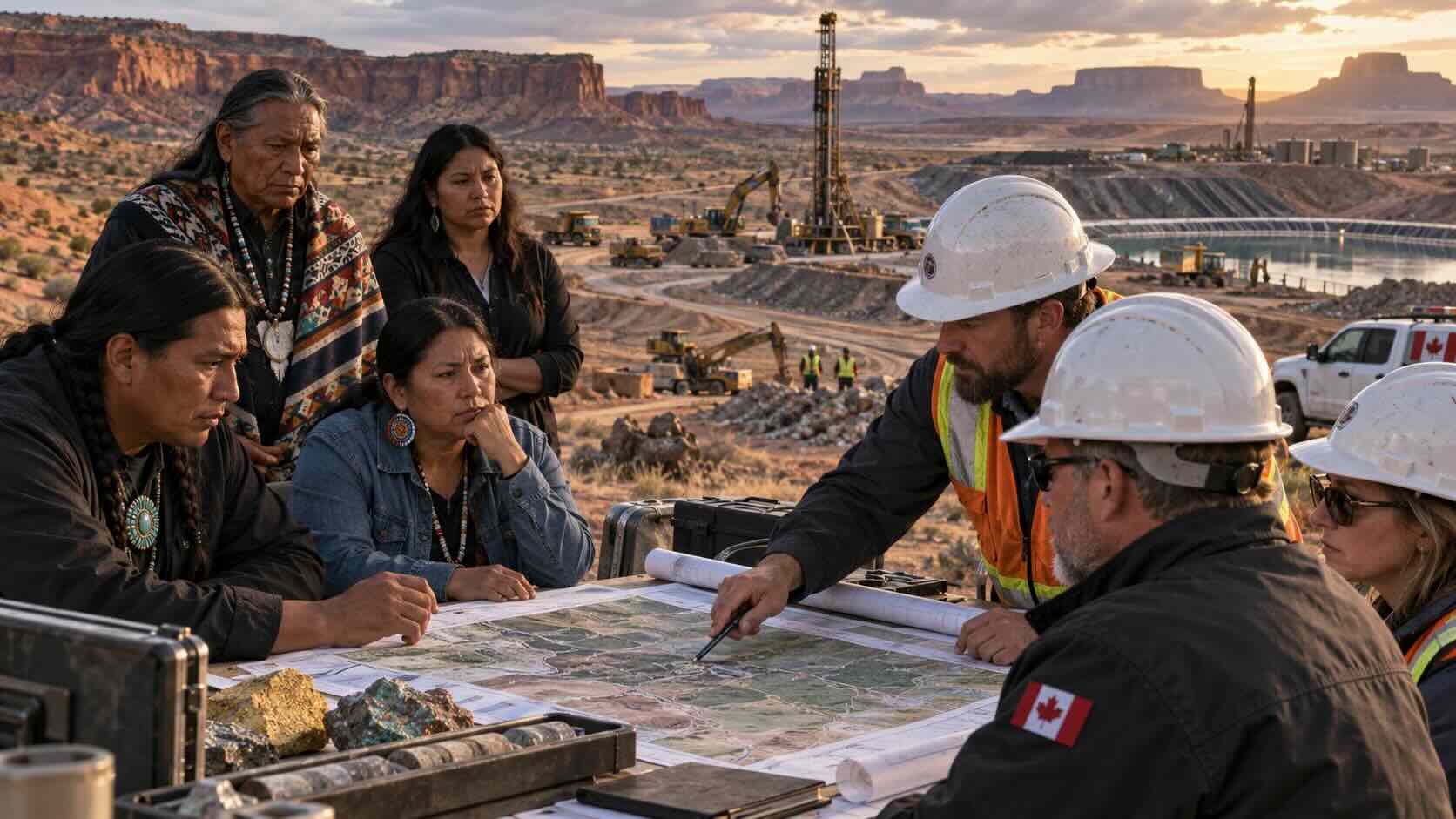
In a bid to end U.S. dependence on critical minerals from foreign sources, the Trump administration is easing regulations for mining companies seeking to operate in the Southwest.
That includes some that are hoping to dig for minerals like uranium, copper and lithium on or near tribal reservations. Some tribes are still dealing with the environmental impacts of historic mining practices.
Many of the companies are Canadian firms, or are American subsidiaries of Canadian parent companies.
One reason for their apparent prevalence is Canada’s unique tax system, which allows mining companies that are exploring projects to pass their exploration costs along to investors, who can then deduct them.
Those companies also benefit from mining tax subsidies from the Canadian federal government and provincial governments. They raise funds from shareholders with the prospect of going to an area that shows potential for rich ore deposits. Then, if they find them, they can be bought out by much larger companies.
But why are these exploratory firms setting their sights on the southwestern U.S.?
“They’re hearing that the regulatory regime is maybe not as tight as it was, and they’re seeing the U.S. as an attractive place for investment and exploration,” explains John Steen, the director of the Bradshaw Research Institute for Minerals and Mining at the University of British Columbia. He says Canada is home to hundreds of mineral exploration companies.
Among the lineup is Vancouver-based Chakana Copper, which is using a U.S. subsidiary to explore the possibility of mining copper on the Navajo Nation near Page. Chakana is facing opposition from some in the Coppermine Chapter who worry about the effects on public health and the environment, though the company says any mine would be safe.
Or take Laramide Resources, based in Toronto. It wants to mine uranium near Church Rock, New Mexico, which is adjacent to both the Navajo Nation and the site of the largest release of radioactive mining material in U.S. history.
There’s also Gamma Resources, based in Vancouver. It’s exploring mining uranium in northwestern New Mexico’s Chama Basin. The company has already issued a public statement apologizing for seeking mining permits before introducing itself to local communities, including tribes.
Others include North Shore Uranium, which is based in White Rock, Canada and is drilling for uranium not far from the Pueblo of Laguna in New Mexico; American Atomics, which is based in Vancouver and is pursuing uranium claims in Utah’s Lisbon Valley; and Anfield Energy, which is based in Burnaby, Canada and is developing the Velvet-Wood uranium mine in Utah.
That mine passed the federal environmental review process in just 11 days, causing tribes like the Ute Mountain Ute and the Pueblo of Pojoaque to push back.
Steen says it appears some Canadian firms are responding to President Trump’s March 2025 executive order, which allows expedited permits for projects that will mine critical minerals. That’s to reduce dependence on foreign adversaries like Russia and China.
The rush to fulfill that objective has dismayed some tribal nations, says James Hopkins, an associate clinical professor in the Indigenous Peoples Law and Policy Program at the University of Arizona.
“With the increased deregulation, you’re seeing these conflicts arising more and more with respect to tribal lands and tribal resources,” he says.
Uranium, which is used to power nuclear reactors, is having something of a renaissance in the U.S. right now, Hopkins adds. He calls the current growth of uranium mining in the country “unprecedented.”
“It’s really something,” he says. “I have colleagues who have left their day jobs to go join uranium mining companies.”
Hopkins says some Canadian companies have language in their shareholder agreements about consulting with Indigenous people — language that may be legally enforceable.
It would be best for both tribes and mining companies if genuine, meaningful consultation takes place as early on in the permitting process as possible, he says. That’s especially true given that the U.S. is facing a future that looks like it will involve less dependence on fossil fuels.
“You have to have these discussions, but you don’t want to have the discussion sort of post permit, post development, when people who are the most affected haven’t had a voice in the process, because they’re the ones who are going to live with the consequences,” Hopkins says.