Close Menu
Metals Weekly
    TRENDING -
    • A red flower found nowhere else loses ground as mining expands in Brazil’s Amazon
    • New Venezuelan Mining Law Obscures Old Corruption Problems
    • Rethinking Environmental Clearance for Critical Mineral Mining
    • Malawi government suspends coal miner’s license over river pollution
    • Environmental group sues US Interior for approving rare earth mining in Mojave Desert
    • US companies eye Congo mining assets, including Rubaya, State Dept official says
    • Seabed mining talks show key issues remain unresolved
    • Vancouver-based mining company confirms the deaths of 9 of 10 workers kidnapped in Mexico
    Metals Weekly
    • Home
    • Critical Materials
    • Environment
    • Global Policy
    • Mining
    Metals Weekly
    Home»Environment»Driving best practice in mining waste management

    Driving best practice in mining waste management

    Environment 3 Mins Read
    Facebook Twitter Pinterest LinkedIn Tumblr Reddit Telegram Email
    Share
    Facebook Twitter LinkedIn Pinterest Email

    As the world races to secure the critical minerals needed for the energy transition, military technology, and more, and new mines open across the globe, we need to ensure that mining rules globally protect people and the environment. Mining waste in particular represents one of the most significant harms and risks of mining. Therefore, robust legislation governing mining waste is key to protecting people and the planet.

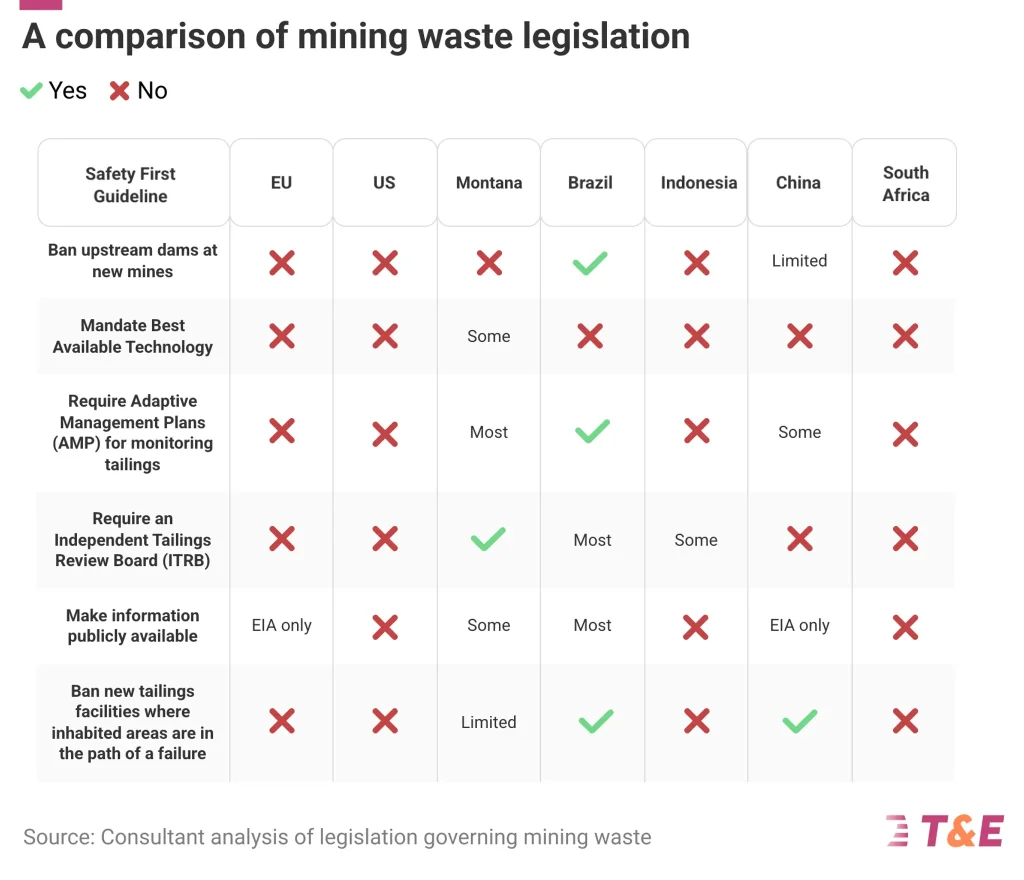
    Research by T&E and Earthworks shows that whilst examples of best practice in mining waste legislation exist, such as in Brazil, legislation across the board remains weak. By benchmarking legislation governing mining waste in six countries, against the Safety First: Guidelines for Responsible Mine Tailings Management, we explore key gaps and areas for improvement.

    Overall, the research finds significant weaknesses in mining waste legislation globally. No region mandates the use of best available technologies, and all regions fail to meet all the requirements set out in Safety First on safe closure of tailings facilities. Nevertheless, in certain areas, some countries are leading the way. For example, Brazil has in many respects the strongest legislative framework, being the only country or region to fully ban upstream dams. Legislation in Brazil also goes the furthest when it comes to monitoring requirements, whilst the US State of Montana has some strong requirements around independent monitoring. In addition, Brazil has clear rules limiting how close a tailings facility can be to an area where people live, and China also has restrictions in this regard. Finally, almost all of the legislation analyzed in this study found that governments require some sort of financial assurance.
    Taking into account the results of the research, T&E and Earthworks call on:

    • All governments to take significant steps to bring mining waste legislation in line with Safety First;

    • The European Commission to commit to a revision of the EU Extractive Waste Directive, as part of the upcoming EU Circular Economy Act, in order to bring it in line with Safety First;

    • US Congress to reform the archaic 1872 mining law to better protect taxpayers, communities, and the environment, and align regulation with Safety First;

    • Indonesia to close the regulatory gaps in the laws related to mine waste such as Law 32/2009 on Protection and Management of the Environment, in accordance with the guidelines set out in Safety First; and

    • South Africa to establish a legally binding national standard for tailings storage facility (TSF) design, with clear definitions and bans on upstream and hybrid construction methods in high-consequence areas.
      https://www.transportenvironment.org/articles/driving-best-practice-in-mining-waste-management

    Share. Facebook Twitter Pinterest LinkedIn Tumblr Email

    Related Posts

    Malawi government suspends coal miner’s license over river pollution

    Senate Republicans send Trump resolution to lift mining ban near Boundary Waters Canoe Area

    US Senate repeals Biden-era ban on mining near Minnesota wilderness area Measure passes 50-49 to overturn a 20-year ban on mining near renowned Boundary Waters canoe area wilderness

    Don't Miss

    US companies eye Congo mining assets, including Rubaya, State Dept official says

    Global Policy 3 Mins Read

    U.S. companies are showing “significant” interest in Democratic Republic of Congo mining assets, including the…

    Seabed mining talks show key issues remain unresolved

    Vancouver-based mining company confirms the deaths of 9 of 10 workers kidnapped in Mexico

    Chile sets quarterly record in environmental permitting with mining projects totaling US$17.3bn

    Top Stories

    A red flower found nowhere else loses ground as mining expands in Brazil’s Amazon

    New Venezuelan Mining Law Obscures Old Corruption Problems

    Rethinking Environmental Clearance for Critical Mineral Mining

    Chile, US to Sign Agreements on Mining and Security

    Our Picks

    Zambians pay price amid Copperbelt mining boom

    Zambia mine regulator lifts suspension of operations at Mopani’s Mufulira mine

    Zambia dismisses US health warning after toxic spill in copper mining area

    Don't Miss

    DRC Cobalt Mining Controversy: Environmental and Social Challenges

    Grief grows as bodies of kidnapped workers of Canadian mining company identified in Mexico

    Artisanal and Small-Scale Mining in Africa

    Weekly Newsletter

    Subscribe to our weekly Newsletter to keep up to date on the latest news in the metals, minerals and mining industry

    Copyright © 2025 - Metals Weekly. All Rights Reserved.

    Type above and press Enter to search. Press Esc to cancel.