
Roughly two years ago, Teck Washington, the local arm of the Canadian-based mining company, reached out to the Kalispel Tribe for a meeting.
The tribe wasn’t told exactly why, but staff members knew it likely had something to do with the closure of the Pend Oreille Mine, a lead and zinc operation idled for decades by a previous owner until Teck reopened it in 2004 and ran it until 2019. Teck announced it was starting the mine’s closure in 2021, under a process regulated by the state Department of Ecology.
“We knew they probably wanted to talk about the environmental side of the mine closure with the tribe and see where we sat,” explains Ray Entz, the director of wildlife and terrestrial resources for the Kalispel Natural Resources Department. “They introduced us to their nature positive impact program for mitigating mine site impacts, and their desire to work with Indigenous organizations when possible.”
As he pieced together the goals Teck’s team was outlining during the meeting, Entz says he immediately had project ideas and raised his hand.
The larger of those two projects ended up being the perfect fit.
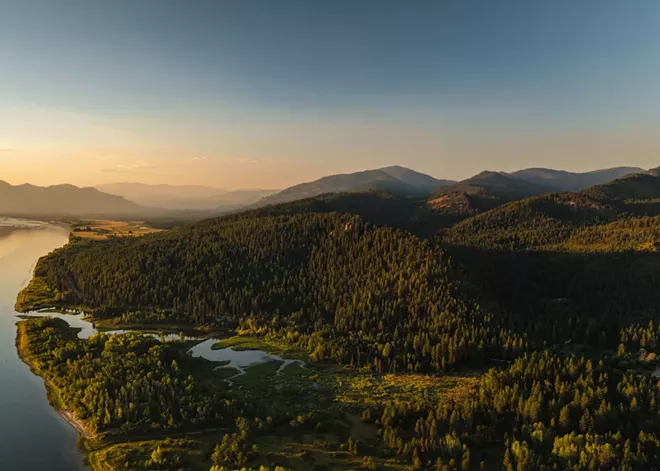
With $3.5 million, Teck helped purchase what’s now called the Cee Cee Ah (Sisiyé in Salish — named for a Kalispel master canoe maker) conservation land, about 752 forested acres next to the Pend Oreille River on the eastern side of the Kalispel Reservation. The land was previously owned by timber companies, which harvested trees there on a decades-long rotation, most recently in the late ’90s and early 2000s, Entz says. The tribe took ownership of the land from Teck earlier this year.
“Our long-term objectives align well,” Entz says of the tribe and Teck’s goals for the conservation land. “Forest management is more than just economic harvesting, but focusing on trying to create a mosaic of habitat types that support a wide variety of animals and plants.”
Ungulates — including deer, elk, moose — are key protein sources for the subsistence harvesting that many tribal members still rely on, Entz says, as are plants, which provide food and medicine. Ideal management on the Cee Cee Ah land could help both plants and animals, in addition to providing some timber harvest for the tribe.
Cutting some trees to allow others to become more mature and fire resilient can also open up some of the understory to allow other plants to thrive, he says.
“It’s a dance, but it’s a dance we do both with the cultural and ecological knowledge passed to us,” Entz says, “as well as the Western scientific understanding of the data we collect from the forest, and blending those together to an outcome best suited to serve the Kalispel people and the community at large.”
Running through the property is Cee Cee Ah creek, the only fishbearing creek on the reservation. Previously the tribe has worked in the creek to eliminate non-native brook trout and restore native Westslope cutthroat trout, Entz says.
“We’ve invested millions of dollars in that watershed to restore habitat from the headwaters down,” he says.
Teck’s funding for the conservation project also included money for ongoing maintenance, as well as a conservation easement.
To ensure the land will only be used for the type of conservation work Teck’s “nature positive” impact program is intended for, the tribe signed a limited waiver of its sovereign immunity so that the Inland Northwest Land Conservancy can hold a conservation easement on the property in perpetuity.
“What I saw in my involvement through this project was a genuine desire and effort to do good in the world, to thoughtfully consider what sort of conservation impacts could be made with the funding that was available,” says Carol Corbin, director of philanthropy for the land conservancy. “The conversations were very open, very trusting, and were very centered around what could Teck bring to the table and what could Inland Northwest Land Conservancy bring to the table to support tribal conservation priorities.”
The collaboration with the Kalispel Tribe and the Inland Northwest Land Conservancy will help conserve wildlife in Washington, said Jonathan Price, Teck’s president and CEO, in a news release earlier this month. (Teck did not respond to a request for an interview last week).
“The work to conserve these lands located near Pend Oreille mine supports Teck’s goal to contribute to meaningful biodiversity management efforts,” Price stated.
While the tribe now owns the land, any work done there to improve the environmental conditions will benefit everyone, Entz emphasizes.
“The boundaries of our reservation are artificial and immaterial to the natural world,” Entz says. “Anything we can do to improve the property benefits the broader community up there.”
The Kalispel Tribe’s reservation is fewer than 5,000 acres, but the tribe also owns and manages roughly 6,500 other acres for various conservation projects. This property is closest.
“I feel especially proud on behalf of the tribe and its members that we were able to repatriate a piece of ground that’s close enough to add a lot of opportunity for access to the members. It just means a lot,” Entz says. “A lot of our other lands are not necessarily adjacent and can be miles away, while they still provide that benefit. This one’s in their backyard and provides that opportunity quite easily.”
Having the mining company show a genuine interest in not only getting ahead of the regulatory mandates of mine closure and mitigation, but trying to do more, and better than what’s been done in the past, was good to see, and part of why it made sense to partner, he says.
“It doesn’t absolve them of their reclamation obligations at the mine site itself … They’re still on the hook to do all that. This is just above and beyond the basic minimums of meeting the regulatory obligations,” Entz says. “It’s a bold step for Teck to sort of jump out in front and lead on the environmental side of mine reclamation and cleanup.”