Close Menu
Metals Weekly
    TRENDING -
    • The Moscow Metals Maestro’s Bid for Ukraine’s Titanium Raises New Security Questions
    • A better way to model the behavior of metal alloys
    • Indonesia’s Alamtri starts aluminium exports, ships metal to the US
    • Asteroid metals worth billions: The reality behind the next space rush
    • Quebec Firm Pioneers Cyanide-Free Gold Extraction and Arsenic-Capture to Clean up Mining Industry
    • Gold price loses its grip: World’s 50 biggest mining companies shed $228 billion in Q2
    • Deep-sea molluscs face extinction as countries urge ISA to fast-track mining
    • Mexico Seeks Deal to End Vulcan Limestone Mining for Good
    Metals Weekly
    • Home
    • Critical Materials
    • Environment
    • Global Policy
    • Mining
    Metals Weekly
    Home»Headline News»Scientists successfully mine meteorites on International Space Station — using microbes

    Scientists successfully mine meteorites on International Space Station — using microbes

    Headline News 3 Mins Read
    Facebook Twitter Pinterest LinkedIn Tumblr Reddit Telegram Email
    Share
    Facebook Twitter LinkedIn Pinterest Email

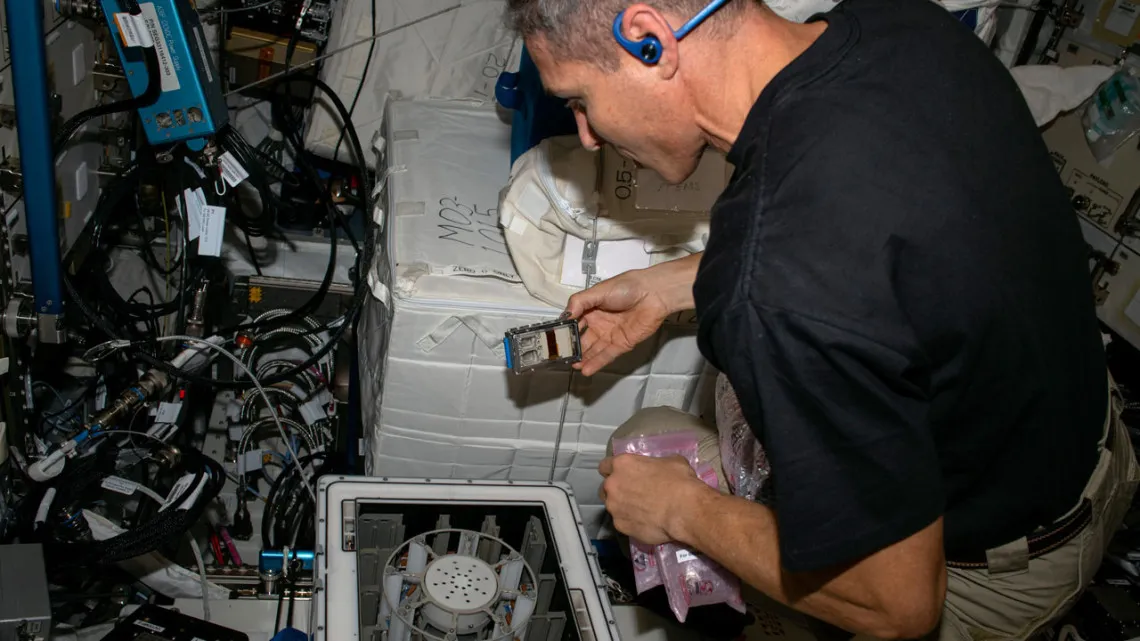
    A NASA astronaut aboard the International Space Station carried out the experiment.

    Using microorganisms to mine meteorites could be an effective way to extract precious metals in space, scientists say. This is the subject of an experiment aboard the International Space Station that examines how such mining in low-gravity environments could support space exploration.

    Researchers from Cornell University and the University of Edinburgh have been working on a study based around the results of the experiment, which was carried out by NASA astronaut Michael Scott Hopkins. “This is probably the first experiment of its kind on the International Space Station on meteorite,” Rosa Santomartino, Cornell professor and first author for the study, said in a statement to Cornell Chronicle.

    The experiment used two different microorganisms for the meteorite extraction — a bacterium, called Sphingomonas desiccabilis, and the fungus Penicillium simplicissimum.

    “These are two completely different species, and they will extract different things,” Santomarinto said. “We wanted to understand how and what, but keep the results relevant for a broader perspective, because not much is known about the mechanisms that influence microbial behavior in space.”

    The microbes “mined” the specimens by producing carboxylic acids, which attached themselves to minerals in the meteorites. The acids help to release the minerals into a liquid solution.

    The researchers specifically wanted to see how the extraction method worked in space compared to how it works on Earth. While the method worked similarly in both environments, there were some interesting differences, Cornell researcher Alessandro Stirpe said in the same statement.

    It turns out that space changed the fungus’ microbial metabolism, which allowed it to increase molecule production, including carboxylic acids. This enhanced the release of palladium, as well as platinum and other elements,” the statement says.

    The researchers warned there are many variables, so their work may not necessarily lead to a tidy conclusion. “Another complex but very interesting result, I think, is the fact that the extraction rate changes a lot depending on the metal that you are considering, and also depending on the microbe and the gravity condition,” Santomarinto said.

    Resource production in space has become more important as space companies and agencies are looking into how to reduce the cost of long-term space travel. One way to cut the cost is by mining materials in space, rather than shipping them from Earth.

    Some of the minerals that can be mined in space are also very valuable. Palladium is a precious metal with a variety of specialized uses in technology, and even very small amounts can fetch thousands of dollars.

    For instance, Astroforge is one of the companies that’s been working on asteroid mining. But rather than relying on microorganisms, Astroforge has been working on a process that involves lasers and magnets to extract minerals from asteroids.

    By – https://www.space.com/space-exploration/international-space-station/scientists-successfully-mine-meteorites-on-international-space-station-using-microbes

    Share. Facebook Twitter Pinterest LinkedIn Tumblr Email

    Related Posts

    A better way to model the behavior of metal alloys

    Federal government weighs seabed mineral mining off Virginia coast

    Ocean Partners backs Alaska gold project

    Don't Miss

    Asteroid metals worth billions: The reality behind the next space rush

    Global Policy 4 Mins Read

    Asteroids are often described as floating treasure chests, packed with iron, nickel, and platinum group…

    Iran war squeezes acid, aluminum, miners’ margins

    Kazatomprom sees room for all in nuclear revival

    Venezuelan crime boss’s demise creates opening for mining boost

    Top Stories

    Mexico Seeks Deal to End Vulcan Limestone Mining for Good

    Uranium mining grows as Trump seeks to feed a nuclear boom

    Chile, Argentina revive mining treaty with $20.7B pipeline

    Greenland rejects Energy Transition Minerals’ request for licence renewal

    Our Picks

    Zambians pay price amid Copperbelt mining boom

    Zambia says privacy, minerals concerns stall US health aid deal

    Zambia mine regulator lifts suspension of operations at Mopani’s Mufulira mine

    Don't Miss

    Apex Critical Metals Accepted into U.S. Defense Industrial Base Consortium

    Hidden Deforestation from Global Mining in 21st Century

    Indonesia says 4 million hectares of plantation, mining lands reclaimed in crackdown

    Weekly Newsletter

    Subscribe to our weekly Newsletter to keep up to date on the latest news in the metals, minerals and mining industry

    Copyright © 2025 - Metals Weekly. All Rights Reserved.

    Type above and press Enter to search. Press Esc to cancel.