

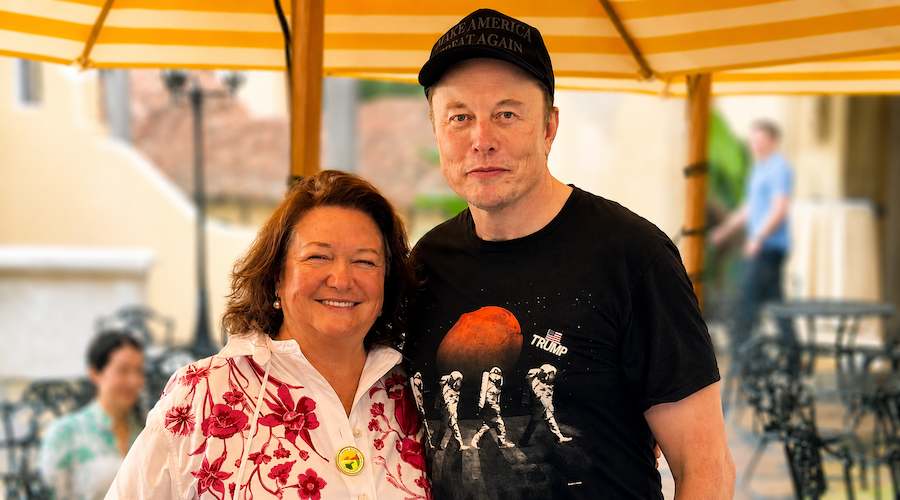
Australia’s richest person Gina Rinehart has taken a “significant stake” in Elon Musk’s SpaceX, betting that the world’s largest space company could become a major driver of demand for critical minerals and off-Earth infrastructure.
Hancock Prospecting said Monday it received an allocation of SpaceX shares in the company’s record-breaking initial public offering last week, though it did not disclose the size of the investment.
The Australian Financial Review reported the stake is worth more than $1 billion. SpaceX, formally known as Space Exploration Technologies, raised $75 billion in the largest IPO on record and closed its first trading day up 19%.
“This is a significant investment for Hancock,” Rinehart said in the statement. SpaceX is “operating in sectors that are crucial and with long-term potential.”
The investment deepens ties between the mining and space sectors as governments and private companies increasingly explore how critical minerals, water and energy resources could support future activity beyond Earth.
Hancock has built one of the largest critical minerals portfolios outside China, including stakes in Lynas Rare Earths (ASX: LYC) and MP Materials (NYSE: MP), positioning the company to benefit if space development becomes a meaningful source of demand.
An investment exceeding $1 billion would rank among Rinehart’s largest holdings outside Hancock’s core iron ore operations in Western Australia. The billionaire has expanded aggressively into rare earths and other strategic minerals in recent years.
“We also see the possibility of mutually beneficial arrangements between SpaceX and Hancock Prospecting’s significant critical minerals investments,” Hancock CEO Garry Korte said in the statement. “We look forward to the potential of working with the SpaceX team on its exciting journey.”
Moon economics
Industry experts increasingly argue mining will need to expand into more challenging environments, from the Arctic and deep oceans to, eventually, the Moon and asteroids. NASA’s Artemis program aims to establish pilot processing facilities for lunar resources by 2032, initially focusing on water, energy and lunar soil before advancing toward metals and minerals.
Last week, NASA unveiled the crew of Artemis III and offered an optimistic update on the mission’s progress, but left unanswered a key question: whether the mission will be ready to launch next year.
Much of Artemis III’s success depends on Musk’s SpaceX and Jeff Bezos’ Blue Origin, which are developing lunar landers designed to transport astronauts from lunar orbit to the Moon’s surface. Before that can happen, Artemis III must first demonstrate critical manoeuvres with versions of those spacecraft closer to Earth.
Lunar water is viewed as one of the most valuable resources because it can be separated into oxygen and hydrogen for life support and rocket fuel. That shifts the early economics of space mining away from metal production and toward building infrastructure for long-duration exploration missions.
Asteroids and lunar deposits are believed to contain nickel, iron and platinum-group metals, but extracting them remains a formidable challenge. Even as launch costs fall, operators would still need to identify targets, travel to them, extract material and either process it in space or return it to Earth economically.
Long road
Private companies are nevertheless advancing the sector. AstroForge recently raised $40 million for a mission designed to rendezvous with a metallic near-Earth asteroid, with future plans to extract and refine materials. The company also received the first commercial licence from the US Federal Communications Commission to operate in deep space, establishing an early regulatory precedent for private missions beyond Earth orbit.
The economics remain daunting. Using NASA’s OSIRIS-REx sample-return mission as a benchmark, analysts estimate iridium prices would need to rise roughly 140,000-fold for a comparable asteroid-mining venture to break even, highlighting how far the industry remains from commercial-scale returns.
The legal landscape is also unresolved. The Outer Space Treaty prohibits national sovereignty claims over celestial bodies, while ownership rights to extracted resources remain contested. China and Russia have not joined the US-led Artemis Accords, and the 1979 Moon Agreement lacks support from major space powers, leaving significant uncertainty over how future lunar and asteroid resources will be governed.
By – https://www.mining.com/rineharts-1b-spacex-bet-targets-mining-beyond-earth/