

BRASILIA, Sept 24 (Reuters) – Brazil’s Federal Police can trace whether gold came from an illegal mine in the Amazon rainforest, and investigators told Reuters they are expanding the program to other countries, hoping to catch more criminals who are trying to escape Brazil’s tightening enforcement by smuggling gold across borders.
Gold prices have surged to record highs this month as political uncertainty around the world has pushed investors to seek safe havens. Rising prices are a powerful incentive for those illegally mining the precious metal in the Amazon rainforest.
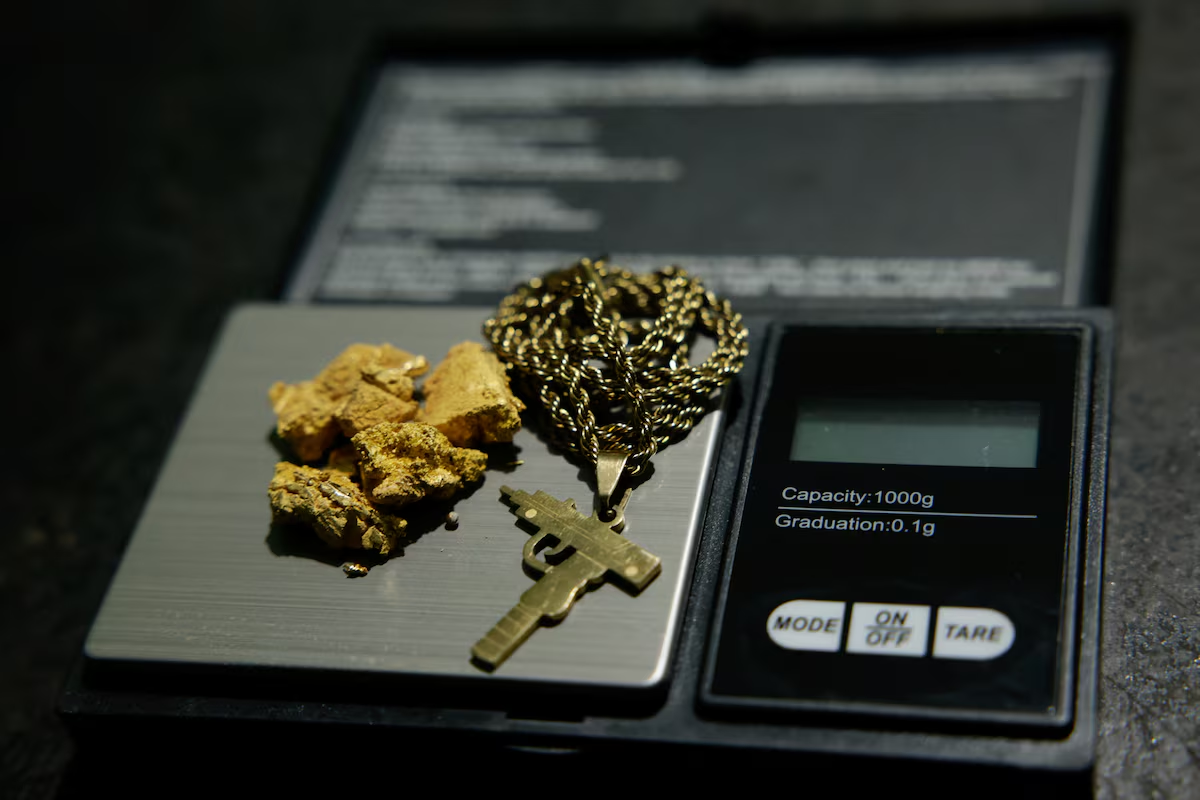
The Brazilian program catalogues “gold DNA,” the metal’s unique morphological signature, to connect each piece of gold police seize from suspects to environmental damage caused by illegal mining in specific sections of the rainforest.
In 2023, Brazil prosecuted its first case using the technique. But, as criminal groups expand their reach, taking gold from illegal mines in one country to smelters in another, police say they need to grow their gold library to keep pace.
“When we have samples from all gold-producing areas across the Pan-Amazon region, our gold database will be complete, allowing us to scientifically identify the origin of seized samples,” said Humberto Freire, who heads the Amazon and Environment Department at Brazil’s Federal Police.
AMAZON GOLD DATABASE GROWS BEYOND BRAZIL
Some expansion work has already started.
A series of agreements signed by Brazilian President Luiz Inacio Lula da Silva and France’s Emmanuel Macron allowed police in Brazil and French Guiana to access samples from each other’s databases to increase cooperation between investigators. In August, Freire met with Colombian Defense Minister Pedro Sánchez to discuss implementing the program there.
In Colombia, criminal groups often launder drug trafficking money through illegal mining operations. Officials across the region fear the practice could expand to other countries, making investigations harder.
In recent years, Colombian authorities have increasingly found Brazilians working in illegal gold mines near the border, according to Colombia’s National Police and Defense Ministry.
Two Colombian Defense Ministry officials told Reuters, on condition of anonymity, that the country is interested in cooperating with Brazil and modeling its initiative to develop its own project to analyze “gold DNA.”
The Brazilian Federal Police’s work in tracing also spurred Interpol to develop the Gaia Project, backed by the German government, to train police agencies worldwide to use the Brazilian method of cataloguing gold.
Interpol Secretary-General Valdecy Urquiza, a Brazilian Federal Police officer, said he supports initiatives to map gold-producing regions as a strategy for successful investigations against illegal mining.
CRACKDOWN FORCES GOLD SMUGGLERS TO SHIFT TACTICS
The sharp increase in investigations and raids into illegal gold miners under the Lula administration pushed criminal groups to turn to international routes, exporting gold to neighboring countries for processing and sale, one source at Brazil’s Federal Police told Reuters.
A series of state-led enforcement measures, including a Supreme Court ruling that forced smelters to verify the origin of gold, have also made it harder for illegally mined gold to enter the market.
“We used to see gold coming from Venezuela into Brazil — now it’s the opposite, gold is leaving Brazil,” said Erich Moreira Lima, who heads Brazil’s gold-tracking program.
Investigators say this shift is already evident in data. Last year, there was a sharp drop in gold trade, with Federal Police seizures falling to 80 kg from a record 308 kg in 2023.
But between January and August this year, police have already seized 253 kg of gold – half of which was headed to smelters in Venezuela, investigators believe. Now, federal police officers are working to analyze the “DNA” of the seized gold to figure out where it came from.
As environmental criminals increasingly operate across borders, governments in the region are working to create other tools for cooperation.
This month, Lula joined Colombian President Gustavo Petro and other authorities to inaugurate the Amazon International Police Cooperation Center in Manaus, in the heart of the Brazilian Amazon. The center, first announced in 2023, is designed to facilitate information-sharing across Amazonian countries, with a focus on environmental offenses.