
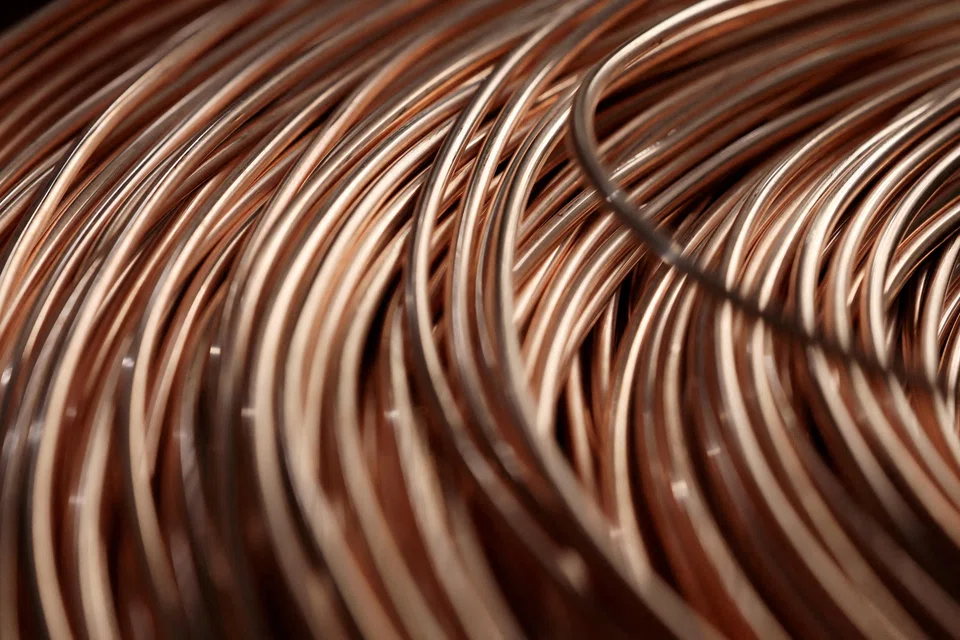
Analysts note that Asia is most vulnerable to volatility in base metals due to a lack of buffers.
SCARCITY in industrial metals, particularly in Asia, due to supply bottlenecks caused by the war in the Middle East is stoking fears of slowing demand in the region amid surging energy prices.
Hopes of a de-escalation are fading after the failed US-Iran negotiations over the weekend, followed by US President Donald Trump’s vow to block the Strait of Hormuz, a critical passage for global energy flows.
The alternating hopes and despair are reflected in the price of copper, which shed as much as 10.6 per cent to US$11,929.50 a tonne between the start of the war and Mar 20, but rebounded to US$12,845.50 a tonne on the London Metal Exchange (LME) last Friday (Apr 10) on the eve of talks between the US and Iran.
Meanwhile, aluminium rallied as much as 12.5 per cent to US$3,531.50 between the start of the war on Feb 28 and Apr 1, but closed at US$3,498.50 a tonne on the LME on Friday.
Alex Ho, sales trader at CMC Markets Singapore, noted that the impact of industrial metal volatility is unevenly spread, as Asia “absorbs the hit on every axis”.
He noted that China alone consumes 54 per cent of the world’s copper and 57 per cent of aluminium.
South-east Asian exporters such as Vietnam, Malaysia and Thailand face a “double squeeze” resulting from higher input costs and war-risk surcharges on the shipping routes they depend on, he added.
In comparison, Europe’s pain is concentrated mainly in the supply of aluminium from Gulf smelters, and North America has partial insulation from domestic production and reshoring. These are buffers which Asia lacks.
Higher aluminium prices
Rising metal prices could lead to cost inflation, which affects both upstream processing and downstream manufacturing of electric vehicles, electronics and construction.
Sabrin Chowdhury, head of commodities at Fitch Solutions unit BMI, said that Asia’s industries in, for example, real estate, infrastructure and cars are likely to be badly hit as a result of the rise in aluminium prices.
With the Middle East accounting for around 8 per cent of global aluminium output, regional premiums have moved up. Between Feb 27 and Mar 31, premiums in the US went up by 4.6 per cent; in Europe, the rise was 33.9 per cent, and in Asia, 60.9 per cent.
Chowdhury said US premiums responded less sharply from having been supported by tariff-related supply concerns in recent months.
S&P Global Energy said a prolonged period of elevated aluminium prices raises the possibility of a recession and demand destruction, starting with the construction sector.
It noted that the US and Europe would be the “most vulnerable” to this outcome. Meanwhile, China’s ability to produce above the legal smelter capacity cap of 45 million metric tonnes per year could cushion the impact.
“If that materialises and China decides to export the metal in volume, then the market might find some relief, probably more so in Asia than elsewhere,” said the research house.
S&P Global Energy noted that if the conflict is prolonged, it would affect exports of metal and products out of the Middle East, which is a key supplier to Europe, US and Asia. This would likely drive up prices.
Dr Copper
David Fyfe, chief economist at Argus Media, noted that copper is often referred to as “Dr Copper” in that it is a bellwether for expectations of the global economy.
“(Copper) is so closely correlated to industrial activity, infrastructure investment, power-sector investment and so on, so it’s one to watch,” he said.
“All these gauges are telling us we’re in a real crisis – a crisis that could end up being recessionary if it isn’t brought to a close fairly quickly.”
Ho of CMC Markets Singapore said that copper’s pullback from its all-time high in January suggests the market is “looking past supply disruptions and pricing in demand destruction”.
“Higher energy costs feed directly into wider input prices, which means stickier inflation, a stronger dollar and rate cuts pushed further out. That combination tightens financial conditions and compresses industrial activity.
“Right now, copper is trading as a growth barometer, not a supply story. If energy stays structurally elevated through the second quarter, the pressure on copper remains downward,” he said.
What’s ahead?
In the near term, Ho expects aluminium to “bear the most direct impact” as the closure of the Strait of Hormuz disrupts Gulf Cooperation Council smelter exports and sustains elevated premiums.
He added that while copper faces limited supply risk, rising energy costs may pressure miner margins.
Over the next three to six months, a prolonged conflict could “deepen aluminium deficits and amplify cost-push inflation across Asian manufacturing and construction”, he said.
“Beyond 12 months, we believe structural drivers, such as energy transition demand, capacity constraints and mine-supply shortfalls, are likely to reassert themselves as the dominant pricing force,” said Ho.