

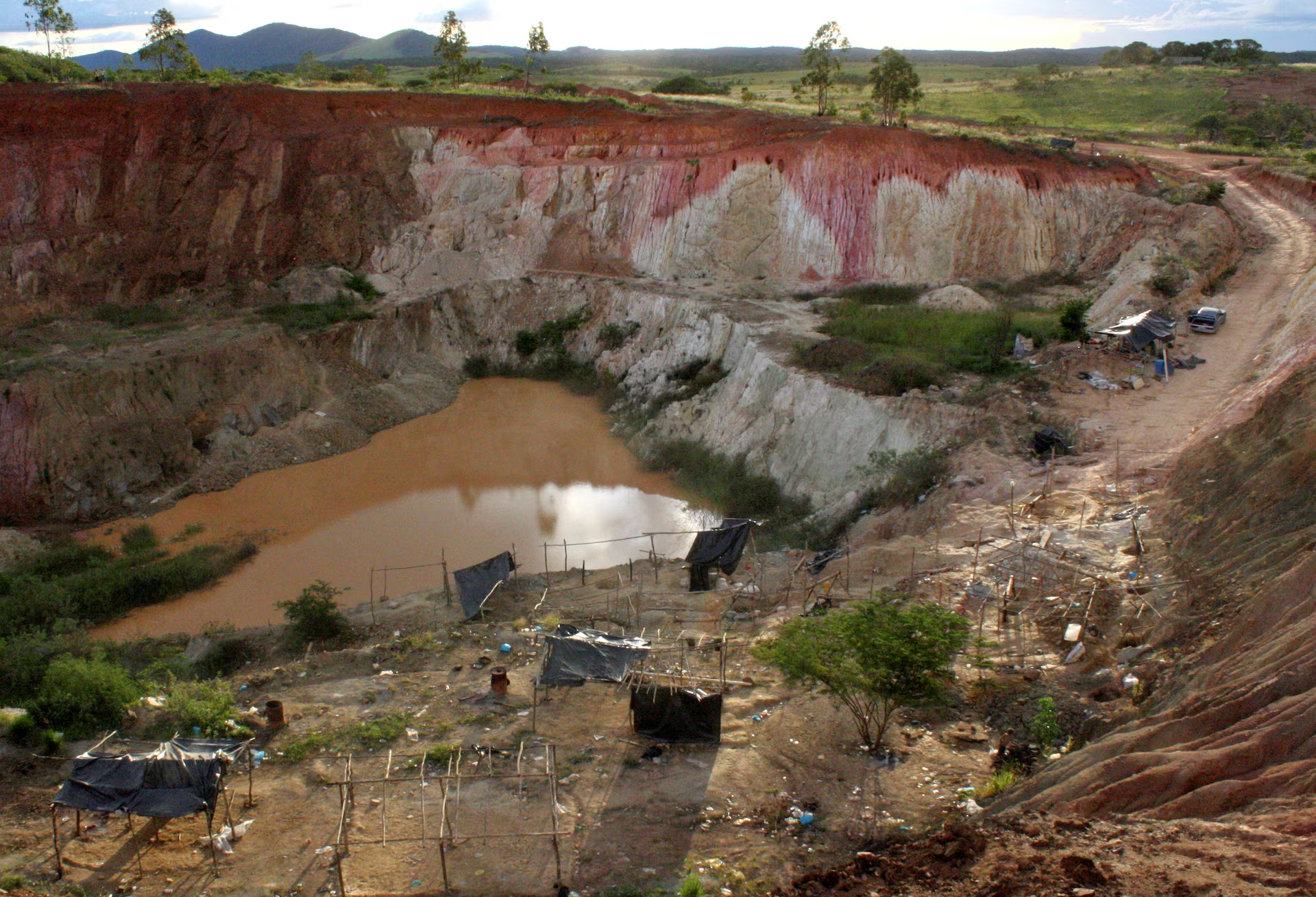
Venezuela’s effort to attract foreign investors to develop its gold, iron and bauxite seams has enthusiastic backing from the Trump administration but faces big challenges, including armed groups with deep interests in the chaotic, largely illegal prospecting industry that has developed over the past 20 years, according to nine miners, residents and community activists who spoke to Reuters.
The sources in the sprawling southeastern state of Bolivar said they were skeptical international companies will be able to meaningfully invest without major improvements to security in the state, where local criminals operate alongside Colombian rebels and state security forces have been accused of colluding with criminals to prop up illegal gold operations.
“The (crime) syndicates control the mines. They’re the ones who set the rules and enforce the law in many of the mines where we work. Depending on the situation, they impose punishments and can be very violent,” said Ines Garcia, a 51‑year‑old informal miner in El Callao municipality. “You look after yourself, because even talking is a risk.”
The administration of U.S. President Donald Trump has supported moves by Venezuela’s acting president, Delcy Rodriguez, to attract investors since she took power in January, including a mining law passed in April by the ruling party-controlled national assembly, headed by Rodriguez’s brother Jorge, which allows foreign and private companies or consortiums to extract gold and strategic minerals.
Venezuela’s oil-dependent economy has for years been battered by hyperinflation, a sustained brain drain, international sanctions, deteriorated oil infrastructure and deep corruption. It desperately needs income to fund Rodriguez’s promises to improve public services and wages after Washington removed former president Nicolas Maduro in January. Mining investments would offer another source of taxes, royalties and employment.
U.S. Interior Secretary Doug Burgum said during a March visit the law will create opportunities for companies and that Rodriguez will ensure their security. The U.S. has already issued a license authorizing certain transactions involving Venezuelan-origin gold, including with state-owned mining company Minerven.
“You have guarantees, you have legal certainty, political security, stability and peace of mind so your investments can be developed fully — not only in the hydrocarbons sector, where there are many opportunities, but also in the mining sector,” Rodriguez told visiting investors at a March event. The government has provided no details about its security plans for Bolivar.
Canada-listed Gold Reserve, which has said it intends to resume mining in Venezuela and which was part of the Burgum delegation, was afterward granted a U.S. license allowing it 30 days to negotiate with the government. Gold Reserve did not respond to Reuters questions about whether it was seeking the return of its Brisas mine, which was seized by the government in 2009.
Swiss commodities trader Trafigura is already working with Venezuela’s state gold miner Minerven on a responsible sourcing program announced last month and said the work is in compliance with a license issued by the U.S. Treasury. Mining companies Hartree, Peabody Energy, Ivanhoe and TechMet, which were named in local press as having been part of the Burgum delegation, did not respond to questions from Reuters.
Though many international miners have wide experience grappling with security issues, for people who live and work in the so-called Orinoco Mining Arc, a quartet of municipalities in Bolivar designated by Rodriguez’s predecessor as strategic for mining development, corporate interest feels like the cart before the horse.
“For real investment to take place it is essential to resolve supply‑chain transparency, security — because this is a hot zone with armed groups present — and oversight of the socio‑environmental impact of operations,” said an engineer who worked for Minerven for a decade and asked to remain anonymous for fear of reprisals.
Colombia’s National Liberation Army (ELN) rebels and former members of the now-demobilized Revolutionary Armed Forces of Colombia (FARC) are active in Bolivar, the sources said, as are local criminal organizations the Tren de Guayana and 3R, along with unnamed groups run by gang leaders who go by the aliases ‘Juancho’ and ‘Fabio.’
Criminals have supplied mining machinery, fuel and weapons in the region, as well as extracted gold, for years, said Pedro Yepez, 61, a two-decade veteran of mining in El Callao and Sifontes municipalities. “There is no way they can do that without the government’s complicity and permission,” he said.
A community activist who has monitored human rights violations in the area for decades and asked not to be identified out of safety concerns also said armed groups control the mines and operate in complicity with the government. Other residents and community leaders echoed his concerns, with several telling Reuters that criminals regularly extort businesses as the government looks the other way.
The Venezuelan communications ministry, which handles all press queries for the government, did not respond to detailed questions about the allegations of complicity by the military, security plans for the region or contacts with potential investors.
The military’s ‘Operation Roraima,’ meant to combat illegal mining in Bolivar, began in 2023 and has continued in the years since, with top leaders publicly celebrating the destruction of illegal mining camps and equipment, including by posting photos of controlled explosions to social media.
The U.S. Department of the Interior did not respond to detailed questions about security concerns in the region.
UN REPORT DETAILED ALLEGATIONS OF MILITARY INVOLVEMENT
Both the military and armed groups have been accused of involvement in killings and disappearances, along with other rights violations in the region, a UN Human Rights Council fact‑finding mission said in a 2022 report, which also expressed deep concern over worker exploitation, child labor, human trafficking, violations of Indigenous rights and environmental destruction.
There has been a sustained increase in gold flows from Venezuela since Maduro created the Arc in 2016, driven primarily by informal and illegal mining, the Organization for Economic Co‑operation and Development said in a separate 2021 report. The report highlighted human rights violations, environmental destruction and military collusion with armed groups related to the industry.
The new mining law would provide “a veneer of legality” to “severe environmental degradation and ongoing human rights violations,” 16 local non-governmental groups said in an open letter published in late March, adding they were concerned about continued military control.
“Military presence in mines has historically been associated with human rights violations, corruption and the creation of hybrid governance structures,” the letter said.
Even if foreign mining companies were able to establish themselves in Bolivar, some activists and residents said they still worry about the impact on communities and what foreign presence would mean for the livelihoods of small-scale and informal miners, including the region’s Indigenous groups.
“You have to put the term ‘benefit’ in quotation marks — who benefits? Because the same state that negotiates and seeks investors forgets all the problems that exist,” said Italo Pizarro, an activist from Sifontes municipality, who said Indigenous communities could face particular risks.
A Bolivar geologist with more than 40 years of experience in the sector said it would be difficult to oust tens of thousands of informal miners who work in the region, as well as criminals who live off extortion: “This won’t be simple.”