

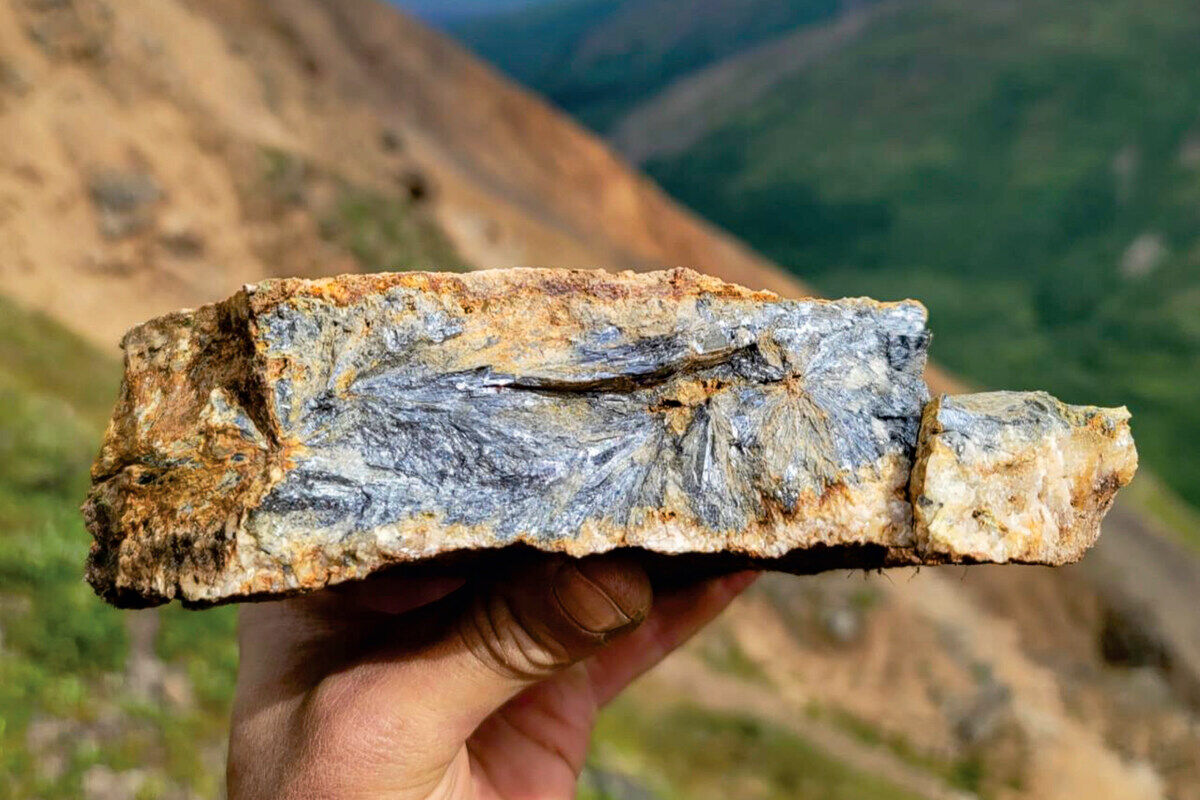
Three Last Frontier projects poised to fill a supply gap left by China’s export ban; one is already delivering into U.S. stockpiles.
With high-grade antimony being trucked from an old gold mining project near Fairbanks to United States Antimony Corporation’s refinery in Montana, and then onward to America’s National Defense Stockpile, Alaska is once again stepping in as a domestic alternative to China and Russia for this strategically vital metalloid.
“This project highlights Alaska’s important role in America’s resource future, while also underscoring USAC’s mission to strengthen U.S. critical mineral independence away from foreign adversaries,” U.S. Antimony Chairman and CEO Gary Evans said during a Sept. 8 event at the company’s Mohawk Antimony (formerly Ester Dome) project near Fairbanks.
As the municipal, state, and federal dignitaries departed, crews began loading high-grade stibnite – an antimony mineral – into trucks bound for U.S. Antimony’s smelter near Thompson Falls, Montana.
Under a $245 million contract signed with the U.S. Defense Logistics Agency (DLA), antimony bars produced from Alaska-mined and Montana-refined stibnite will replenish stockpiles of this mineral essential to defense, manufacturing, and energy technologies.
“It’s incredibly meaningful for all our employees to play such a strategic role in strengthening our nation’s defense readiness,” said Evans.
And U.S. Antimony’s Mohawk project is not a one-off. Alaska has supplied the U.S. with antimony during every major conflict since World War I, and several new projects are now advancing as China tightens exports of critical minerals and Russia remains sidelined by war in Ukraine.
The rise of antimony criticality
Long prized for hardening bullets and making flame-retardant compounds, antimony has been of strategic interest to the U.S. since World War I. Today, it is also used in automotive batteries, semiconductors, specialty glass, and liquid metal batteries.
The same traits that make antimony essential to the U.S. military have expanded into the civilian realm – from the car batteries in garages and fireproof mattresses in nurseries to semiconductors in high-tech devices and liquid metal batteries that store renewable energy.
Today, American manufacturers require roughly 50 million pounds of antimony per year for a wide range of military and consumer goods.
Until recently, this antimony was primarily imported from China, Tajikistan, and Russia, which collectively account for roughly 90% of the global supply.
Beijing’s 2024 export ban – which included gallium, germanium, and graphite – and strained U.S.-Russia relations have created a supply emergency for American manufacturers and the Department of War (formerly Department of Defense).
“China and Russia control the market for antimony and all its derivatives, putting the United States at risk of interruptions that could jeopardize national security,” said Jeffrey Frankston, acting Deputy Assistant Secretary of War for Industrial Base Resilience.
Needing to establish a secure supply of antimony as quickly as possible, Pentagon officials, Washington policymakers, and critical minerals experts all looked north to Alaska – a state that has historically provided America with a domestic supply of this metalloid essential for military readiness and still has high-grade antimony boulders littering the ground of its gold-rich mining districts.
100 years of strategic Alaska antimony
The current interest in Alaska as a source of antimony during a time of strategic need is the continuation of a trend that dates back to the dawn of the 20th century.
“It has long been known that stibnite, the sulphide of antimony and the principal source of that metal, is widely distributed in Alaska,” Alfred Brooks penned in a 1917 report, Antimony deposits of Alaska.
That year, 67 stibnite occurrences were documented, with wartime supply coming from deposits across the state.
“WWI created considerable demand for antimony,” James Barker, who investigated much of Alaska’s critical minerals potential while working as a geologist for the U.S. Bureau of Mines, told Mining News.
Most of the stibnite occurrences detailed in Brooks’ report were found in the districts surrounding the gold rush towns of Nome, Fairbanks, and Iditarod.
The Fairbanks district proved particularly rich.
“In 1915 antimony ore was mined on four properties in the Fairbanks district at the Scrafford, in Treasure Creek basin; the Stibnite, in Eva Creek basin; the Gilmer, in Vault Creek basin; and at Chatham Creek mine,” Brooks wrote. “All the operations were on a small scale and consisted chiefly of open cuts. The total shipments of stibnite from the district during 1915 were 685 tons, which probably averaged 58 percent antimony.”
Scrafford, the most prolific of the Fairbanks district stibnite mines, produced an estimated 2,700 tons of ore containing greater than 50% stibnite during intermittent operations that spanned both World Wars and into the 1970s.
“The Scrafford antimony deposit is affiliated with an east-west, south-dipping shear zone of the same name that can be followed for at least six miles,” Barker told Mining News.
Treasure Creek Partnership, a mineral exploration company Barker is involved with, optioned the Treasure Creek antimony-gold project encompassing the historic Scrafford mine to Felix Gold Ltd., which is advancing toward the development of a small mine that will produce a significant quantity of antimony to help meet America’s strategic needs.
“Against the backdrop of China’s export ban and tightening global supply, the strategic nature of this asset is clearly evident,” said Felix Gold Executive Director Joe Webb.
A return to Treasure Creek antimony
In 2025, senior officials from the Federal Permitting Improvement Steering Council (Permitting Council) and the Environmental Protection Agency visited Treasure Creek to evaluate the project’s potential role in securing a U.S. supply chain.
“Critical mineral projects are a top priority for the Trump Administration,” said Permitting Council Executive Director Emily Domenech. “Our visit helps us understand how the Permitting Council can best support timely reviews of this important antimony project, as we work to develop a stronger domestic supply chain for critical minerals while reducing our reliance on China.”
During their visit, the federal regulators had the opportunity to observe the high-grade antimony veins emerging at the NW Array target, which is located approximately one mile west of the historic Scrafford mine.
Samples from trenches dug across these veins in 2024 returned grades as high as 12.2% antimony over four meters, 14.5% antimony over three meters, and 50.26% antimony over three meters.
Drilling has confirmed that mineable widths of high-grade antimony at NW Array continue to depth. Highlights include: three meters averaging 14.24% antimony, 1.5 meters of 26% antimony, and 6.1 meters of 13% antimony.
With its sights set on developing a small mine by early next year, Felix’s 2025 program includes resource drilling, baseline environmental surveys, engineering studies, and community consultation.
Webb is encouraged by the recent visit by high-ranking regulatory officials within the Trump administration.
“During their visit, federal agencies provided feedback that Treasure Creek is one of the most infrastructure-ready and well-serviced projects at near shovel-ready status that they have visited, highlighting our extensive baseline studies, proactive community consultation, and advanced yet small-scale potential design – a project capable of delivering meaningful outcomes for the United States,” he said.
Mohawk antimony to national stockpiles
While Felix prepares for development, U.S. Antimony’s Mohawk project, approximately 10 miles to the southwest, has already begun shipping ore for U.S. stockpiles via U.S. Antimony’s smelter in Montana.
This route from Fairbanks to government stockpiles is the product of U.S. Antimony’s antimony metal supply contract with DLA.
With an operating smelter in place and decades of antimony expertise on its team, U.S. Antimony has already secured several properties in Alaska enriched with high-grade stibnite that it could refine into metal bars and other antimony products needed by the U.S. military and domestic manufacturers.
Mohawk, a road-accessible project with high-grade stibnite left behind from past gold mining operations lying on the ground, was selected as the company’s first Alaska antimony source.
Because Mohawk is not a mining operation in the traditional sense, and crews are cleaning up old cars and garbage that have been dumped on the property over the years, the company quickly gained state authorizations to load antimony into Montana-bound trucks.
This expedited approach is allowing U.S. Antimony to deliver antimony metal to national stockpiles under its DLA contract.
“To put this in proper context, we have successfully won a sole-sourced long-term contract from the U.S. Government for approximately $245 million, while our total reported revenues for 2024 were $14.9 million,” said Evans.
The company has since broken ground on a fourfold expansion of its Montana refinery, which will soon produce up to 20 million pounds of antimony bars annually.
“This significant expansion, along with new innovations being implemented, underscores USAC’s ability to move swiftly in an effort to respond to shifts and demands for not only our industrial customers, but now our U.S. military,” Evans said on Sept 24.
Less than a week after the groundbreaking ceremony, U.S. Antimony reported that DLA has placed an initial $10 million delivery order for 315,000 lb of antimony metal ingots to begin replenishing the National Defense Stockpile.
“We are anxious to begin deliveries of antimony ingots to the government over the next few months, prior to year-end,” Evans said on Sept. 30.
Estelle attracts Pentagon funding
The Fairbanks district will likely not be the only area of Alaska delivering Alaska antimony into U.S. supply chains in the near term.
Thanks to a $43 million grant awarded by the War Department on Sept. 30, Nova Minerals Ltd. is rapidly advancing a pilot-scale antimony mine at the Stibium target on its Estelle gold and critical minerals project about 100 miles west of Anchorage.
While Estelle hosts more than 5 million ounces of gold in two large deposits, the high-grade antimony found at the project has attracted the most attention from high-ranking government officials from the U.S. and Australia.
During an August visit to Alaska to discuss resource investment opportunities with Gov. Mike Dunleavy and his cabinet, Australian Consular-General Tanya Bennett took a side trip to Estelle.
“It is a great example of collaboration between Australia and the U.S. on critical minerals, something that is so important to our economic security going forward,” she said while standing on a drill pad at Estelle.
Soon after, U.S. Sen. Lisa Murkowski (R-Alaska) flew into Estelle to get a first-hand look at the high-grade stibnite boulders collected as drills were turning to establish an inaugural resource at Stibium, where Nova plans to begin mining antimony.
“Notably, Nova has already accumulated surface stibnite stockpiles potentially capable of producing antimony trisulfide for U.S. strategic purposes,” Nova Minerals CEO Christopher Gerteisen said earlier this year. “While the material requires modest further concentration to meet military specifications, this positions Nova as a potential critical contributor to national defense supply chains.”
The modest upgrade could be accomplished with ore sorting technology.
During testing, a Steinert Mining ore sorter equipped with X-ray transmission (XRT) sensors upgraded a 500-kilogram sample collected from Estelle grading 15.2% antimony to an 80-kilogram concentrate containing 35.2% antimony.
The potential to quickly and easily produce high-grade antimony at Estelle has attracted the attention of officials within the Pentagon, who awarded Nova subsidiary Alaska Range Resources with a Defense Production Act (DPA) Title III grant to establish a mine and refinery capable of producing military-grade antimony trisulfide in Alaska.
“This award will fund the initial phase of the company’s strategy to establish a full-spectrum state-of-the-art antimony mining and refining hub based in Alaska to supply refined antimony products to the U.S. industrial base and beyond,” said Gerteisen.
Combined, the Treasure Creek, Mohawk, and Stibium projects could rapidly help fill the supply gap left by China’s export ban – making Alaska a key supplier of the strategic metalloid critical to America’s economy and military readiness.