

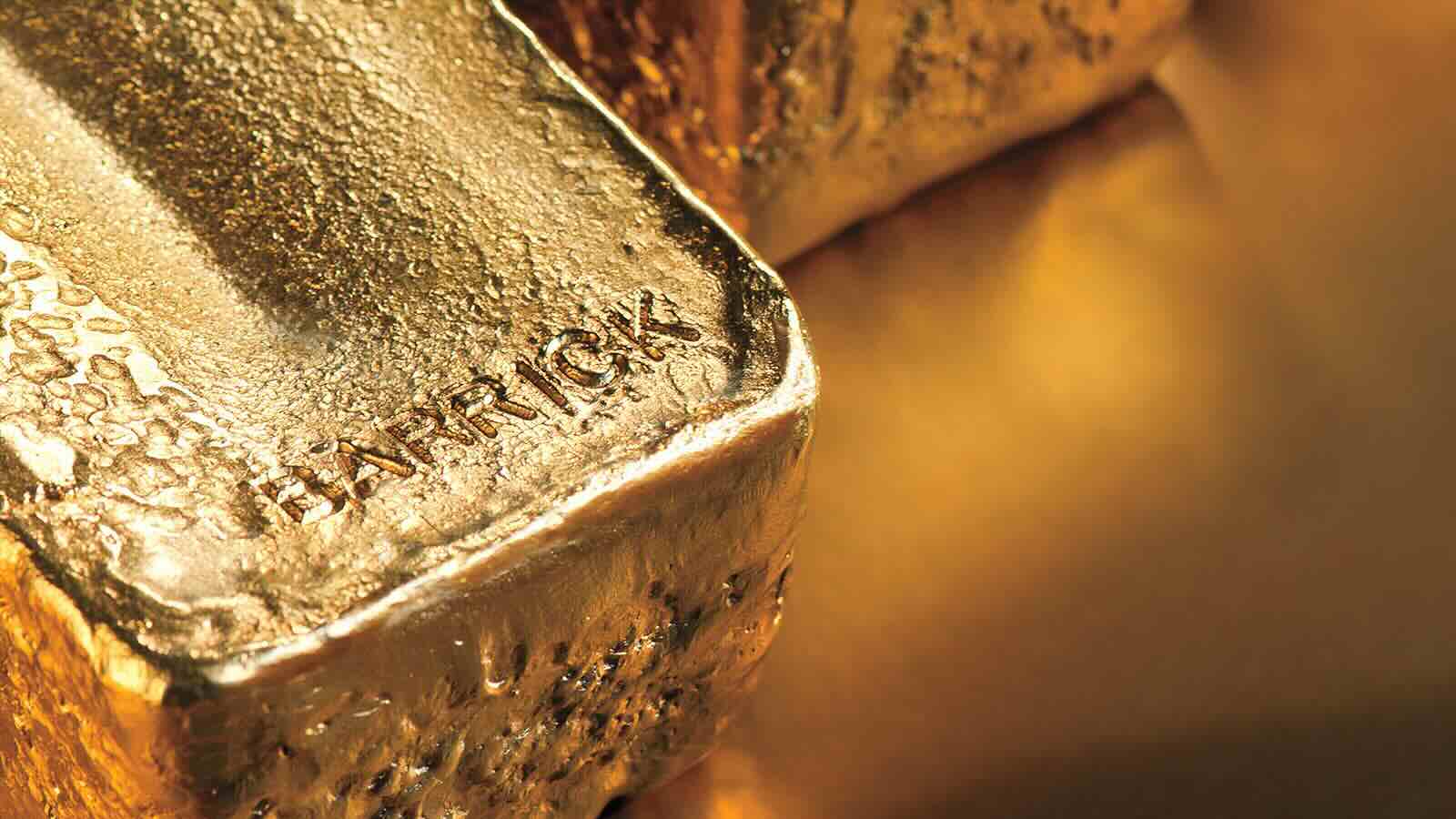
For the first time ever the price of an ounce of gold went above $4,000 this week. The price has shot up by 50% since the start of the year.
Bitcoin’s a cyberslacker by comparison. It’s only gone up 30% year-to-date.
Gold’s skyrocketing price has even outpaced the ballooning (some say bubbling) price of Nvidia stock, up 43% so far in 2025.
Earlier this week Goldman Sachs predicted gold’s run of good fortune will continue, projecting the price will be pushing $5,000 by the end of next year.
Given its frantic pace — it was only six months ago that gold hit $3,000 for the first time — it wouldn’t be entirely shocking if gold hit $5,000 by the end of this year.
Then again, gold momentarily slipped back under $4,000 Thursday, and it also wouldn’t be shocking if the price eventually settled in somewhere between $3,000 and $4,000 for the next, oh, several years. In January of 2014, gold was $1,269 an ounce. Five years of more or less slogging along later, in January of 2019, the price had shot all the way up to… $1,286. Gold can be a volatile asset. It can also be a sleepy one.
Gold’s surge was initially sparked by broad and deep uncertainty and anxiety created by Donald Trump’s insistence on confusing his feelings for sound economic and fiscal policy. When things get weird, the price of gold shoots up.
There currently being no indication things will stop being weird any time soon, Goldman’s $5,000 projection may indeed be an underestimate.
In any case, a loose pattern, in the current century anyway, is that when gold does spike, even after it retreats, a new, higher floor price has been established going forward.
And even if the price did fall all the way back to $3,000 by the end of this year, it would still mark one of the best years ever for the corporations that mine gold in Nevada.
So what?
If Nevada were a country (amusing thought), it would be the world’s fifth largest producer of gold, after China, Russia, Australia, and Canada.
But while Nevada’s economy sure could use a break, it won’t get much if any of one from gold’s momentous price surge.
In 2024, $9 billion worth of gold was mined in Nevada. That’s equivalent to a respectable 3.5% of Nevada’s gross domestic product.
Yet as of August, the Nevada industry employed less than 11,000 people, about seven-tenths of 1% of the state’s workforce.
As mining in Nevada and everywhere has become more mechanized and automated, more minerals are produced with fewer employees. Despite increased production and new and expanding mines, the number of people employed in Nevada’s mining industry now is a couple hundred fewer than it was ten years ago.
If Barrick Mining Corp. and Newmont Corp., who together form the Nevada Gold Mines joint venture that accounts for more than two-thirds of the gold mined in the state, were to mine even more gold to take advantage of higher prices, that would likely entail the creation of relatively few additional jobs. This year’s stunning price increases notwithstanding, there were fewer people working in Nevada mines in August of this year than there were in August 2024.
The industry’s contribution to the state’s public services, programs, and infrastructure is similarly undersized relative to its revenue.
Nevada has two mining-specific taxes — the net proceeds on minerals tax, and the gold and silver excise tax — which combined to generate almost $205 million in tax revenue last year.
That sounds like a lot. But it’s merely about 2% of the value of gold mined in Nevada in 2024, an affectionately light tax burden.
Nevada’s politicians, regardless of party, have further coddled the industry by coupling irresponsibly small mining tax rates with recklessly generous tax deductions.
Thanks to the deductions, each year several gold mines pay no mining net proceeds tax at all. Last year gold production was reported at 25 mines in Nevada. Eleven of them, most but not all of them smaller mines, collectively produced $623.6 million worth of gold while paying zero under the state’s primary mining tax, the one on “net proceeds of minerals,” according to the 2024 Net Proceeds of Minerals Bulletin published by the Nevada Department of Taxation.
Gold’s skyrocketing price almost certainly means Nevada’s mining tax revenue will be bigger this year than it was last year (though never underestimate the industry’s artistry at maximizing the aforementioned tax deductions).
And yet even if Nevada mining tax revenue were to echo the price of gold and rise by more than 50%, it would still be almost negligible relative to the state’s overall tax revenue. For example, that $205 million in mining taxes the industry paid in 2024 is a mere one-ninth the $1.8 billion in state revenue generated by sales taxes when Nevadans buy a car, shoes, or a sandwich for lunch.
And unlike coal, oil, and natural gas, the federal government doesn’t tax the value of gold production at all. Like the late Sen. Harry Reid before her, Democratic U.S. Sen. Catherine Cortez Masto has proudly protected the industry from having to pay federal mineral royalties.
Substantial portions of federal mineral royalties paid on coal, oil, and natural gas are returned to the states where the mineral is produced, and hence a windfall for those states’ services and programs. So while no one can say Cortez Masto shies away from protecting the industry, her commitment to protecting her constituents’ best interest is less obvious.
Colonialism’s staying power
As investments go, gold can be pretty lame. It doesn’t earn any interest, like a bond or even a money market account. It doesn’t pay dividends, like equities. There have been those occasional stretches when its value just doesn’t move much at all for years.
And as an industry, gold’s moment in the spotlight can be pretty inconsequential to the very jurisdictions where it operates.
The industry is crucial to people in local communities in Nevada and the four countries that produce even more gold than Nevada does — people without whom the industry’s magnificent financial performance this year would not have been possible.
But the industry would have carried on more or less as it has this year even without its run of excellent fortune. For Nevada’s people and economy, gold’s amazing price spike is essentially a nothingburger.
The Nevada gold mining industry remains a stubborn vestige of economic imperialism, it’s primary mission being to extract resources from its Nevada colony to enrich shareholders elsewhere.
And that’s going great. The price of gold may be up 53% so far in 2025. But as of Friday morning, year-to-date the price of Barrick and Newmont shares were up 114% and 132%, respectively.