

[ad_1]
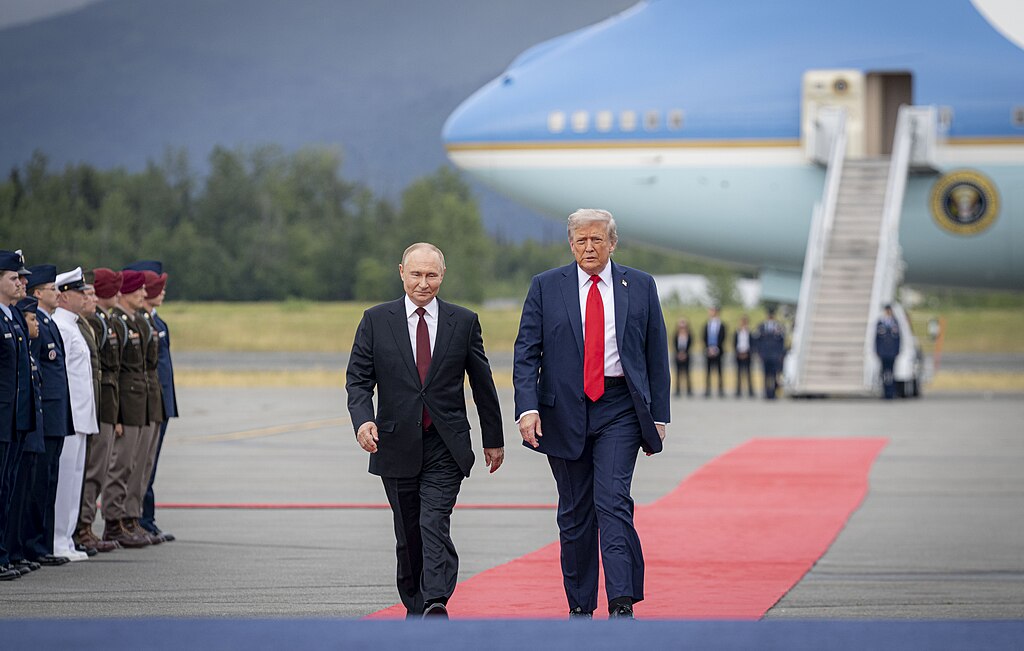
Two conferences, 1000’s of miles aside, carried the identical message: the conflict in Ukraine is now not about borders alone however about who will management its assets. In Alaska, Donald Trump met Vladimir Putin; in Washington, he sat down with Volodymyr Zelenskyy and Europe’s leaders. Trump forged himself as the one man in a position to minimize a deal between East and West. Nevertheless, his declare to mediation uncovered much less about peace than about energy—about minerals, markets, and the uncooked battle for management.
However Trump’s guarantees ring scrawled. He ruled out American boots on the bottom, insisting that “as president” he wouldn’t threat U.S. lives in Ukraine. On the similar time, he dangled the thought of U.S. peacekeepers—hinting at American presence however with out dedication. He reassured Kyiv that safety ensures would come, however largely from Europe. France, Germany, and the UK, he claimed, have been weighing troop deployments. His message was clear: America is not going to combat this conflict, however it’s going to supervise the spoils.
The contradictions are evident. Trump insists Ukraine is not going to enter NATO, but guarantees “ensures.” He talks of peace, however pushes Kyiv towards territorial concessions. He claims Putin accepts safety ensures, at the same time as Moscow warns that NATO troops in Ukraine would imply uncontrollable escalation. The Alaska and Washington talks thus revealed not a coherent technique however a theatre of offers, with Trump casting himself because the impatient businessman, Putin because the imperial gambler, Zelenskyy because the cornered chief, and Europe because the reluctant companion.
The Trumpian Diplomacy
Trump’s mediation is much less about rules than about optics and transaction. His model is rooted in velocity and spectacle. In Alaska, he boasted of non-public chemistry with Putin; in Washington, he pressed Zelenskyy to compromise. For him, “there’s no deal until there’s a deal,” however any deal is best than no deal—so long as he will get credit score for brokering it.
That is Trump’s trademark strategy: scale back advanced wars to boardroom negotiations. In his world, sovereignty turns into negotiable, borders turn out to be bargaining chips, and peace turns into a contract signed below stress. He brazenly recommended that Ukraine might “finish the conflict virtually instantly” if it conceded territory. He floated the thought of land swaps, as if states have been actual property parcels.
Nevertheless, Trump isn’t naïve. He is aware of assets are on the coronary heart of recent conflicts. His repeated hints that U.S. support must be tied to Ukraine’s mineral wealth reveal his instincts. For him, diplomacy can also be about enterprise entry. On this sense, his mediation displays not solely a need to finish the conflict however to restructure who earnings from Ukraine’s assets as soon as the conflict is completed.
Trump aspires to be remembered as the good dealmaker-president who solved Ukraine the place others failed. However what he gives isn’t sturdy peace. It’s a fast repair constructed on concessions, one which dangers legitimising conquest and opening the door for useful resource exploitation.
Putin’s strategic ambition
For Putin, the conflict is existential. He sees it as defence towards NATO, however his goals go far past geopolitics. By annexing Crimea and now holding swathes of Donetsk, Luhansk, Kherson, and Zaporizhzhia, Russia has already seized assets value an estimated $12.5 trillion. These territories comprise coal, oil, gasoline, and important minerals. Russia now controls 80% of Ukraine’s offshore gasoline reserves and half of its coal. This isn’t solely about power safety—it’s about establishing a useful resource empire that sustains Russia’s economic system below sanctions and strengthens its bargaining energy over Europe.
Putin aspires to revive Russia’s sphere of affect. However he is aware of that army dominance alone is not going to assure it. Financial leverage issues simply as a lot. By controlling Ukraine’s industrial heartlands, Moscow can weaken Kyiv completely and maintain Europe hostage to its assets. The Donbas isn’t solely a battlefield; it’s an industrial treasure. Management of it secures metal, coal, and power that Ukraine can’t afford to lose.
For this reason Putin’s calls for stay maximalist. He insists on Crimea’s recognition, on Donbas sovereignty, and on Ukraine’s neutrality. He makes use of conflict fatigue within the West as leverage, playing that in the end Kyiv’s allies will push it towards concessions. For him, even partial victories imply long-term management of assets and the political subjugation of Ukraine.
Zelenskyy’s Survival Technique
Zelenskyy stays defiant. He rejects territorial concessions and insists that peace should start with a ceasefire, not a land swap. He is aware of that giving up the Donbas would give Russia a springboard for future offensives. However he’s additionally constrained. Ukraine is deeply depending on Western support—about $407 billion since 2022, together with $118 billion from the U.S. His authorities has needed to stability survival with compromise, signing offers that tie support to drone exports and defence contracts.
For Zelenskyy, the battle isn’t solely about sovereignty however about preserving Ukraine’s financial viability. Shedding its mineral and industrial base would cripple the nation for generations. He is aware of that Ukraine’s independence relies upon not solely on borders but additionally on who controls its mines, fields, and power reserves.
Geopolitics and Geoeconomics of Ukraine
Ukraine is excess of a frontline state. It’s a strategic resource hub. Its 20,000 recognized deposits make it the richest untapped reserve in Europe. The nation holds huge reserves of titanium, lithium, graphite, gallium, neon gasoline, and uranium. These are the uncooked supplies of recent energy: chips, batteries, renewable power, and superior weapons.
Earlier than the conflict, Ukraine provided 90% of the neon utilized by U.S. semiconductor makers. It was poised to turn out to be a number one provider of lithium, a mineral central to electrical autos and power storage. Management of those deposits is now contested. If Russia consolidates its maintain over japanese Ukraine, it’s going to dominate Europe’s entry to important minerals, giving Moscow an financial lever as highly effective as its army arsenal.
This explains why the West sees Ukraine as “the defend of Europe.” It isn’t nearly defending democracy. It’s about safeguarding the assets that may energy Europe’s inexperienced transition and digital industries. The EU’s Inexperienced Deal can’t succeed with out safe entry to lithium, cobalt, and uncommon earths. Shedding Ukraine’s reserves to Russia would tie Europe extra tightly to China’s mineral monopoly.
For the U.S., the stakes are equally excessive. Washington sees Ukraine as a solution to diversify provide chains away from Beijing. Trump’s feedback about tying support to entry weren’t gaffes—they mirrored a tough actuality. American corporations already eye Ukraine’s reserves as future sources of independence from Chinese language uncommon earths. Assist, on this gentle, is not only humanitarian or strategic—it’s funding capital for useful resource entry.
Russia, the U.S., and Europe thus converge on the identical level: Ukraine’s future lies in who controls its mineral wealth. That is the true prize of the conflict. Borders, NATO membership, and ensures are all essential. However they’re additionally the diplomatic covers for a useful resource conflict whose end result will form Europe’s financial future.
Europe’s Dilemma
European leaders, from Macron to Starmer, resist Trump’s shortcuts. They warn that half-baked compromises might encourage Moscow and destabilise Europe. However in addition they know their economies rely upon Ukraine. Lithium for batteries, titanium for aerospace, and uranium for nuclear energy are all important to Europe’s industrial and local weather targets.
Thus, Europe’s place isn’t purely ethical. It’s strategic. Defending Ukraine is defending Europe’s financial independence. Ceding territory wouldn’t solely weaken Kyiv’s sovereignty; it will hand Europe’s future provide chains to Moscow. That’s the reason European leaders, although cautious of Trump’s impulsiveness, have little selection however to face by Ukraine.
The Political Economic system of Fashionable Battle
Fashionable wars are hardly ever about flags alone. They’re about pipelines, mines, and markets. The Ukraine conflict is a putting instance. Russia bleeds for assets and empire. Ukraine fights for sovereignty and survival. The U.S. intervenes to safe entry and weaken rivals. Europe helps Kyiv to guard its financial future.
For this reason diplomacy falters. Peace talks stumble not solely due to maximalist calls for however as a result of the stakes are materials. Territorial concessions are additionally useful resource concessions. Safety ensures are tied to contracts. Humanitarian support comes with situations of extraction. The logic of conflict and the logic of markets overlap.
What Lies Forward
The alternatives are clear. If Ukraine is pressured into concessions, Russia consolidates a useful resource empire and Europe faces long-term dependency. If Ukraine resists, the conflict drags on, however Western industries retain hope of entry. Trump’s pursuit of a fast deal dangers normalising conquest as negotiation. If borders could be modified by pressure in alternate for minerals, worldwide legislation collapses.
Putin aspires to revive Russia’s empire and safe its economic system. Trump aspires to be the grand mediator, however what he delivers is a contract formed by assets, not rules. Zelenskyy aspires to protect Ukraine’s sovereignty and financial viability, however is trapped in dependency. Europe aspires to stability however is aware of its industrial future is sure to Ukraine’s minerals.
The Ukraine conflict is due to this fact not solely a combat for territory. It’s a battle for the fabric foundations of world energy. Whether or not the end result is determined in trenches or boardrooms, the stakes are the identical: management of assets. If diplomacy reduces sovereignty to mineral concessions, conquest regains its legitimacy.
This conflict is about Ukraine. However additionally it is about whether or not the foundations of the worldwide order nonetheless maintain, or whether or not, within the new age of useful resource wars, uncooked pressure and market offers determine the destiny of countries.
[Benjamin D Applebaum, Public domain, via Wikimedia Commons]
The views expressed on this article are these of the writer and don’t essentially replicate TGP’s editorial stance.
Ok.M. Seethi, Director, Inter College Centre for Social Science Analysis and Extension, is the Tutorial Advisor of the International Centre for Polar Studies at Mahatma Gandhi College, Kerala. He additionally served as ICSSR Senior Fellow, Senior Professor and Dean of Worldwide Relations at MGU.
[ad_2]
Source link