

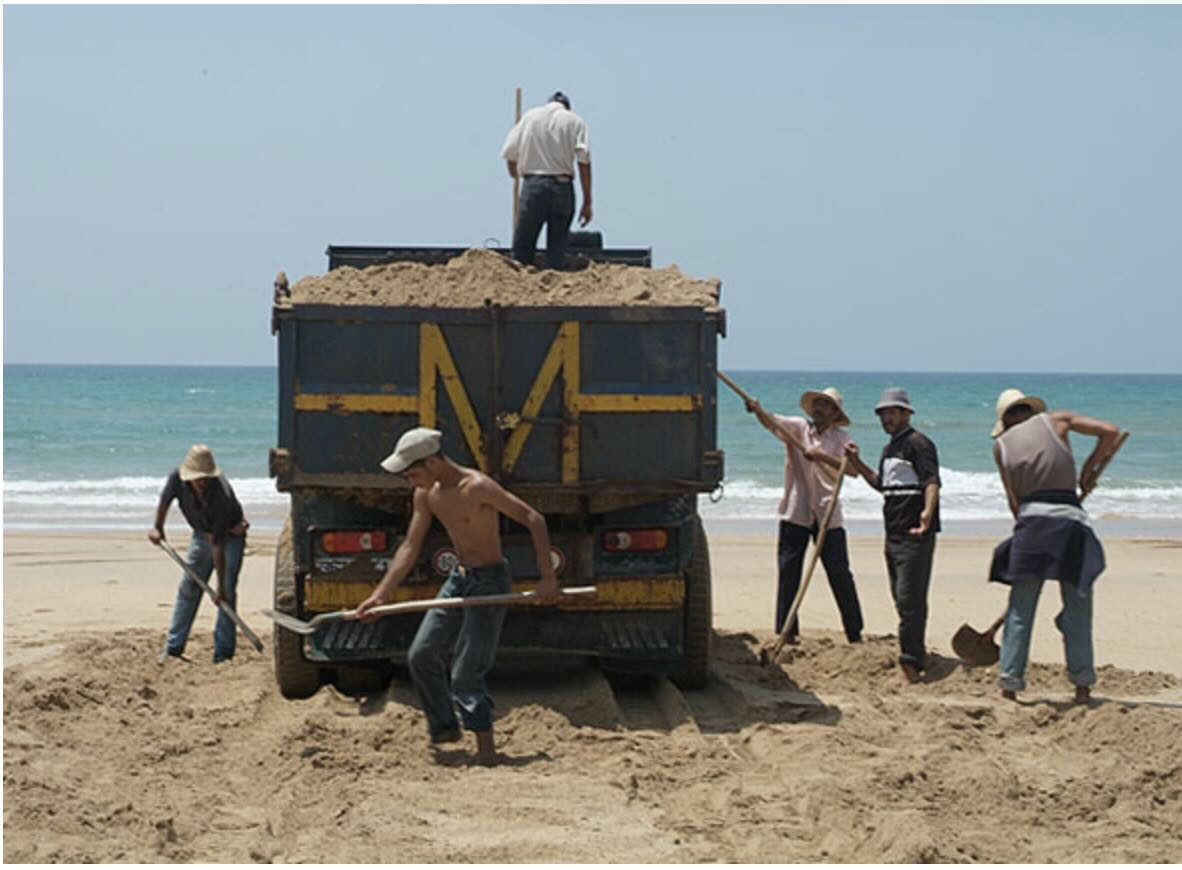
The grains on our beaches and riverbeds might seem infinite, but they’re actually running out. For almost my entire life, and that of my 82-year-old father, a company called McCallum Brothers has been taking sand from Pākiri, the vast white beach a few kilometers north of our family home.
Most of those grains were sold to construction companies in the nearby city of Auckland. Some now sit in the concrete cylinder of New Zealand’s tallest building, the Sky Tower, with others in the foundations of the Auckland Harbour Bridge.
A few stayed closer to their original purpose: shoveled onto city beaches to beautify them.
While Aucklanders appreciated the sparkle underfoot, Pākiri’s people, plants and animals suffered.
Local iwi [Maori tribe] Ngati Manuhiri fought the extraction across three generations, alongside other community members who watched their beach gradually disappear and awaited worse impacts as sea levels rise under the climate crisis.
The mining operation also threatened the survival of the country’s most endangered endemic bird, the tara iti or fairy tern (Sternula nereis), which nests in the sand dunes of Pākiri and a couple of nearby beaches. There are now less than 40 birds left.
Pākiri’s sand, prized in the construction industry for its shape and mineral content, which is ideal for use in high-strength concrete, is ancient and irreplaceable. It was delivered there over 20,000 years ago as sediment from New Zealand’s longest river, the Waikato, which has since changed course.
“There is a finite supply of sand along the coastline of these beaches,” writes local activist group Stop Sand Mining. “Once it’s gone, it’s gone.”
How much sand is there, really?
The activists’ message shirks the common assumption that sand resources are infinite. It’s an easy error to make, says earth scientist Eline Rentier, a PhD candidate at the University of Bergen and lead author of a recent study on the environmental impacts of river sand mining.
“I’d come across a news article on how sand had become such a scarce resource, and I was like, ‘What do you mean, scarce? It’s everywhere.’” she recalls.
“So, I decided to do a literature review on it, and it became clear very quickly that it’s a global problem – and one that’s constantly growing.”
At current projections, the world could completely run out of construction-grade sand as early as 2050.
It’s hard to keep track of how much sand is being mined globally because so much of it is done illegally, but the United Nations Environment Programme (UNEP) puts the figure at about 50 billion tonnes per year.
That’s about 63 lorry loads every second – and around six times the annual volume of 25 years ago. Just 30 percent of that trade, or 15 billion tonnes, is thought to be legally traded.
Not all sand is the same
River sand is the most sought-after type for the construction industry, where by far the biggest demand for sand lies. But the scale and pace of extraction is putting riverine ecosystems at risk, says Rentier.
When you mine a riverbed, “you take away the habitats of microorganisms. You change the shape of the riverbed or nearby areas, which can alter the flow of the river or lower the water table, which can affect fish or other organisms living in the river.”
“You increase turbidity, which is disturbing the habitat of a lot of organisms living there.”
Marine sand extraction also has detrimental environmental impacts, with marine biodiversity particularly affected by water turbidity, nutrient availability changes and noise pollution.
“And what about desert sand?” I ask Rentier. Surely there’s plenty there to spare?
Unfortunately, that sand doesn’t make the grade for the construction industry. “You need angular sand grains,” she says. “If it’s been eroded for a long time and the sand grains are perfectly round, any concrete that’s made from them is not structurally strong.”
“It’s unfortunate, because we have a lot of desert sand and there’s not much use for it.”
Why are gangs stealing sand?
While legal sand mining, like that which occurred at Pākiri, clearly has environmental and social costs, the impacts of its illegal counterparts are even more alarming.
The black market for sand, which makes up the bulk of the sector, is estimated to be worth up to USD 350 billion a year.
The biggest illegal operations are in Asia, with India – the third-largest sand user after China and the U.S. – home to criminal networks known as the ‘Sand Mafia’.
Within these networks, forced and child labor is common, and the work is often carried out in extremely dangerous conditions; would-be whistleblowers have been intimidated, hurt and even killed.
Yet, there’s money to be made: an illegal miner can earn more than four times what they’d get on the average wage, and intermediaries can then sell the sand for four times what they paid for it.
So, it’s not hard to see why the sand mafia are continuing to recruit across the country.
And whilst India’s ‘mafia’ is the most notorious, sand theft also happens in many other parts of the world, including China, Southeast Asia and Eastern Europe.
That’s changing our landscapes, often irrevocably: at least 24 Indonesian islands have disappeared since 2005 due to illegal sand extraction, and over 2,000 more are at risk of the same fate.
Can we keep our beaches – and keep on building?
On the prospects of sustainable sand mining, Rentier is uncertain. “I’m not sure there is an entirely sustainable way to mine sand,” she says.
“The demand is so vast that it feels like a bit of a dream scenario. So can we really meet it in a sustainable way? I don’t know.”
Might demand ever slow? The situation certainly points to the impossibility of continued growth on a finite planet. Yet much of the increase in sand demand comes from low-to-middle-income countries like India, where newbuilds are helping to address overcrowded living situations.
The squeeze on sand isn’t taking everyone by surprise, and new alternatives are popping up, like manufacturing sand out of crushed rocks. In China, the world’s biggest consumer of the resource, manufactured sand now makes up 90 percent of annual sand consumption.
Researchers at the Norwegian University of Science and Technology (NTNU) and the University of Tokyo are also finding ways to use desert sand in construction by using heat to combine the grains with tiny pieces of wood to create a new kind of ‘sandcrete.’
“The production process is relatively simple, so in principle the material can be made in many places,” says Ren Wei, a postdoctoral fellow at the Department of Manufacturing and Civil Engineering at NTNU.
“But we need to test more, including how it can withstand cold, before it can be used in Norway.”