

Swinburne and CSIRO researchers have successfully produced iron in Mars-like conditions, opening the door to metal production beyond Earth.
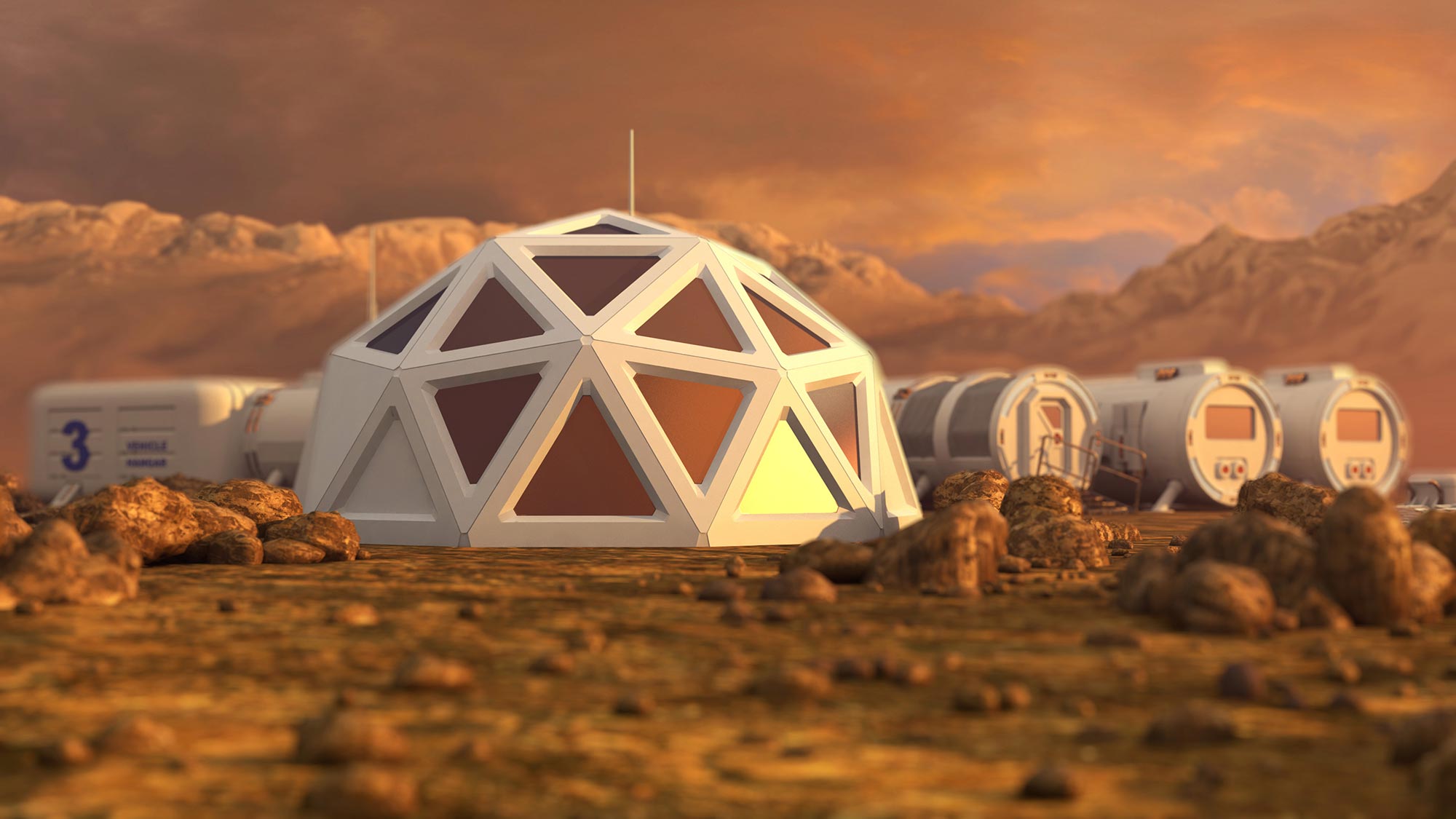
The vision of establishing settlements on Mars has captured the imagination of billionaires, government space programs, and space exploration advocates.
However, building such colonies requires vast amounts of material, and transporting it all from Earth is not practical. To put it in perspective, sending NASA’s one-ton Perseverance Rover to Mars cost around US$243 million.
Clearly, unless we plan to build a settlement fit only for ants, far more resources will be necessary. The challenge then becomes: how do we obtain them?
For CSIRO Postdoctoral Fellow and Swinburne graduate Dr Deddy Nababan, the solution may lie in Mars’s own soil, known as regolith.
“Sending metals to Mars from Earth might be feasible, but it’s not economical. Can you imagine bringing tonnes of metals to Mars? It’s just not practical,” Dr Nababan says.
“Instead, we can use what’s available on Mars. It’s called in-situ resource utilization, or ISRU.”
More specifically, Dr Nababan is looking at astrometallurgy — making metals in space.
Building an off-world foundry
As it turns out, Mars has all the ingredients needed to make native metals. This includes iron-rich oxides in regolith and carbon from its thin atmosphere, which acts as a reducing agent.
Swinburne University of Technology astrometallurgist, Professor Akbar Rhamdhani, is working with Dr Nababan to test this process with regolith simulant – an artificial recreation of the stuff found of Mars.
“We picked a simulant with very similar properties to that found at Gale Crater on Mars and processed them on Earth with simulated Mars conditions. This gives us a good idea of how the process would perform off-world,” he says.
The simulant is placed inside a chamber at Mars surface pressure and heated at increasing temperatures. The experiments showed pure iron metal formation around 1000°C, with liquid silicon-iron alloys produced around 1400°C.
“At high enough temperatures, all of the metals coalesced into one large droplet. This could then be separated from liquid slag the same way it is on Earth,” Professor Rhamdhani says.
Along with Dr Nababan, Prof Rhamdhani is collaborating with CSIRO’s Dr Mark Pownceby to further advance the process. They’re particularly focused on making metals with zero waste, where the byproducts of the process are used to make useful items.
If you can’t ship it, make it
In space exploration, in-situ resource utilization (ISRU) is becoming increasingly important because every kilogram launched aboard a rocket adds to the cost and complexity of a mission. Although launch costs are gradually decreasing, the scale of resources needed to support human exploration remains enormous.
Significant progress is already being made, including the first off-world demonstration of ISRU. NASA’s MOXIE experiment, carried by the Mars Perseverance rover, successfully generated breathable oxygen from nothing more than the carbon dioxide in Mars’s atmosphere.
Metal production is the next giant leap. Prof Rhamdhani hopes Mars-made alloys could be used as shells for housing or research facilities, and in machinery for excavation.
“There are certainly challenges. We need to better understand how these alloys would perform over time, and of course, whether this process can be recreated on the real Martian surface,” Prof Rhamdhani says.
But in the meantime, Swinburne and its partners are doubling down. Prof Rhamdhani, together with Dr Nababan and Dr Matt Shaw, another CSIRO researcher and Swinburne alum, recently delivered a 4-day bespoke workshop on astrometallurgy in South Korea. The feedback was promising.
“We’re starting to see increased interest in this field globally as the world gets serious about Mars exploration,” he says.
“To make it happen, we’re going to need experts from many fields — mining, engineering, geology, and much more.”
For Dr Nababan, the benefits go beyond exploration. He hopes their research will also drive more efficient metallurgy here on Earth.
“By doing this, I wish that I can help the development of space exploration, and at the end it will bring good to human life here on Earth.”
https://scitechdaily.com/the-unexpected-material-that-could-build-our-first-mars-colony/