

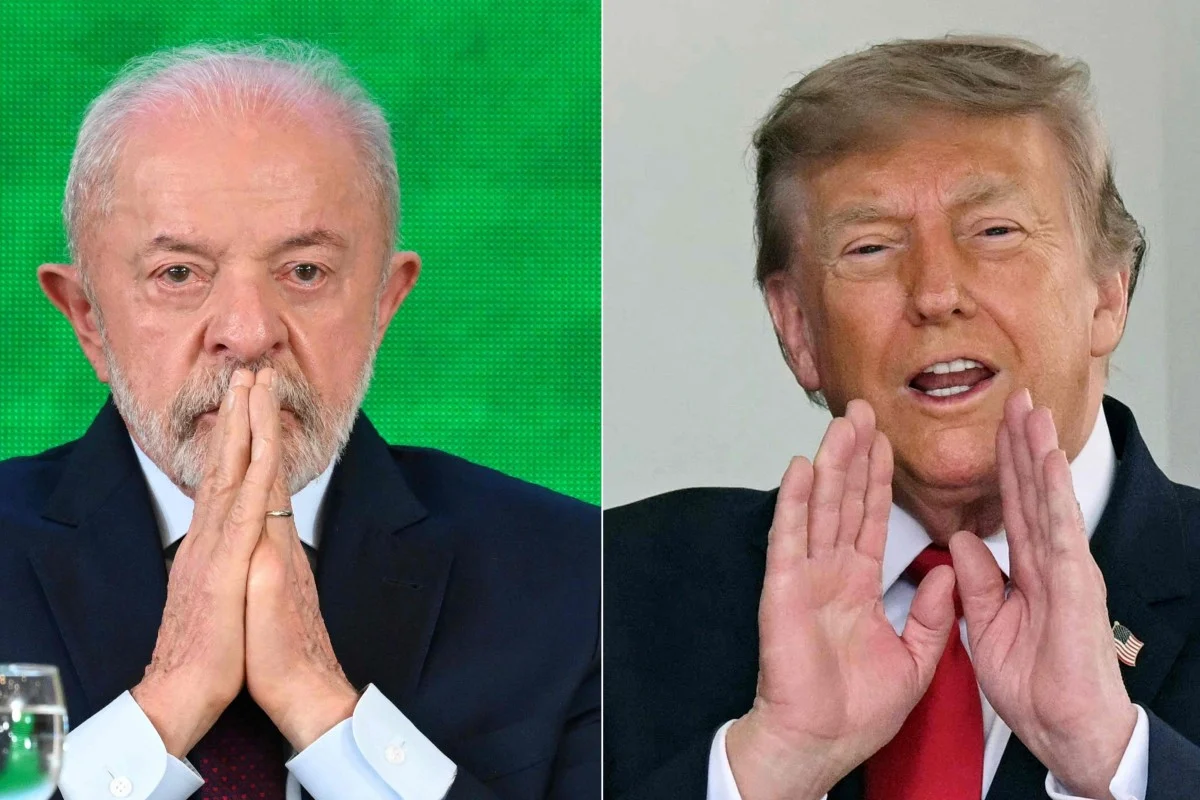
“I spent an hour with President Trump and his team, the vice-president, some ministers, and I heard that they lost the race to China on electrification, on the separation of minerals, on the defence industry,” Silveira said in the speech, in which he defended the government’s push to bring foreign capital into mineral processing on Brazilian soil.
The two sides met in the Oval Office and then over an extended working lunch, covering trade, tariffs, organised crime and critical minerals in a session that ran more than an hour past schedule.
A US$600 billion vulnerability
“If the United States were to lose 30 per cent – just 30 per cent – of the supply of its magnets, it would wipe off US$600 billion, or 2.2 per cent of United States [gross domestic product] overnight,” he said.
To underline how cheaply Beijing could exercise that leverage, Dhawan set the figure against the total value of Chinese rare earth exports last year, which he put at US$3.2 billion. A government weighing that trade-off, he said, would be looking at an action costing it a fraction of what it would destroy.
He said more than 100 countries now had some form of critical minerals policy in place, part of a shift since 2020, as governments moved into the sector at a level unseen in decades.
“The United States has only one way out, because it does not have abundance,” he said, adding that Washington had to invest where there were plentiful deposits.
Producing and manufacturing rare earths in the United States costs two and a half times more than producing them in Brazil, according to the minister, who did not give a source for the figure.
China, by contrast, might have little reason to build separation capacity in Brazil at all, Silveira said.
“Perhaps China is not interested in investing in Brazil in the production and separation of rare earth minerals through the chemical elements, because they have abundance and they have mastered the technology,” he said.
US$1.55 billion for a Brazilian mine
Also on Monday, the US Department of Defence announced a US$750 million investment in a special purpose vehicle that buys mixed rare earth carbonates from Serra Verde’s Pela Ema operation in the state of Goias.
The money is part of a US$1.55 billion investment structure that also includes US$300 million in forward purchase commitments from the Defence Logistics Agency and a US$500 million debt facility from a major commercial bank.
Serra Verde said the vehicle had completed its capitalisation, putting a 15-year offtake agreement into force with price floors for neodymium, praseodymium, dysprosium and terbium, and that deliveries should begin early in the fourth quarter.
“By partnering with Serra Verde, we are taking a decisive step to break our adversaries’ near-monopoly on rare earth elements,” Mike Cadenazzi, US assistant secretary of defence for industrial base policy, said in a statement.
The special purpose vehicle buys rare earth carbonate, an intermediate product rather than separated oxides or finished magnets. This puts the deal closer to the export model Lula has said his government intends to abandon than to the processing industry Silveira promoted in Belo Horizonte.
Neither the US Department of Defence statement nor Serra Verde’s said where the carbonate would be separated.
Until recently, the mine had committed its output to Chinese processors under 10-year contracts, which Serra Verde renegotiated in December to expire this year.
Meanwhile, ownership is changing, with USA Rare Earth having agreed in April to buy Serra Verde Group for about US$2.8 billion in cash and shares, a transaction expected to close in the third quarter.
The transaction is already being challenged at home by Rede Sustentabilidade, a small left-wing political party, which has filed a constitutional complaint with Brazil’s Supreme Court seeking to force the mining regulator to produce its review of the sale and, if that review proves inadequate, to have the deal suspended. The party argues the current framework does not adequately protect the national interest when strategic mineral assets change hands.
Lula has insisted since the Washington meeting that Brazil would not choose between countries offering to supply capital for the critical mineral sector.
“We have no preference. What we want is to share with whoever wants to invest in Brazil,” he told reporters in Washington in May.
“Americans, Chinese, Germans, Japanese, French, whoever wants to participate with us to help us mine, separate and produce the wealth that these rare earths offer us, they are invited.”
Gaps in copper and aluminium
Rare earths are the clearest example of a larger pattern executives described at the conference: Brazil has the mineral resources in the ground but exports the value that processing would add.
According to Eduardo de Come, vice-president of Canadian-listed miner Ero Copper, Brazil is the only one among the 10 most developed economies without a working copper smelter, while roughly 70 per cent of global copper refining sits in China.
The country’s only significant smelting complex, operated by Paranapanema at Dias d’Avila in Bahia, has been in judicial recovery since December 2022, and its partial restart has so far covered only the conversion of copper scrap into anode, with the processing of concentrate still awaiting repairs to the main furnace.
“Brazil produces more copper than it consumes, but it exports 100 per cent of that production,” he said, adding that while Brazil was geopolitically stable and traded with every country, in terms of risk it depended “100 per cent on imported refined copper”.
Anderson Barreto Arruda, Brazil’s national secretary for geology, mining and mineral transformation at the mines and energy ministry, said the government accepted that regulation alone would not create a processing industry.
He said the critical minerals strategies of Canada, Australia, the United States and the European Union all featured tools for the state to share risk with companies.
“A mineral processing industry that today does not exist outside Asia is not going to be born solely from a regulatory instrument of imposition,” Arruda said. “We need to build this jointly.”
Luciano Alves, CEO of Companhia Brasileira de Aluminio (CBA), one of Brazil’s largest aluminium producers, said Chinese expansion was now happening abroad because Beijing had capped capacity at home.
“Indonesia today is the main destination of Chinese investment, so there are many aluminium smelters being built in Indonesia,” Alves said. “The question is: why not Brazil?”