

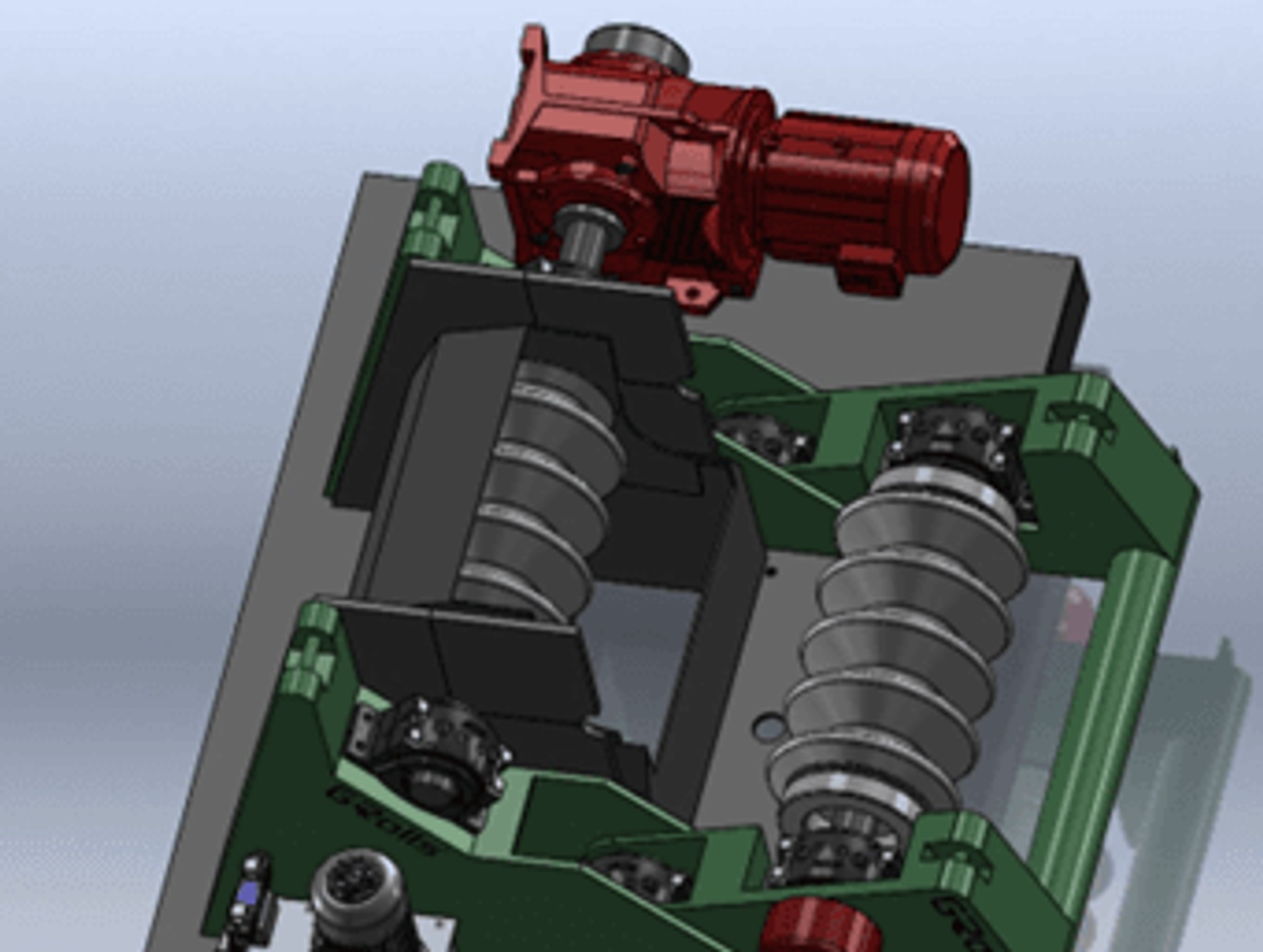
New crushing technology could reduce mining supply chain costs by cutting energy use and eliminating traditional grinding processes, increasing efficiency.
The mining industry’s supply chain complexity has intensified as demand for critical minerals surges, driven by the global transition to renewable energy.
This pressure on procurement and logistics operations has coincided with mounting scrutiny over carbon emissions across the entire value chain.
Mining companies are now investing in technologies that could reshape their operational supply chains, from extraction through to processing and delivery.
South Australian company Gyratory Roller Solutions (GRolls) is developing emerging crushing technology which could transform mineral processing operations and ripple through mining supply chains.
Currently being investigated by researchers at Adelaide University, the technology is already showing advantages that could influence procurement decisions, operational logistics and downstream processing efficiency.
The mining industry has undergone transformation in recent years, driven by ongoing demand for critical minerals amid the move towards renewables. Mining companies around the world are modernising their operations to meet demand and embed sustainability throughout their supply chains. Though each region has a different list of what it classes as a critical mineral, materials such as copper, gold, lithium and aluminium are key commodities around the world.
Due to its significant role in the clean energy transition, electric vehicles and national infrastructure, copper is increasingly being classified as a critical mineral. However, mining processes can be time-consuming, expensive and emission-heavy, due to a range of techniques. These factors directly impact supply chain costs and the ability of mining operations to meet downstream delivery commitments.
Emerging technology for mineral processing
GRolls is aiming to transform the sector with its new crushing technology. According to Mark Drechsler, GRolls Director and Adelaide University PhD candidate, the technology reduces the need for grinding and milling of copper and gold ore. This process, known as comminution, is an essential but energy-intensive process to free valuable minerals from waste rock through the crushing and grinding of materials.
The implications for supply chain operations could be significant. Mark says there is a reduction in operating costs and the industry’s carbon footprint, factors that directly influence procurement strategies and logistics planning.
“Ore crushing and grinding are traditionally one of the most energy-intensive processes in mining, accounting for more than 1% of global energy use and up to 80% of a mine’s site power consumption,” Mark says.
The technology combines pulsed compression, tension and shear forces in order to break down ore. This blend of processes reduces more than 40% of particles to less than 425 microns in a single pass, as well as generating less than 14% of fine particles smaller than 75 microns. It is particularly useful when working with finer ore feeds that are under 2.36 mm.
By reducing particle size more efficiently in a single pass, the technology addresses one of the mining industry’s most persistent supply chain challenges. Traditional multi-stage grinding circuits require extensive infrastructure, maintenance schedules and coordinated logistics that add complexity and cost throughout the processing chain.
Demonstrating efficiency across operations
The GRolls circuit was tested alongside a traditional grinding operation at a copper-gold operation in NSW, demonstrating a 20% reduction in energy consumption. As well as this, it nearly halved the total comminution cost. For supply chain managers, these metrics could translate into more predictable operational costs and improved margins across the value chain.
“These are significant savings. Not only do you reduce power use, but you eliminate the cost of grinding minerals. There are also potential savings in water usage and a reduction in greenhouse gas emissions,” Mark says.
“Our testing shows that GRolls can process hard porphyry copper-gold ores while using significantly less energy and no grinding, making it more sustainable and cost-effective.”
This new technology could be a strong alternative for the mining industry, particularly as deposits become more complex and remote and ore grades decline. These challenges have increasingly strained supply chain logistics and procurement operations.
Dr George Abaka-Wood, Future Industries Institute metallurgist and supervisor of the GRolls project, says: “The team is committed to showing the downstream benefits of using dry crushing technology in collaboration with other innovative technologies to address the need for more energy-efficient and higher processing efficiencies within mineral processing flowsheets.”
Scalable solution for integration
The technology is a compact but scalable solution which can be used across a range of environments and processes. From a supply chain perspective, this flexibility could allow mining operations to retrofit existing infrastructure or integrate the technology into new processing circuits without extensive capital investment or logistical disruption. It can be used as standalone unit or it can be integrated into existing circuits, as well as being used dry or wet.
“This could be a game changer for mineral processing,” says Professor Bill Skinner, co-author of the study and Research Leader of Minerals and Resource Engineering at the Future Industries Institute.
“It offers an opportunity to simplify processing circuits while improving sustainability across the board.”
GRolls is aiming to commercialise the technology in 2026, utilising a A$300,000 (US$211,400) South Australian Government Seed-Start grant. If this technology can be scaled and commercialised, procurement teams across the mining sector may need to reassess their processing equipment strategies and supply chain configurations. The aim is to redefine minerals processing while delivering tangible benefits throughout the operational value chain.