


[ad_1]
Introduction
The world has been explored, the deposit has been modeled, and the ore has been extracted: now what? It’s time for mineral processing. Mineral processing is the very first thing that occurs to ore and mineral-bearing rock after they depart the mine or quarry.
There are 4 steps in mineral processing: sampling/evaluation, comminution, focus, and dewatering. This text is the second in a collection about mineral processing and covers the final two steps. For those who missed the primary article within the collection or want a refresher, read it here.
Focus/Separation
Separation or focus is the method of separating useful minerals from the gangue or uncooked materials. At this stage, the ore materials has been ground into small pieces. Minerals are separated primarily based on their bodily and chemical properties, equivalent to coloration, density, and magnetism. Relying on key variations of the properties between useful minerals and surrounding materials, the next methods are used:
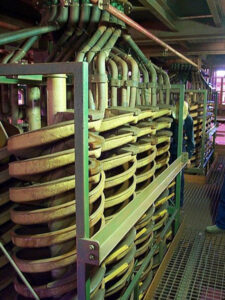
Gravity Separation is used to separate minerals of various densities. Materials is suspended in a viscous medium, like water or natural/inorganic fluids, and uncovered to centrifugal, magnetic, or buoyant forces. Spiral concentrators are probably the most generally used methodology. They use centrifugal forces, inflicting heavier minerals to pay attention nearer to the within of the fluid stream. These are usually used to pay attention heavy minerals like ilmenite, rutile, zircon, iron, chromite, and manganese. Shaking tables are low-capacity machines that use forwards and backwards vibrations to pay attention fantastic ores of Nb, Ta, and W.
Flotation is a solid-liquid separation pushed by the wettability of minerals–that’s, whether or not they entice water (hydrophilic) or repel water (hydrophobic). Throughout this course of, bubbles are injected into the pulp (the free-flowing combination of water and powdered ore). Because the bubbles rise by the pulp, the hydrophobic mineral particles connect to them. When the minerals connect to the bubbles’ surfaces, they rise to the froth that types on the prime of the pulp. From right here, these mineral particles may be eliminated with the froth. Waste minerals will sink to the underside of the combination. This system is used to separate Cu, Pb, and Zn-bearing minerals.
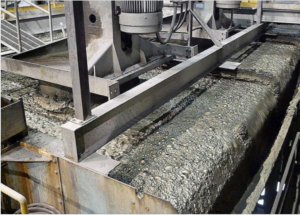
Magnetic Separation is used to separate magnetic minerals from waste materials. Strongly magnetic minerals like magnetite, Fe-Ti oxides (ilmenite and maghemite) or Fe sulfides (pyrrhotite) may be faraway from their gangue by low-intensity magnetic separation. Examples of magnetic separation instruments embody disc separators, drum separators, roll separators and overhead magnets.
Optical Separation is the separation of minerals by coloration. Optical sorters expose the ore materials to infrared, seen, and ultraviolet mild. A sensor detects how the sunshine is mirrored or absorbed by the completely different minerals within the ore materials. That is an rising know-how and has been examined on magnesite, quartz, lignite, hematite, copper, and gold ore samples.
Dewatering/Drying
After separation, the ore materials have to be dewatered/dried. Most components of the mineral processing workflow depend upon water– for instance, comminution and flotation use massive quantities of water. All remaining water have to be faraway from the ore for it to be transported for refining. The dewatering methodology for a particular mineral/ore largely will depend on the particle measurement and preliminary water content material. Fashionable dewatering methods use pulse combustion, vacuum filters, thickeners, dewatering screens, and centrifuges to scale back ore moisture. The water faraway from the ore materials is commonly recycled to be used in ore processing plant operations.
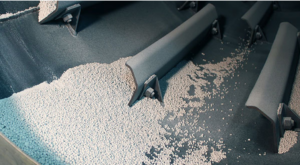
Thermal drying can also be used for dewatering ore materials, significantly for fine-grained supplies with low moisture content material. This course of is finished with industrial dryers, like rotary drums, fireplace dryers, and conveyor dryers.
Conclusions
As soon as mineral processing is full, and the precious minerals have been separated from waste, they are often became helpful merchandise. Iron ore is smelted and refined to type metal. Refined copper ore is utilized in electrical wires, constructing supplies, and industrial equipment. Processed lithium ore is handled with sulfuric acid and transformed to metallic by way of electrolysis to be used in batteries.
Finally, all ore have to be processed for it to be transformed right into a helpful materials. The mineral processing workflow is extremely depending on the kind of ore, and processing prices will fluctuate accordingly. Mineral processing is an important a part of a complete funding determination, despite the fact that it comes lengthy after exploration, drilling, and mining.
Additional Studying
- Wills’ Mineral Processing and Expertise (textbook)
[ad_2]
Source link