

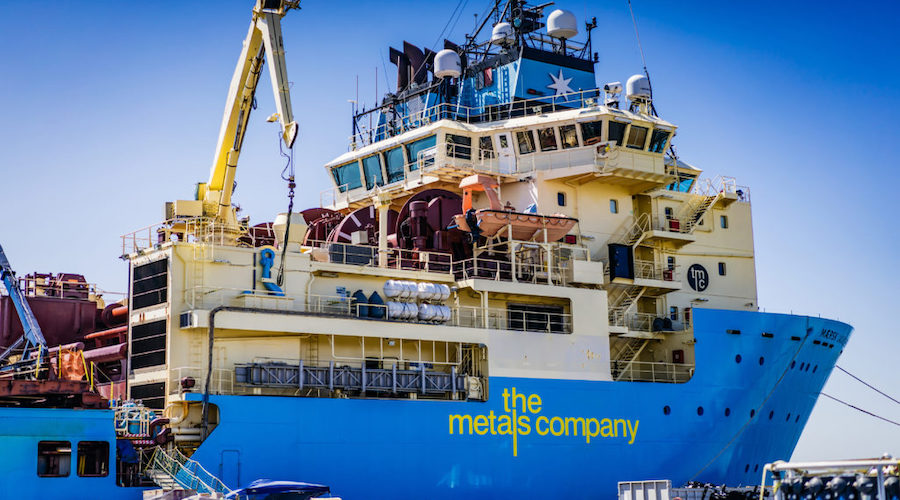
Deep-sea mining hopeful TMC the metals company (Nasdaq: TMC) took a key step forward in the US regulatory process for securing its permit to explore and extract minerals from the Pacific Ocean floor.
In a press release on Monday, TMC said its application for an exploration licence and commercial recovery permit has been deemed to be “in substantial compliance” by the National Oceanic and Atmospheric Administration (NOAA) within its new regulations.
In January, the NOAA revised the Deep Seabed Hard Mineral Resources Act — the federal law regulating deep-sea mining exploration in international waters — to essentially combine the exploration licence and commercial recovery permitting processes. Previously, deep-sea mining companies had to follow a two-step sequential process.
The revision was first proposed in July 2025 after President Donald Trump signed an executive order aimed at bolstering the deep-sea mining industry, part of a broader push to counter China’s control on the critical minerals supply chain.
Shortly after, TMC, through its US subsidiary, submitted a consolidated application, becoming the first company to do so under the streamlined process. The application replaces the one it filed in April 2025 under the old regulations.
65,000 km2 area
“NOAA’s determination reflects the depth of work our team and partners have put into understanding this resource and how it can be responsibly developed,” Gerard Barron, chairman and CEO of TMC, stated in the press release.
For years, the Vancouver-based company has been preparing to mine part of the Pacific Ocean between Hawaii and Mexico known as the Clarion-Clipperton Zone, looking to tap into the seafloor polymetallic nodules that contain essential battery metals such as manganese, nickel, copper and cobalt contained in the
“After more than a decade of environmental research, successful offshore trials and commercial-scale metallurgical processing, we believe polymetallic nodules can provide a new and lower-impact source of critical metals for the US,” Barron said.
TMC’s consolidated application covers a commercial recovery area of approximately 65,000 km2, more than double the 25,000 km2 from its previous application. According to TMC, the licensed area contains an estimated resource of 619 million tonnes of wet nodules and potential exploration upside of an additional 200 million tonnes.
Shares of TMC rose as much as 4% to $6.00 apiece in New York, giving the company a market capitalization of $2.42 billion.
Greenpeace opposition
TMC’s efforts to mine the ocean floor has long faced opposition from industry groups for its potential impacts on the natural environment, and its application for the consolidated licences has placed the company under further scrutiny.
Environmental group Greenpeace International, which previously fought with TMC on the issue in 2023, said on Monday that the company’s application for “unilateral” deep-sea mining licences from the Trump administration violates its existing contracts under international law.
Seabed mining beyond national jurisdiction is currently regulated by the International Seabed Authority (ISA), which was created by the United Nations Convention on the Law of the Sea. However, ISA has spent years formalizing deep-sea mining rules to no avail due to unresolved differences over acceptable levels of dust, noise and other factors from the practice.
In its statement, Greenpeace urges the ISA to take action against TMC, including considering not renewing the contract, alleging the company of breaching the “core contractual obligations under the United Nations Convention on the Law of the Sea.”
TMC says consolidated permit application passes US compliance