

Brazil sees no need to create a state-run critical minerals company, Industry Minister Marcio Elias Rosa said Friday, pushing back on proposals for a state-backed entity.
“There is no need whatsoever to create a state-owned company to carry out the exploration or processing of critical minerals,” Rosa told local broadcaster CanalGov, adding the current regulatory framework already offers incentives for the sector.
His comments come as a proposed national framework for critical minerals remains stalled in Congress and the Lula administration misses its own deadline to deliver a broader mining strategy.
The bill, led by federal deputy Arnaldo Jardim, includes a fund of up to 5 billion reais ($1 billion) to back mining projects, though officials have raised concerns about provisions that could expand state intervention.
Finance Minister Dario Durigan said the forthcoming framework will prioritize national sovereignty and domestic value creation without relying on broad tax breaks,. He argued strong global demand is already sufficient to attract investment while targeted tools like the Eco Invest programme will be used selectively to support projects.
“Brazilian critical minerals are too great for any potential political impediments to stand in the way,” Neil Harrington, senior vice president for the Americas at the US Chamber of Commerce, said at a São Paulo summit last month.
“It makes too much sense from a strategic, economic and investment perspective for both countries not to engage in this sector,” Harrington noted.
Policy uncertainty is not halting projects but is making capital allocation more selective, particularly for higher-risk downstream investments, as developers seek clearer signals on permitting, financing and the state’s role, Carlos Nogueira, senior advisor Brazil at consultancy Plusmining, told MINING.COM.
The absence of a clear policy is not stopping investment but is limiting how much capital Brazil could attract, while measures such as fast-tracked permitting could significantly accelerate project timelines, Adriano Drummond Trindade, a Brazilian mining lawyer, added.
Other analysts point to a broader policy vacuum that is highlighting rising friction between Brasilia and Washington, with missed diplomatic engagements, blocked visits and trade tensions complicating efforts to secure a bilateral minerals agreement ahead of Brazil’s October election.
State by state
Despite the lack of a federal deal, the US is deepening engagement at the regional level. Goiás is advancing a memorandum of understanding with US partners to expand research, investment and processing tied to the Serra Verde rare earths operation.
Serra Verde has secured a $565 million loan from the US International Development Finance Corporation and is currently the target of a $2.8 billion acquisition by USA Rare Earth (NASDAQ: USAR).
The deal could potentially create one of the few Western producers of heavy rare earths outside China. It includes a 15-year supply arrangement with minimum pricing, marking a shift from previous exports to China.
Rafaela Guedes of the Brazilian Centre for International Relations said the transaction strengthens Brazil’s role in diversifying supply but warned it falls short of building an industrial base.
“Without clear policies for adding value, building technology, and aligning mining with industry, Brazil may end up negotiating assets one by one instead of from a national strategy,” she said.
Other companies, including Aclara Resources (TSX: ARA) and Meteoric Resources, have also secured US-backed financing for early-stage projects.
Strategic market
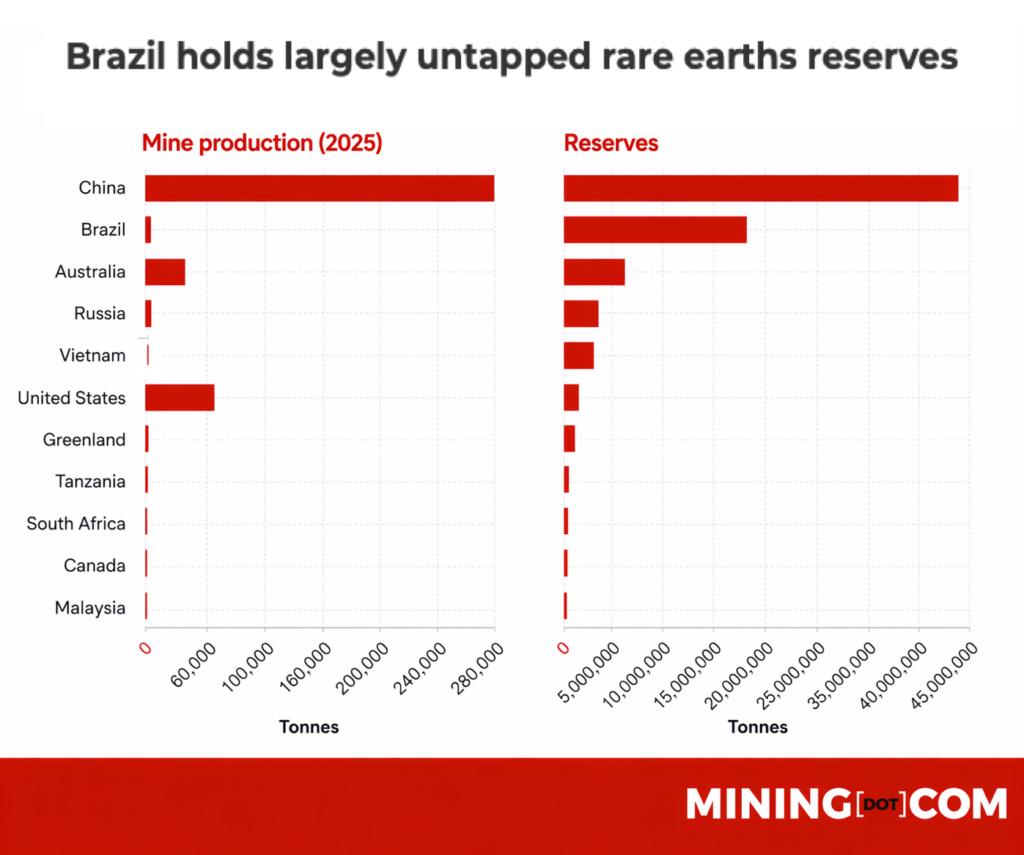
Brazil’s vast rare earth reserves make it a strategic prize as Beijing tightens export controls. President Luiz Inácio Lula da Silva has pushed for domestic processing and diversified partnerships, including recent agreements with India, while resisting pressure to simply export raw materials.
Domestic processing is increasingly driven by project economics rather than policy alone, particularly in rare earths and lithium where pre-processing is often necessary, though it raises capital costs and execution risks for investors, Nogueira said.
Building a competitive rare earths value chain will likely require partnerships with the US to access advanced processing technology and innovation, as Brazil faces steep technical barriers to matching China’s capabilities, Juan Ignacio Guzman, head of GEM consulting said.
Incentives rather than export restrictions are the more effective path to building domestic processing, while proposals such as export taxes or state intervention risk undermining competitiveness, Trindade said. He added that current geopolitics could favour Brazil as a neutral investment destination if policy clarity improves.
Debate over a potential state-backed entity, often dubbed “TerraBras” (Terra= land or earth in Portuguese and Bras= shorthand for Brazil), has added to regulatory uncertainty, even as authorities insist no such plan is under consideration. Instead, officials say the focus remains on attracting private investment and expanding refining capacity.
Geopolitical competition is likely to steer Brazil toward a flexible framework that avoids choosing between the US and China, preserving access to Chinese processing while encouraging Western investment and technology partnerships, Nogueira said.
Advisory firm Speyside Group points to Brazil’s combination of mineral diversity and relatively clean energy as a competitive advantage, but warns that fragmented policy, weak implementation and misalignment with global ESG standards could delay projects and raise costs.
With 13 bills related to critical minerals under review, according to the National Mining Agency (ANM), analysts say legislative gridlock is already weighing on investment decisions and delaying partnerships. Without a unified strategy, experts say Brazil risks missing a window to align foreign interest with its industrial ambitions as demand for critical minerals accelerates.