

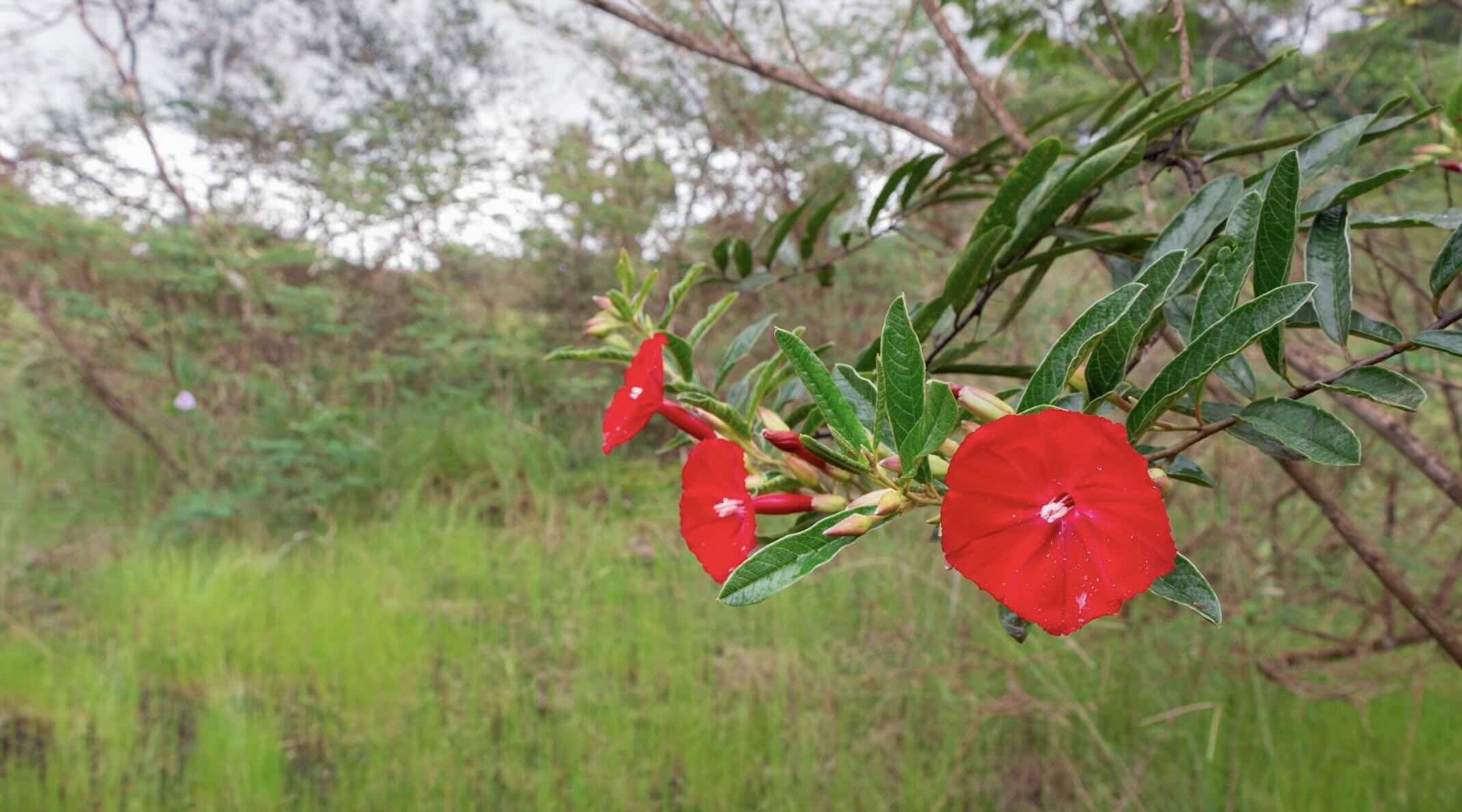
In Brazil’s eastern Amazon, a bright red flower found nowhere else on Earth is threatened with extinction from expanding iron ore mining, scientists warn.
The flowering plant, Ipomoea cavalcantei, known locally as flor-de-Carajás, only grows in cangas, an island-like ecosystem of metal-rich rocky soils and shallow vegetation in the middle of dense rainforest. There are only five patches of this unique habitat in the world, all of them in Brazil.
“You’re walking through a forest, and suddenly you step into this environment where the ground is basically iron, and you’re quite literally stepping on iron,” Rita Portela, a biologist who studies the biodiversity of the Carajás region of southern Pará state, told Mongabay by phone. “It’s a very beautiful flower … it really stands out, because there aren’t many flowers with such an intense color in the cangas.”
The canga soils where the plant grows sit atop some of the highest-grade iron ore deposits in the world. The ore extracted here is so rich in iron that it’s blended with lower-grade ore from other parts of Brazil to meet industrial standards.
Two of the five patches are protected as part of Carajás National Forest. Another two are mining sites for Brazilian mining giant Vale. In September 2025, Vale obtained the license to begin mining on the fifth patch of canga. The company, the world’s biggest iron ore producer, plans to begin operations in the second half of 2026, which means three of the world’s five cangas will be mining sites.
The first mine has already been in operation for 40 years, before any biodiversity surveys could be carried out.
Portela said an estimated 25% of the cangas have been destroyed by mining so far, not including the upcoming third location.
The flor-de-Carajás has become a symbol of the Carajás region for its vivid red color. Another 37 plants are also endemic to the habitat, four of which — including flor-de-Carajás — are classified as endangered by the National Center for Flora Conservation.
The other three endangered species are Paspalum carajasense, a grassy plant with small white or purple flowers at its tip; Carajasia cangae; and Parapiqueria cavalcantei.
Most other canga plants are small and delicate, relying on wind pollination. But flor-de-Carajás is largely pollinated by bees and hummingbirds, an interaction still being studied by researchers.
Vale has funded conservation research in the region as a part of its legal obligations, and also carefully removes any endemic vegetation from the mining site. The company also funds restoration research, but Portela said the loss of natural range is largely irreversible.
“It’s a species that only occurs in this environment, there is no other natural environment where it grows,” she said. “If they mined all five areas, the species would become extinct in the wild.”
A red flower found nowhere else loses ground as mining expands in Brazil’s Amazon