

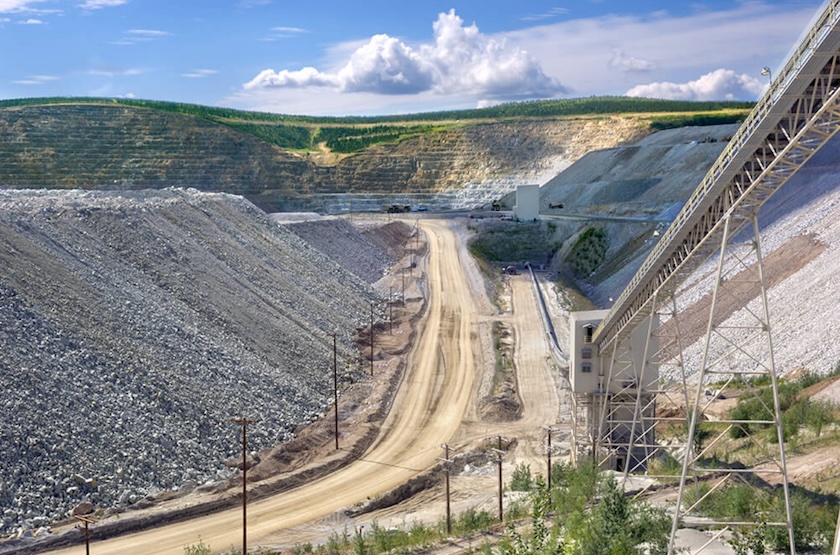
Mining, long a part of state history, is now a $4 billion-a-year industry in Alaska, with export value rivaling that of seafood, a state analysis shows.
Metals mining has a prominent place in Alaska history. Today, it remains a prominent economic driver in the state.
Over the past decade, the metals mining sector has made up 3% to 4% of Alaska’s gross domestic product, and those mined metals rival Alaska seafood as top exports from the state, according to a state Department of Labor and Workforce Development analysis.
Metals such as zinc produced at the Red Dog mine in Northwest Alaska, silver produced by the Greens Creek Mine in Southeast Alaska and gold, lead and copper produced by various mines, now support an industry worth close to $3 billion a year, according to the analysis, published in the current issue of Alaska Economic Trends, the department’s monthly research magazine.
Alaska has six major metals mines, three of which produce more than one type of metal, and hundreds of small placer operations.
Among the mined products coming from Alaska is germanium, a byproduct of zinc that is classified as a critical mineral and used in electronics. In 2024, the Red Dog mine produced about 10 tons of germanium, according to the analysis, making it a critical source to the nation because China cut off deliveries of its germanium. That year, the Red Dog mine was the only U.S. mine producing germanium, though prior to 2023, a Tennessee mine was also producing the mineral, said Karinne Wiebold, the state economist who wrote the Alaska Economic Trends report.
The value of Alaska’s mining sector, including coal, gravel and sand as well as metals, actually peaked in 2011 at nearly $3.5 million and close to 5% of the state’s gross domestic product. That peak reflected extremely high metals prices and the startup of the Kensington gold mine in Southeast Alaska.
Still, mining has been a strong economic factor in Alaska for the last two decades, after jumping in value in 2006. Every year since then, its total value to the state has generally been above $2 billion and usually accounted for 3% to 4% of Alaska’s gross domestic product.
Metals mining has also become a big employment driver as well, according to the analysis.
There were 3,533 metal mining and support jobs in Alaska in 2024, the most recent data available, and jobs in the sector grew by 37% over the past decade, compared to an overall state job growth rate of 0.3%, Wiebold’s analysis said.
The average metal mining job paid $135,000 in 2024, well above the state average of $71,000 that year and second only to the average pay for workers in the oil and gas sector, the analysis said.
But a large percentage of mine workers are not Alaska residents. Wiebold’s analysis puts resident hire at 56%. That puts the non-resident hire percentage in the metals mining sector well above the state average.
In 2024, the most recent year for which data is available, 22.9% of workers in the state were not Alaska residents, according to an annual report published by the Department of Labor and Workforce Development. That is the highest percentage since such records began in state average, which is the highest percentage since records started in the 1990s.
Wiebold noted that the nonresident hire in the mining sector is about the same as that in the oil and gas sector, which in 2024 was 40.5%, according to the state’s report.
Mining and oil and gas work in Alaska is conducive to nonresident employees because it is generally conducted at remote locations, typically with rotating schedules of two weeks on and two weeks off, she said.
“This combo means most folks don’t live near the mine and have to commute and stay at the worksite, and that there is not a significant time/cost/commute savings for living in the state,” she said by email. “As a result, miners from out of state can work in Alaska and live somewhere less expensive or more appealing to them.”
Another reason for the high percentage of nonresidents lies in Alaska’s demographics, she said. “In the last several years, with Alaska’s working age population fairly stagnant after a decade of significant declines, more jobs are being held by out of state workers,” she said.
The sector is poised for future growth, with projects like the Donlin gold mine in Southwestern Alaska, the Graphite One graphite mine in Northwestern Alaska and, potentially, the commercialization of the copper-rich but isolated Ambler Mining District in Northwestern Alaska.
But none of those proposed mines can be expected to be developed quickly, and development itself is uncertain, Wiebold’s article said.
“Mines take years to come to fruition — exploration, feasibility studies, environmental reviews, and permitting are expensive, and all have the potential to derail a project. Public concerns and controversy can also slow or stop development,” the article said.