

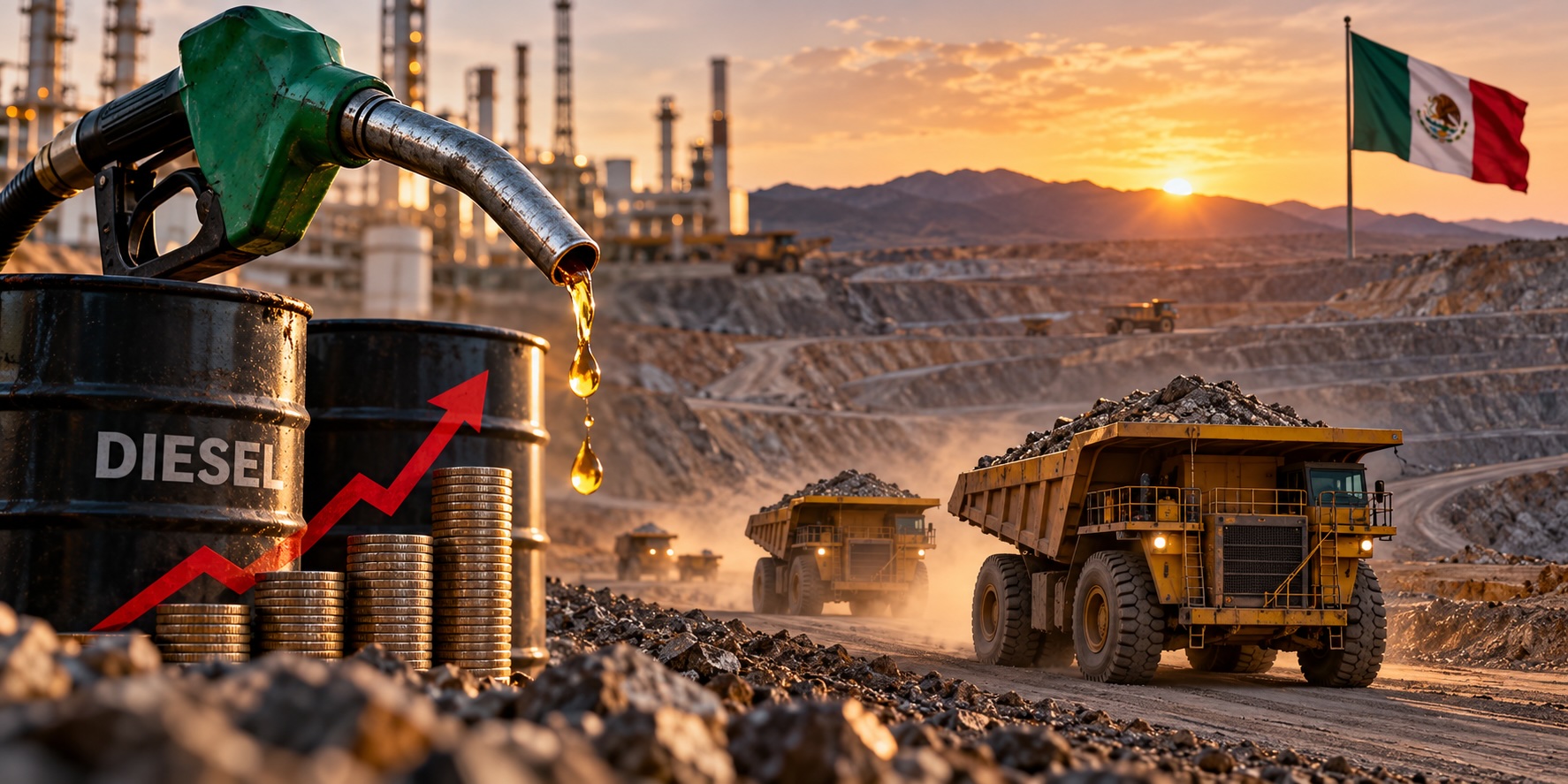
Global diesel price volatility and refining bottlenecks are increasing production costs across mining operations in Mexico, testing margins as energy inputs outpace commodity price gains. This cost environment influences capital allocation and operational planning for major producers, accelerating operational adjustments and long-term decarbonization strategies.
Escalating diesel costs are increasing cash operating expenses for mining companies operating in Mexico and Latin America, narrowing profit margins despite robust base and precious metal prices. Energy inputs represent a significant variable expense in open-pit and underground extraction, directly impacting haulage fleets, crushing circuits, and remote generation.
Analysts at TD Cowen estimate an average 15% year-on-year increase in All-In Sustaining Costs (AISC) alongside a 22% increase in all-in expenditure across global mining assets.
Global middle-distillate supply constraints stem from refinery capacity limitations, regional geopolitical friction, and shifts in global crude processing. Disrupted marine transit through maritime chokepoints and lower runs of medium-sour crude have reduced global diesel production relative to demand.
In Mexico, the impact is intensified by structural energy balances. The country relies on the United States for a substantial portion of its refined fuels, writes Stream Energy’s Patricio de la Garza on Mexico Business News. Ultra-low sulfur diesel (ULSD) crack spreads touched US$108 per barrel during peak volatility periods, putting direct pressure on local domestic fuel distribution costs.
To buffer local wholesale fuel consumers, the Ministry of Finance (SHCP) deployed fiscal instruments, including a zero-rate Special Tax on Production and Services (IEPS) on diesel alongside complementary fiscal stimuli. However, with these domestic fiscal buffers largely exhausted to keep domestic fuel prices stable, industrial operators remain exposed to international import parity pricing.
Impact on Mexico-Based Operators and Cash Costs
Fuel constitutes between 10% and 25% of site-level operating expenses in mining, primarily consumed by diesel-electric haul trucks, ancillary heavy machinery, and secondary logistics. Recent corporate disclosures demonstrate how energy inflation influences operating balance sheets.
For example, in its operational filings, Capstone Copper reported a 15% year-on-year increase in consolidated second-quarter cash costs to US$2.82 per pound. At specific extraction units, higher diesel consumption and mining costs accounted for up to US$0.34 per pound of cost expansion. In Mexico, Capstone operates the Cozamin copper-silver underground mine in Zacatecas, where cost management relies heavily on grade consistency and logistical efficiency.
Despite broad-based energy cost pressures, Grupo México reported a 56% surge in third-quarter net profit to US$2 billion, supported by elevated realized copper sales and multi-metal integration that buffered fuel line-item increases, reports Mexico Business News.
While transitioning heavy equipment away from diesel remains a priority, the required electrification introduces secondary structural challenges for mining infrastructure in northern Mexico. On base metals and power grids, the rapid expansion of AI infrastructure and industrial data centers is placing unprecedented pressure on electrical transmission capacity, reports Mexico Business News. For remote mining hubs, replacing diesel generators with grid connections or dedicated renewable capacity requires heavy front-end capital investments, regulatory approvals from the Energy Regulatory Commission (CRE), and extended interconnection timelines, complicating swift decarbonization schedules
Sector Competitiveness and Regulatory Factors
The rise in fuel input costs coincides with broader policy and operational considerations for the Mexican mining sector. According to CAMIMEX, the mining industry possesses the capacity to generate US$43 billion in investment and 500,000 direct and indirect jobs over a six-year horizon, provided regulatory clarity and fiscal competitiveness remain stable, reports Mexico Business News.
Operating margins determine the economic cut-off grades of active deposits. When diesel expenses rise, operators often adjust mine planning models. Some strategies include:
- Cut-Off Grade Adjustments: Higher haulage costs elevate the grade threshold required to process marginal ore, potentially reducing mine life if lower-grade zones become uneconomic to haul.
- Capital Deferral: Discretionary sustaining capital expenditures and greenfield exploration programs face revision as cash is diverted toward fixed energy inputs.
- Supply Chain Consolidation: Companies operating in remote regions such as Sonora, Zacatecas, Durango, and Chihuahua are renegotiating bulk fuel delivery terms and on-site terminal storage agreements to protect against spot-price volatility.
Strategic Transitions in Mine Haulage
Cost volatility in middle distillates is accelerating evaluations of fleet electrification and trolley-assist infrastructure across North American operations.
Persistent petroleum distribution vulnerabilities provide an economic incentive for heavy transport electrification and fuel substitution, reports Mexico Business News. In open-pit extraction, electric drive trucks paired with overhead catenary lines decrease diesel consumption during uphill loaded haulage, which accounts for the majority of a truck’s hourly fuel burn.
For Mexican operations, long-term hedging against diesel price volatility will depend on the expansion of clean industrial power contracts, on-site solar generation, and the introduction of battery-electric haulage systems as equipment replacement cycles mature.
Under elevated fuel expenses, the presence of precious metal by-products has become a primary operational cushion for base-metal operations across Zacatecas, Sonora, and Chihuahua. Polymetallic mines generating meaningful gold and silver streams have managed to neutralize rising C1 cash costs through favorable by-product credits. In contrast, pure copper or zinc extractors face direct margin compression when secondary credits are unavailable, reports MINING.COM, compelling operators to optimize flotation recovery circuits and reconfigure processing plants to maximize every recoverable ounce of associated precious metals.
Upcoming fourth-quarter and full-year earnings reports will provide detailed metrics on whether cost-containment measures offset energy inflation across Mexican operations. While elevated metal prices continue to support corporate revenue, the persistence of refined distillate premiums highlights energy efficiency as a key determinant of operational competitiveness in Mexican mining.
By – https://mexicobusiness.news/mining/news/diesel-price-volatility-squeezes-mining-margins-mexico