

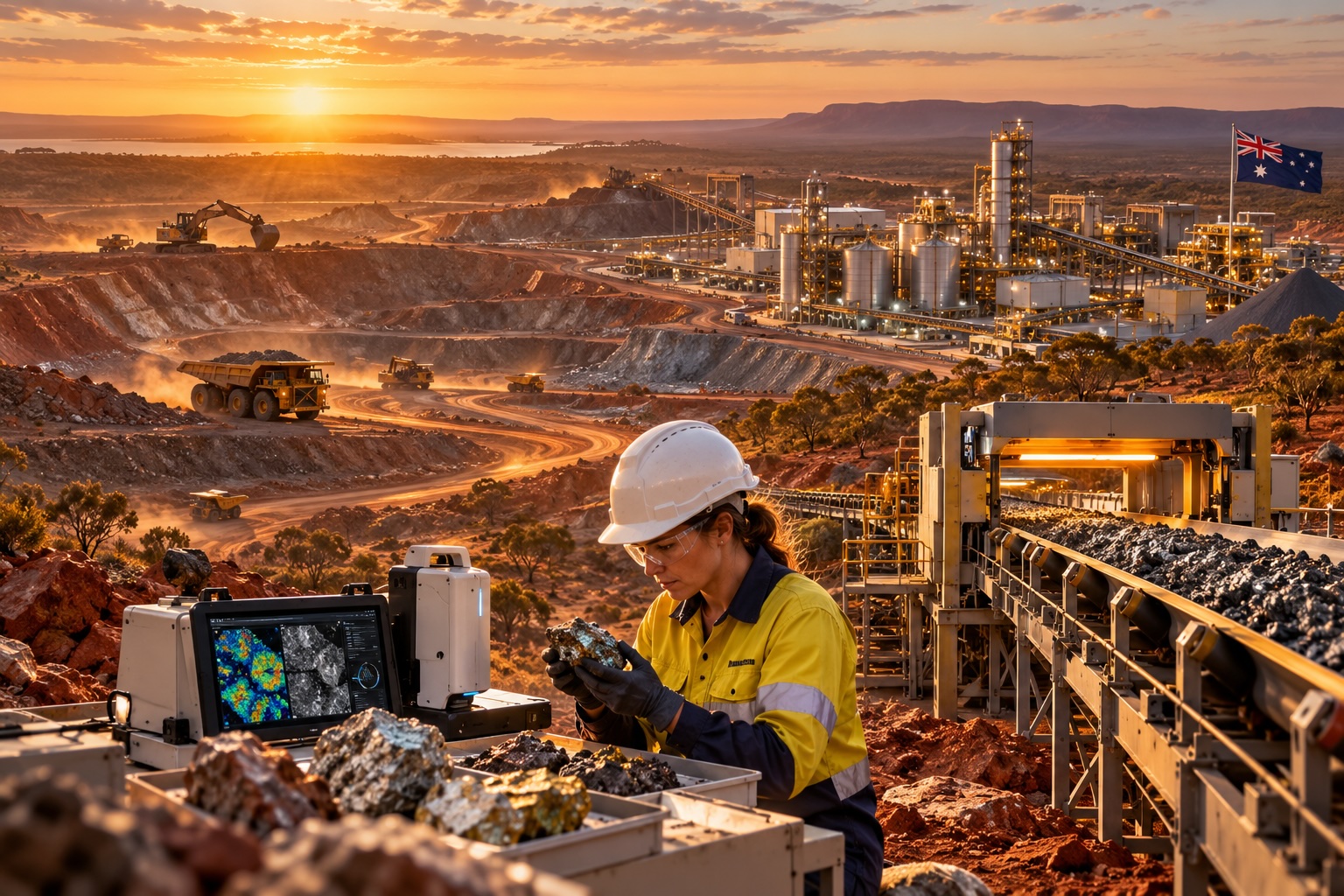
The latest Australian Critical Minerals Prospectus, launched by Resources Minister Madeleine King at the International Mining and Resources Conference (IMARC) in Sydney, includes 58 upstream mining projects and 36 midstream processing and refining projects across 72 companies.
The government also released an updated Critical Minerals Strategy, reinforcing its ambition to strengthen Australia’s position in global supply chains and capture more of the economic benefits of its mineral wealth.
The announcement comes as demand for critical minerals used in electric vehicles, renewable energy, advanced manufacturing and defence continues to drive investment in new supply sources.
However, developing new mines is expensive and time-consuming, while existing operations face rising costs, declining ore grades and growing pressure to reduce their environmental footprint.
Australian technology companies are developing solutions that could help miners extract more value from existing deposits, recover minerals previously considered uneconomic and process more material domestically.
Chrysos: Australian science goes global
A prime Australian example of mining technology commercialisation is ASX-listed Chrysos Corporation (ASX:C79) , which is transforming the way gold miners determine the value of the rock they extract.
Its PhotonAssay technology, originally developed by the CSIRO, uses high-energy X-rays to measure gold concentrations in mineral samples in minutes.
The technology provides a faster, non-destructive alternative to traditional fire assay, a centuries-old process involving high temperatures, lead and other hazardous materials.
For miners, reliable assay results are essential to determining where to mine, what material to process and how efficiently an operation is performing.
Faster information can help companies make more timely operational decisions, improve productivity and better understand the value of their mineral resources.
Chrysos has built an international business around the technology, deploying PhotonAssay units at mining operations and commercial laboratories around the world.
In FY26, the company reported revenue of $88.1 million, up 33%, and EBITDA of $27.2m, up 68%, as demand for its technology continued to grow.
The company processed a record 11.3 million samples during the year, a 67% increase, while its contracted PhotonAssay fleet reached 87 units following four additional agreements signed after year-end.
Its commercial success also demonstrates the importance of turning Australian scientific discoveries into viable businesses.
Resources advisory and investment group RFC Ambrian partnered with CSIRO to establish Chrysos in 2016, helping develop the business model, attract early investors, establish manufacturing arrangements and secure its first customers.
NextOre: Finding value in rock once thrown away
If Chrysos is helping miners understand the value of ore samples, another CSIRO spinout and RFC portfolio company, NextOre, is tackling a different challenge: identifying valuable minerals in the enormous volumes of rock travelling through a mine.
NextOre has developed Magnetic Resonance technology based on the same underlying scientific principles as medical MRI.
Installed around conveyor belts, its sensing systems measure mineral content in real time, allowing miners to distinguish valuable ore from waste before the material reaches the processing plant.
This creates opportunities to improve the economics of existing operations. Mining companies can avoid spending money crushing, grinding and processing material containing little economic value, while directing resources towards higher-grade ore.
The potential benefits include lower energy and water consumption, reduced tailings and increased processing capacity.
This technology could also change the economics of marginal mineral deposits. Material previously considered too low-grade to justify processing may become more attractive if miners can identify and concentrate its valuable components before incurring the full cost of treatment.
That raises the possibility of recovering additional value from existing mines, low-grade stockpiles and, where conditions permit, deposits associated with operations that have been mothballed because they are no longer economically viable.
The opportunities are particularly relevant as Australia looks to develop more critical minerals projects, many of which face challenging processing economics.
NextOre’s technology has been deployed at major mining operations in Chile and Zambia, while research is advancing into applications involving lithium-bearing minerals.
The company was established in 2017 through another collaboration involving CSIRO and RFC Ambrian and is now part of MagnaTerra Technologies.
RFC Ambrian executive chairman Rob Adamson says the commercialisation of such technologies requires a combination of world-class science, practical mining expertise and a business model capable of delivering measurable economic benefits.
Iluka: Turning rare earths into higher-value products
Further along the minerals value chain, ASX-listed Iluka Resources (ASX:ILU) is developing the domestic processing capacity that sits at the centre of the government’s critical minerals strategy.
Iluka is constructing a rare earths refinery at Eneabba in Western Australia, designed to produce separated rare earth oxides for use in technologies including electric vehicles, wind turbines and advanced defence systems.
The refinery will process rare earth-bearing material from Iluka’s own operations and third-party suppliers, creating an Australian processing pathway for minerals that might otherwise be exported for refining overseas.
It is backed by a $1.65 billion non-recourse loan from the Australian Government through Export Finance Australia.
In its August 2026 half-year results, Iluka reported that construction was approximately 60% complete and progressing on schedule, with commissioning targeted for 2027.
The refinery is designed to produce up to 23,000t of rare earth oxides annually, depending on feedstock, including strategically important magnet rare earths such as neodymium, praseodymium, dysprosium and terbium.
The project was specifically highlighted by Minister King in this week’s updated Critical Minerals Strategy announcement as an example of government support helping advance strategically significant developments.
By – https://www.theaustralian.com.au/business/stockhead/content/critical-minerals-push-puts-mining-tech-in-spotlight/news-story/359bf0c7f9dddbce614f569c98ecf5f1