

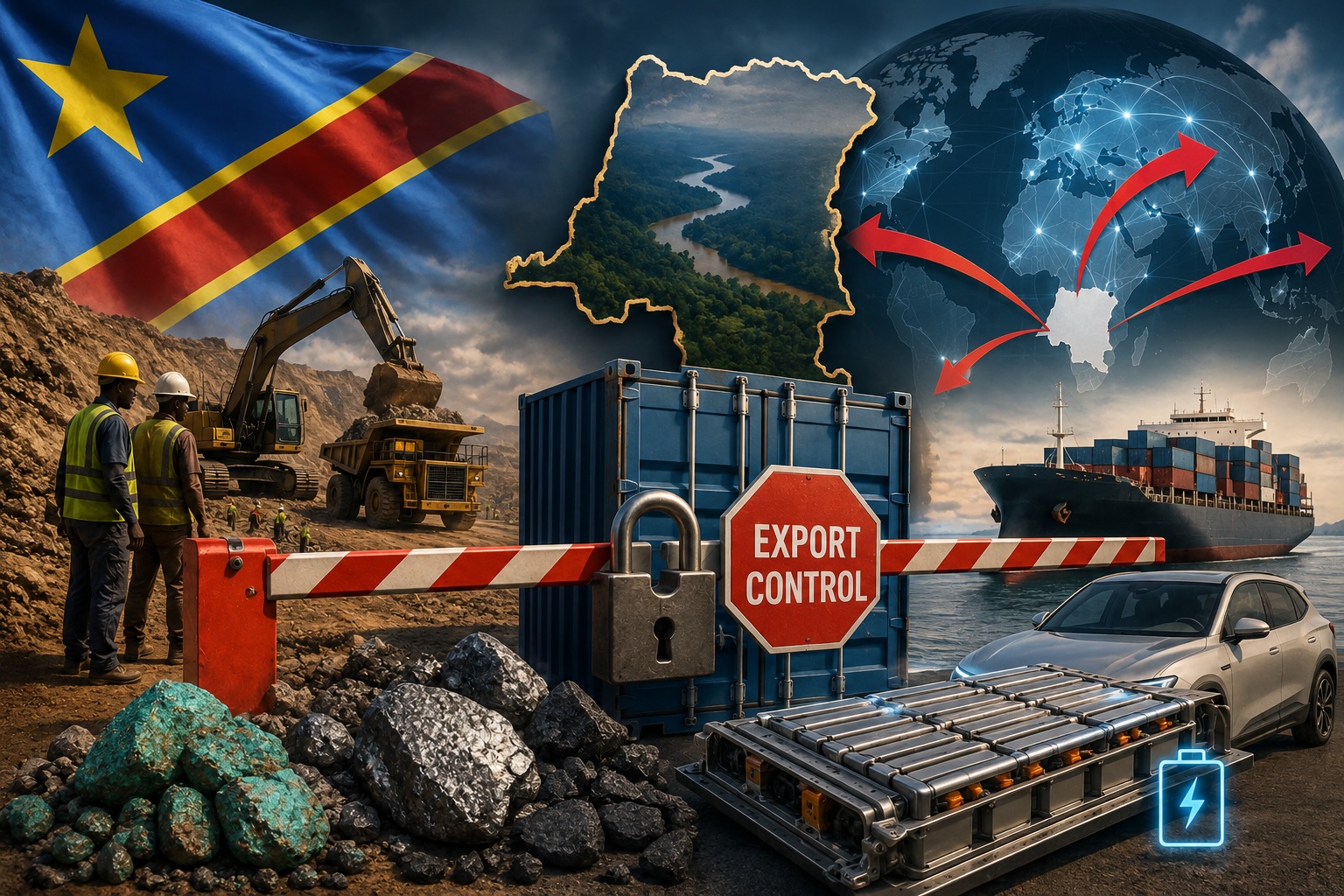
Even as the International Monetary Fund warns of a global demand slowdown for critical minerals due to geopolitical shocks in the Middle East, the Democratic Republic of Congo is projecting confidence. For a country so deeply embedded in global commodity cycles, this calm not driven by complacency, but by strategy, which has put Kinshasa at the driver’s seat in the global race for securing critical minerals supply.
At the centre of this confidence lies cobalt and the Congolese strategy to move up the value chain. The DRC accounts for roughly 80% of global cobalt production, making it the single most important node in the metals supply chain, which are essential for world’s battery production.
In practical terms, mining policy decisions made in Kinshasa now reverberate through global manufacturing lines in Shanghai, Stuttgart, and Silicon Valley. That interdependence also runs in reverse, especially in the context of the ongoing war in Iran and related geopolitical shocks.
IMF has recently predicted a potential negative effect on demand for critical minerals from the global slowdown after the Iran war, but concerns that a global demand slowdown could undermine country’s cobalt exports have been largely dismissed in Kinshasa.
That is because the Congolese policymakers are betting on their strategy to isolate the DRC’s critical minerals sector from global volatility while simultaneously strengthening their leverage over pricing and supply. This wager is already beginning to pay off.
Cobalt quotas
Over the last few years, Kinshasa has made a suite of policy interventions related to the control of cobalt exports, which collectively mark a departure from the DRC’s historical role as a passive exporter of critical minerals.
The most significant of these is the cobalt quota system, introduced following a temporary export ban aimed at addressing a global oversupply that had pushed prices sharply downward from 2022 levels.
Implemented through the country’s mining regulator, ARECOMS, the policy replaced open-ended exports with controlled allocations to producers. The objective, according to officials, was not speculative price manipulation but market stabilization. Kinshasa wanted to prevent excess supply from eroding long-term investment viability related to the DRC’s mineral wealth.
The results speak for themselves. Cobalt prices have risen from approximately $21,000 per tonne in early 2025 to just over $56,000 today. At the same time, Congolese authorities project fiscal revenues of around $2.3 billion this year under the quota system, compared to an estimated $617 million in a no-intervention scenario.
Within a single year, the DRC has moved from price volatility exposure to becoming a price-setting actor. The Congolese government and ARECOMS reportedly acted on advice from Vectus Global, a firm related to the U.S. businessman Erik Prince, which has been working with the government to strengthen its export controls and improve its revenue collection since the end of 2024.
Strategic reserves
This transformation is being reinforced by a second, more strategic layer of policy: the creation of critical mineral reserves in the DRC.
In April, Kinshasa has announced plans to establish strategic stockpiles of cobalt, coltan, and germanium – all essential not only to consumer electronics and EV batteries, but also to semiconductors, fiber optics, infrared systems, and defense technologies.
In practical terms, this reserve will be built through the buyback of part of the stock held by mining companies operating in the country.
By introducing state-controlled buffers into the supply chain, Kinshasa is gaining a mechanism to influence both timing and pricing of exports. This strategy is similar to the stockpiling approaches already pursued by other critical minerals players.
For example, over the past ten years, China accumulated significant cobalt reserves with an impact on global markets as part of stockpiling strategy. The U.S. has also announced plans for a multi-billion-dollar critical minerals stockpile, Project Vault, while European economies are considering similar mechanisms.
Moving up the value chain
In this context, the DRC’s policy shift represents more than domestic resource management. It is an alignment with the emerging geopolitical logic of strategic resource management.
By regaining control over exports and stockpiles, Kinshasa is also seeking to rebalance the asymmetric relationship, primarily, with Beijing, whose strategy is responsible for pushing prices downward. Between 2018 and 2025, cobalt fell from a historic peak of nearly $95,000 per ton to $21,000 before the Congolese restrictions.
Kinshasa also expects this strategy to strengthen revenue collection and create a more predictable investment environment for attracting investors who are looking for confidence in price stability.
And a range of players are positioning to enter or expand in the DRC as a result of the new strategy. Established producers such as Glencore and CMOC still remain key, but new entrants are attracted by improved transparency, market discipline and long-term strategy.
Virtus Minerals’ acquisition of Chemaf is the latest example of such trend and reflects the type of investment partnership Kinshasa is seeking to promote under its new strategic vision. The DRC is no longer simply looking for investors focused on resource extraction and short-term returns, but for credible long-term partners aligned with the country’s broader economic and industrial ambitions.
In the global competition for critical minerals, the real shift may not be that Western and Chinese interests are competing more intensely in the DRC and Africa. It is that Kinshasa itself is increasingly setting the terms of that competition.
By – https://oilprice.com/Energy/Energy-General/DRCs-Export-Controls-Are-Reshaping-the-Battery-Metals-Market.html