

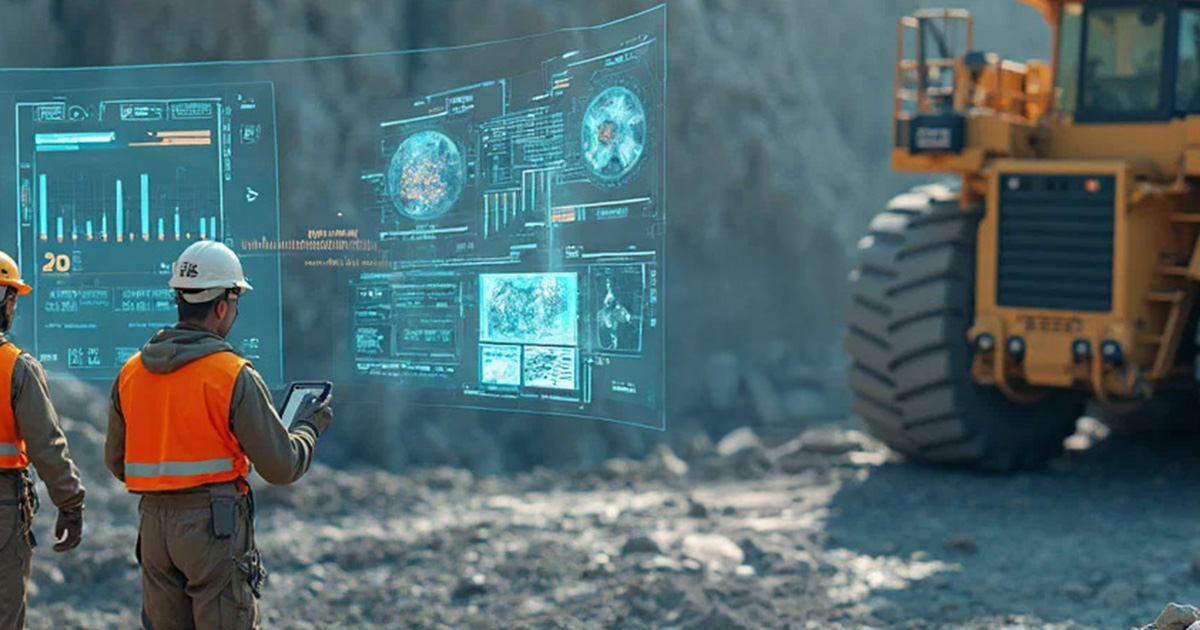
Alastair Bovim, CEO and co-founder of Insight Terra, a data and AI-driven environmental risk platform, says that disaster prevention in mining depends on recognizing, understanding, and responding to risks as they accumulate, not only when they escalate.
In February 2025, the equivalent of 400 Olympic-sized swimming pools of toxic waste contaminated the ecosystem surrounding the Sino Metals mine in Kitwe, Zambia. Beyond the long-term human and environmental cost, the disaster sharpened focus on a truth our industry must confront: when early warning signs go undetected, small problems accumulate quietly until they culminate in catastrophic failure.
AI as a force-multiplier for engineers
Artificial Intelligence (AI) is increasingly promoted as a solution for mining safety and sustainability. When used for the tasks humans cannot do continuously, AI is a force multiplier for engineers and frontline teams.
These tasks are often referred to as the 4Ds of AI:
- Dangerous – Reducing exposure to unstable dam crests or chemically contaminated water.
- Dull – Automating repetitive, error-prone activities such as manual log checks.
- Dirty – Monitoring hazardous materials like toxic slurries or acid mine drainage.
- Difficult – Converting fragmented, high-volume datasets into early warning signals.
Making best-practice prevention achievable at scale, for example, daily water balance monitoring and predictive stability analysis, adds the 5th D of AI: Dynamic. “By making prevention dynamic, AI ensures that human expertise is applied where it matters most: interpreting risks, engaging communities, and taking action,” Bovim explains.
Lessons from IMWA 2025: Failures are multi-factor
At this year’s International Mine Water Association (IMWA) Congress, case studies reinforced that tailings failures rarely stem from a single cause. Hydrological stress, seismic events, poor water balance, and inadequate instrumentation often interact in ways that slowly degrade system stability.
“One factor is seldom responsible for bringing down a dam,” says Bovim. “It’s the unnoticed, often small anomalies across systems that accumulate until the weakest link gives way.” This validates the need for quantitative failure analysis, where continuous streams of data from multiple instruments are integrated, validated, and monitored for weak signals that could converge into a failure pathway. Sporadic audits or annual reviews cannot substitute for continuous assurance.
Virtual twins and continuous assurance
Another key theme at IMWA was the rise of virtual twins: living, data-driven replicas of critical assets such as tailings storage facilities. Unlike static models, these twins ingest satellite imagery, ground sensors, telemetry, and historical data to continuously update stability indices, pore-pressure models, and deformation maps.
Every reading, calculation, and alert is logged, auditable, and reproducible. “This transforms monitoring from a compliance exercise into a defensible process that regulators, engineers, and communities can trust. Our platform is guided by the principle that engineers must be able to look under the bonnet and interrogate the data,” Bovim says.
In practice, this means rainfall forecasts combined with ground sensors can trigger pre-emptive pumping days before a flood, or subtle deformation patterns – otherwise lost in noisy data – can be surfaced and routed to the right engineer with a transparent action plan.
The price of resilience
Global frameworks such as the Global Industry Standard on Tailings Management (GISTM) are raising expectations, but implementation remains uneven.
Some operators still meet only the lowest local legal bar, rather than the higher global thresholds. That misalignment leaves communities exposed and undermines trust. The Kitwe disaster is a stark reminder that prevention is not only possible but essential. Real-time, auditable monitoring of tailings facilities should not be left to voluntary adoption; it must be mandated and enforced.
“Investment in continuous monitoring, high-quality data systems, and engineer-centric AI is no longer optional; it is the price of resilience,” Bovim concludes.