

At least 60 percent of the drinking water produced in the French island territory of Guadeloupe never reaches homes.
Leaks and faulty infrastructure are contributing to a years-long water crisis, during which roughly one-fifth of the island’s 370,000 residents have been forced to receive potable water from community-designated wells.
Now, hundreds of people are organizing a class-action lawsuit against the government, arguing that their lives are being put at risk by water insecurity.
At the current pace, updating water delivery systems will take more than 200 years to complete. As a result, homeowners and businesses are increasingly turning to a water delivery black market, paying more than 30 times the normal utility rate for water tank installations and refills, France24 reports.
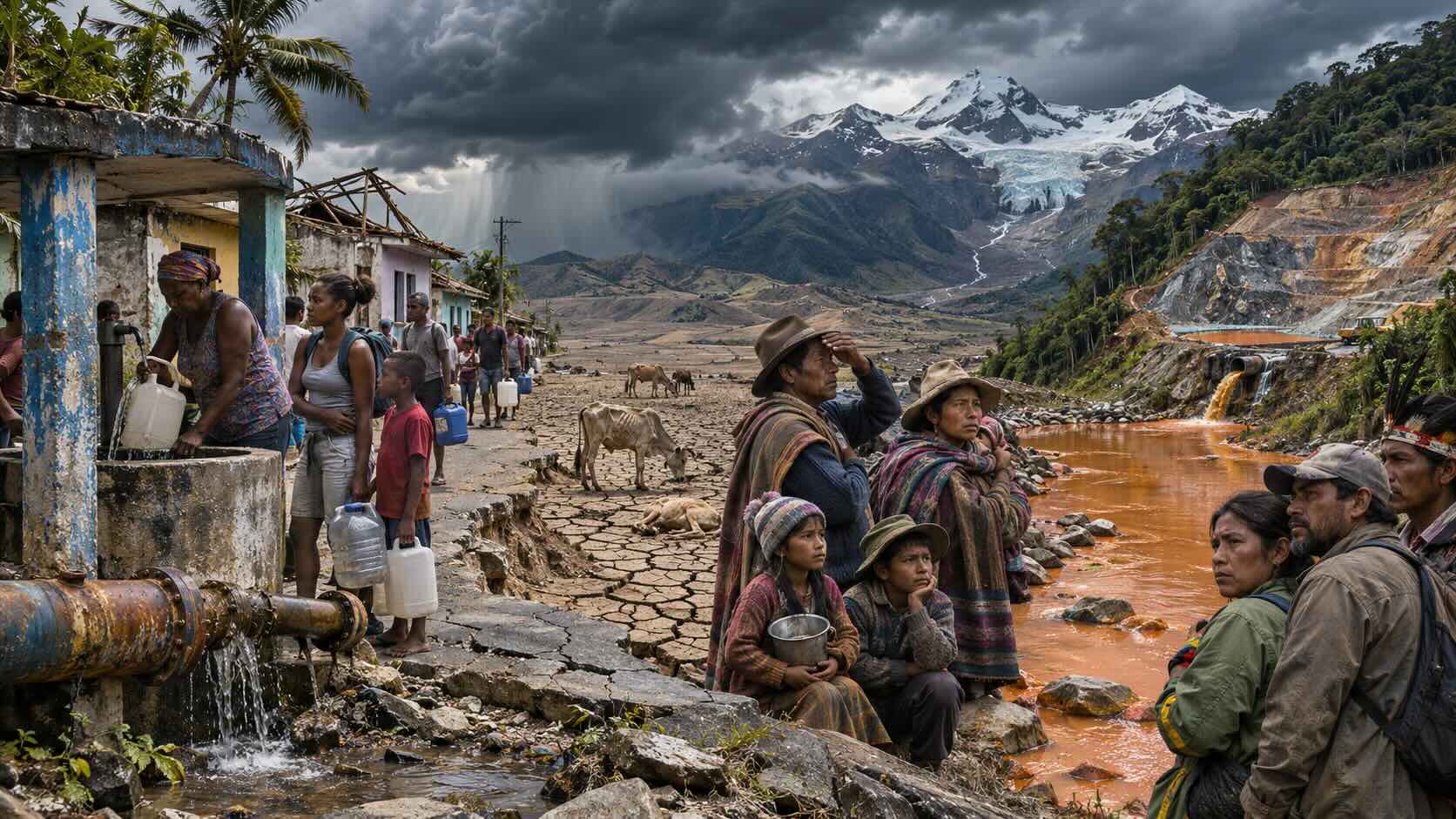
With El Niño weather conditions threatening both severe drought and flooding across Bolivia, the country’s leadership has declared a nationwide state of emergency to release the funding and resources needed to respond, Al Jazeera reports.
Already, some 78,000 families across a majority of Bolivia’s departments are affected this month by drought. Roughly 75,000 cattle have died. Meanwhile, officials fear upcoming erratic rainfall could also spur floods, such as those that killed dozens of people last December in the Santa Cruz region.
Precipitation extremes are also afflicting Bolivia’s neighbors. A series of El Niño-fueled wildfires burned thousands of hectares of forest last month in Peru, while Chile’s capital Santiago recorded its rainiest October on record.
Representatives from six Latin American countries testified last week before the Inter-American Commission on Human Rights, alleging that mines controlled by Canadian companies are poisoning local water supplies, Mongabay reports.
Testimonies from communities in Ecuador, Mexico, Panama, Dominican Republic, Colombia, and Argentina collectively warned that the health of biodiverse habitat, humans, and freshwater systems serving millions of people are under threat from local policies that welcome polluting foreign industries. Compounding these human rights violations, witnesses said, are the sometimes grave consequences of fighting back; the region is historically the deadliest place in the world for environmental defenders. Last year, Colombia led all countries with 39 activist murders, followed by Brazil (26) and Honduras (12).
The allegations come just four months after Canada — home to roughly half of the world’s publicly listed mining companies — shockingly voted to eliminate its Office of the Canadian Ombudsperson for Responsible Enterprise (CORE), which was created to oversee and investigate companies that operate abroad.
The decision was immediately and widely rebuked by human rights and environmental organizations.
“Dismantling the CORE, instead of improving it, undermines Canada’s commitments to human dignity, international human rights, and environmental protections,” read a statement from the Ottawa-based Office of Religious Congregations for Integral Ecology. “We know that often those most impacted by these violations are Indigenous communities, calling into question Canada’s responsibility to uphold the rights of Indigenous peoples and the principles of the United Nations Declaration on the Rights of Indigenous Peoples.”
The representatives hope that their comments will pressure Canada to adopt stronger human rights and environmental standards for mining abroad.
A new report warns that Earth’s cryosphere — fresh waters in a solid state, such as glaciers, snow, and permafrost — will experience irreversible harm when temperatures inevitably exceed, even temporarily, the 1.5°C warming target established by the Paris Climate Agreement.
One of the most urgent downstream consequences of the melting cryospheric will be water insecurity, experts say. Mountain glaciers and snowpack currently provide more than two billion people globally with accessible water for irrigation and drinking, earning these features the moniker “water towers of the world.” But warmer, shorter winters are slowing the accumulation of alpine ice, dramatically reducing water reserves in the long term.
According to the report, published by the United Nations-backed International Cryosphere Climate Initiative (ICCI), if current climate policies do not change and the world warms to 2.7°C, the glacier ice mass in the Rockies, Alps, Russian Arctic, Iceland, and Scandinavia would fall below 10 percent of the current mass. In the Hindu Kush Himalaya region, where one-quarter of Earth’s population lives, glacial mass would settle at 41 percent of current size. But this percentage would double if warming was limited to 1.5°C.
“When you miss an exit on the highway, you don’t abandon plans to get to where you really need to be – you take your first chance to turn back. Continuing full speed ahead just makes things worse,” Pam Pearson, the ICCI director, said in a statement. “The road back to below 1.5°C may be difficult, but science and economics both provide a roadmap to a better future.”