

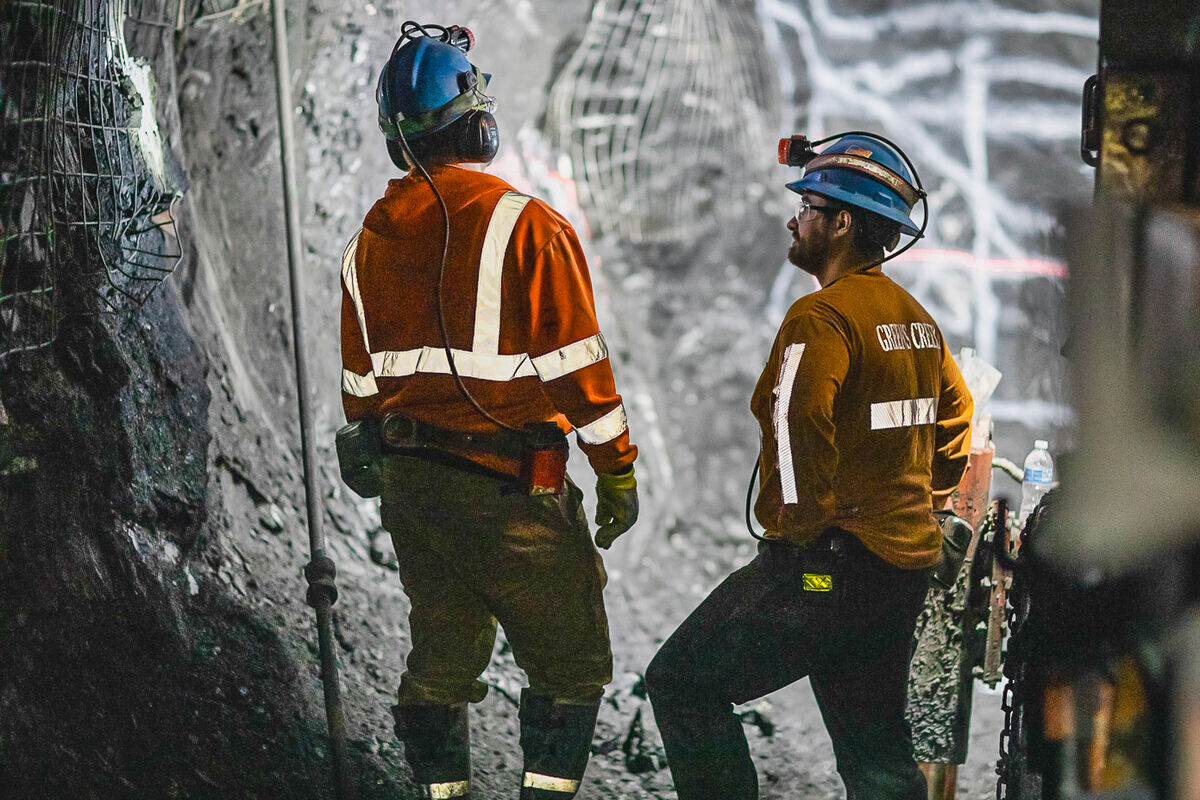
Hecla Mining Company Aug. 4 reported that the Greens Creek mine in Southeast Alaska continues to anchor the company’s current and future position as North America’s premier silver producer.
Over the first six months of 2026, Greens Creek produced 4.23 million ounces of silver – along with 31,509 oz of gold, significant quantities of zinc and lead, and a little copper.
With gold and base metals more than covering operating expenses at Greens Creek, the cost to produce each ounce of silver during the first half of this year was roughly negative $7.
As a result, during the first six months of this year, Greens Creek generated $357.7 million of free cash flow. With the Lucky Friday mine also generating strong free cash flow, Hecla entered the second half of 2026 with $483 million in cash and cash equivalents.
“We ended the (second) quarter with the strongest balance sheet in the company’s history,” said Hecla President and CEO Rob Krcmarov.
As a result of the strong performance over the first six months, Hecla now expects Greens Creek to produce more silver at a lower per-ounce cost in 2026 than was forecast at the beginning of the year.
Going into 2026, Hecla expected Greens Creek to produce between 7.5 million and 8.1 million oz of silver this year at an all-in sustaining cost of zero to 50 cents/oz. The company has now lifted that guidance to 8.1-8.3 million oz at an all-in sustaining cost of negative $3.75 to negative $4.25/oz.
With Greens Creek entering 2026 with 106.1 million oz of silver in reserves and a current tailings storage expansion project expected to support the operation to 2045, the Southeast Alaska mine is positioned to continue as a flagship of Hecla’s portfolio for years to come.
And moving forward, more value could be extracted from Greens Creek ore and tailings, thanks to two initiatives being investigated by the company.
More silver and gold
While Greens Creek is the single largest silver-producing mine in the United States, it does not currently recover all the precious and critical metals that pass through the mill.
To capture more of this value, Hecla is evaluating the potential of developing a pyrite concentrate circuit at the mill.
Under the concept being considered, the new circuit would separate pyrite-rich material into a dedicated concentrate stream that would capture additional silver and gold currently lost during processing.
Preliminary metallurgical and engineering work indicates the pyrite circuit could, at average reserve grades, add roughly 1 million-1.2 million oz of silver and 10,000-15,000 oz of gold to Greens Creek’s annual production.
In addition to improving recoveries, the circuit would reduce the amount of sulfide-bearing material reporting to tailings storage, lowering long-term management concerns.
“If successful, this project would generate an additional marketable concentrate stream, boosting overall silver and gold recoveries from the mill, while potentially reducing the mine’s reclamation liability significantly,” Hecla Vice President of Operations Brian Erickson said earlier this year.
Tailings reprocessing project
The Greens Creek Tailings Reprocessing Project, a second initiative being evaluated by the company, could further reduce tailings management liabilities and produce an even larger array of precious and critical metals.
Hecla estimates that the dry-stack tailings from roughly 36 years of mining at Greens Creek contain $6.1 billion worth of precious and critical metals.
The estimated inventory includes approximately 51 million oz of silver, 600,000 oz of gold, 310 million pounds of zinc, 205 million lb of lead, 27 million lb of copper, and 1.3 million lb of nickel.
The tailings also contain smaller quantities of arsenic, barium, bismuth, chromium, gallium, germanium, manganese, vanadium, and other critical minerals.
Hecla is working with NVRO Metals Ltd. to evaluate processing the Greens Creek tailings through a cutting-edge metals recovery technology that NVRO plans to install at a commercial hub in Australia.
“Hecla has always focused on innovative technologies and solutions to address challenges in the mining industry, and recovery of critical minerals from tailings is just the latest example of this,” Mike Satre, Hecla’s director of government affairs, told Mining News.
Hecla says that the early testing carried out by NVRO indicates the potential for a low-capital-intensity path to achieve initial cash flows from Greens Creek tailings.
In July, the two companies signed a memorandum of understanding outlining a potential campaign to process roughly 35,000 metric tons of Greens Creek tailings at the planned NVRO Metals Hub in Australia’s Northern Territory.
The proposed 35,000-metric-ton campaign contemplated by the MOU is subject to NVRO completing the acquisition and commissioning of an existing mine and processing plant about 55 miles south of Darwin, Australia. NVRO anticipates closing that acquisition in August.
If the pilot project is successful, Hecla plans to conduct a feasibility study to evaluate a larger tailings reprocessing project.
In addition to a relatively low-cost and quick means of extracting more value and critical metals from Greens Creek, the company says reprocessing all or part of the existing tailings would decrease the space needed for storage and help lower the Southeast Alaska mine’s long-term reclamation liability.