

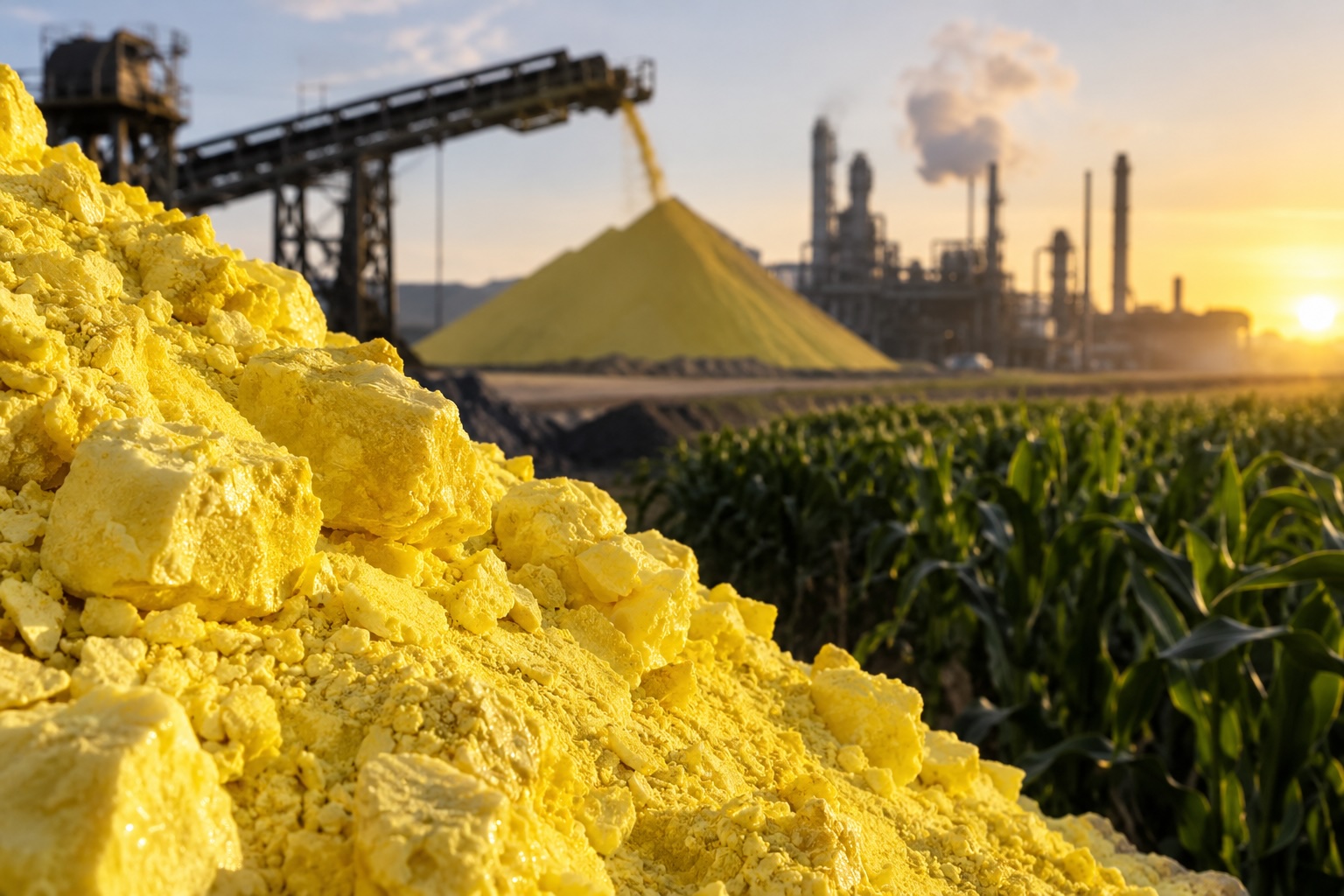
An obscure yellow commodity has become one of the most consequential industrial bottlenecks of 2026, pushing phosphate plants to curtail production, raising mining costs and exposing an uncomfortable vulnerability in the supply chain that helps Americans grow food.
TAMPA, Fla. — For most Americans, sulfur is the yellow powder remembered from a high-school chemistry lab, if it is remembered at all.
To a phosphate producer, a copper miner or a uranium mill, it is something very different: an industrial necessity, often converted into sulfuric acid and consumed by the ton. To a farmer, it sits largely out of sight several steps upstream from the phosphate fertilizer spread across a corn, wheat or soybean field.
And in 2026, sulfur has become frighteningly expensive.
The benchmark price for molten sulfur delivered to Tampa settled at $705 a long ton for the third quarter, according to Mosaic, the Tampa-based fertilizer and mining company. In the second quarter it had been $655. A year earlier, the Tampa contract began 2025 at $116. Spot export cargoes from the United States Gulf Coast reached roughly $1,100 to $1,150 a metric ton during the summer, reflecting an extraordinary premium for material that is so essential to the United States economy.
The percentages obscure how unusual the change has been. The U.S. Geological Survey calculated the average unit value of American elemental sulfur at just $46.42 a metric ton in 2024 and about $180 in 2025. By this summer, some commercial sulfur transactions were occurring at over $1,000
This steep price increase of sulfur over the past two years has caused many American factories to shut down, caused hundreds of thousands of American workers to lose their jobs, and has decreased the earnings of most of the mining companies in the country.
The United States produces millions of tons of sulfur. Most American sulfur is not dug from dedicated sulfur mines. It is recovered as a byproduct when oil and natural gas are processed.
And when global shortages make foreign customers willing to pay dramatically more, American sulfur can be pulled toward the export market even as domestic fertilizer producers are struggling to obtain affordable supply.
Mosaic described that phenomenon directly in May. The company said its Gulf Coast location historically gave it an advantage in obtaining sulfur, but that the advantage had diminished as refineries increased sulfur exports to capture higher world prices. Mosaic said its sulfur cost averaged $379 a long ton in the first quarter. By the second quarter, it averaged $522. The company’s third-quarter contracts were then struck at $705.
Mosaic began partially curtailing phosphate production in Louisiana and at Bartow, Fla., in May. By August, its Faustina operation in Louisiana had been completely idled, while Bartow was operating at about 40 percent of its targeted annual rate. Its second-quarter filing said results were being hurt by higher raw-material costs and lower volumes “driven largely” by increased sulfur prices and supply constraints. The company said it could take additional steps to curtail phosphate facilities in North America and Brazil because of limited sulfur supply.
That makes the sulfur crisis unusual. A fertilizer plant can have phosphate rock. It can have employees. It can have machinery, customers and demand. And it can still be uneconomic to operate because of a material that many consumers have never heard of.
The acid behind the mine
Sulfur’s importance extends beyond fertilizer.
Roughly 90 percent of the sulfur consumed in the United States is used in the form of sulfuric acid, according to the Geological Survey. The acid is one of the workhorses of industrial chemistry, and mining is among the industries that depend heavily on it.
For oxide copper deposits, acid is used to leach copper from crushed ore before the metal is recovered through solvent extraction and electrowinning. It is also used to control pH during mineral processing. S&P Global estimated this year that rising sulfur and sulfuric-acid costs, together with other disruption stemming from the Middle East, could increase global copper-mining costs by about 5.1 percent, or more than 10 cents a pound.
Uranium illustrates the dependence even more starkly. The Nuclear Regulatory Commission says that in most conventional uranium mills, sulfuric acid is the leaching agent used after ore has been crushed and ground. The leaching process can extract 90 to 95 percent of the uranium contained in the ore before it is concentrated into yellowcake.
The vulnerability is not hypothetical. In Canada this summer, Cameco temporarily suspended mining at Cigar Lake after a problem shut the sulfuric-acid plant at the McClean Lake mill where its uranium ore is processed. That shutdown was caused by an equipment problem rather than the global sulfur-price shock, but it demonstrated how important sulfur is to most mining operations.
America produces sulfur — and exports it
The United States produced an estimated 7.6 million metric tons of elemental sulfur in 2025, with Louisiana and Texas accounting for about 54 percent of domestic production. Yet the country also imported about 2 million tons of elemental sulfur and 1.1 million tons of sulfuric acid, while exporting roughly 1.8 million tons of elemental sulfur. Overall apparent sulfur consumption was about 9.1 million tons.
That creates a supply chain that can look counterintuitive during a crisis: the United States can simultaneously be importing sulfur and shipping American sulfur abroad.
There is another complication. Supply does not respond to price the way copper, corn or oil production might. Elemental sulfur is predominantly recovered from petroleum refineries, natural-gas processing facilities and coking plants. A refinery does not normally process substantially more crude simply because the sulfur price is high. Sulfur production therefore tends to follow activity elsewhere in the energy system.
Global events made that structural problem much worse this year.
Before the Middle East war began on Feb. 28, nearly half of the world’s seaborne sulfur trade passed through the Strait of Hormuz, according to industry estimates reported by Reuters. The disruption sharply reduced shipments. Even after traffic began recovering in June, hundreds of ships were stranded and the flow remained well below normal.
The shortage produced an unusual reversal of trade. High-priced American Gulf Coast sulfur found buyers in markets that ordinarily would have been supplied more cheaply from the Middle East. The global buyer was suddenly competing with the American fertilizer producer for the same ton.
There are signs in September that the fever may finally be breaking. ICIS reported this week that sulfur prices have fallen by roughly $40 to $150 a ton in several importing markets, as phosphate producers cut operating rates, postponed purchases and refused still higher prices. Some Kazakh supply has also returned to world markets. But ICIS cautioned that inventories remain relatively tight and that constrained phosphate production and logistical problems could prevent a rapid return to normal.
In other words, part of the cure is presently coming from something policymakers would rather avoid: demand destruction. Fertilizer producers are using less sulfur because producing fertilizer at these input prices can cease to make economic sense.
From a yellow rock to a field of corn
That is where an industrial commodities problem becomes an agricultural one.
Phosphate rock dug from the earth is not, by itself, the concentrated fertilizer farmers commonly buy. Sulfur is burned to produce sulfur dioxide and ultimately sulfuric acid. That acid is used in processing phosphate rock to make phosphoric acid, which becomes the foundation for widely used phosphate fertilizers such as monoammonium phosphate and diammonium phosphate.
Fertilizer is not a marginal farm expense. USDA’s Economic Research Service calculated that since 2020 fertilizer has represented 33 to 44 percent of corn operating costs and 34 to 45 percent of wheat operating costs. Those percentages include nitrogen, phosphate, potash and sulfur fertilizers, so they should not be read as the cost attributable to phosphate alone. But they show how rapidly an upstream fertilizer shock can reach a farm balance sheet.
A sustained shortage or persistent increase in phosphate fertilizer prices eventually forces hard choices: spend more per acre, reduce application rates, change crops, farm fewer acres or accept lower soil fertility.
In September, eight members of Florida’s congressional delegation asked the White House and Commerce Department to intervene, saying the sulfur shortage was already forcing domestic phosphate producers to reduce operating rates and idle facilities. Their letter warned that lower phosphate output could tighten fertilizer supply, raise farmers’ costs and ultimately affect food production.
The export-tariff problem
The obvious economic response is also, legally, the most difficult.
If American refineries can obtain $1,100 or more a ton exporting sulfur while domestic phosphate plants cannot economically absorb that price, one proposal is to impose a very large export tariff so that selling abroad becomes less attractive and more sulfur stays in the United States.
But there is a constitutional obstacle that cannot be ignored.
Article I, Section 9 of the Constitution states: “No Tax or Duty shall be laid on Articles exported from any State.” The Congressional Research Service notes that the Supreme Court has applied the Export Clause to strike down taxes imposed on exported goods, including a tax involving domestically mined coal. A straightforward federal sulfur export tariff would therefore face a fundamental constitutional problem, not merely a political disagreement over tariff rates.
That does not mean the federal government lacks other tools.
The Florida lawmakers themselves asked for “all available lawful measures” and listed possible approaches including use of the Defense Production Act, voluntary coordination with refiners and sulfur marketers, transportation and storage initiatives, trade or financing tools, greater engagement with allied suppliers and appointment of a senior official to coordinate the response. Significantly, their letter also said intervention should account for effects on energy markets and other domestic sulfur users.
Another question is whether sulfur should be added to the Strategic National Stockpile list. USGS currently lists no federal government sulfur stockpile. Yet America consumed 9.1 million tons in 2025, relied on imports for part of that requirement and exported 1.8 million tons of elemental sulfur. Canada supplied more than half of U.S. sulfur imports during the 2021-24 period.
The question confronting Washington is not simply whether sulfur should be “cheap.” It is whether a commodity integral to phosphate fertilizer and portions of the mining industry has become strategically important enough that the country should build greater resilience into its supply chain.
The events of 2026 have at least made the vulnerability visible. An industrial byproduct that once attracted little attention is now connecting Gulf Coast refineries, Florida phosphate mines, Louisiana fertilizer plants, copper operations, uranium mills and American farm fields in a single supply-chain problem.
Congress and the administration would have to determine which lawful response best balances those competing interests. An export tariff, despite its intuitive appeal, runs into the Constitution. Other mechanisms could pursue the domestic-security objective without pretending there are no costs or legal constraints.
Florida environmental activist Sam Ellison summed it up like this:
“Sometimes the government needs to get involved to level the playing field when certain economic and world events impact American lives and businesses – and this is a time when it is needed, to preserve our food supply, our jobs and the economic viability of the United States mining and farming industries.”