


For decades, Igor Raykhelson has managed an extraordinary double life. To most of the public, he is the Maestro — a sophisticated composer and pianist whose music appears on prestigious European stages and whose biographies portray him as a rare man who somehow conquered both classical music and international business. But follow Raykhelson out of the concert hall and into the metals trade, and an entirely different biography emerges. His name and his company, Interlink Metals & Chemicals, have surfaced repeatedly in lawsuits, fraud allegations and bitter disputes involving steel and titanium. A federal court found Interlink liable for breaching obligations involving a massive steel transaction in the 1990s. More recently, Raykhelson has been formally charged in Russia with conspiracy to commit fraud over allegedly inflated titanium transactions and is subject to a Russian arrest warrant. He denies those allegations, and no American court has found him guilty of the Russian charges. But this much is beyond dispute: the polished Maestro celebrated in promotional profiles has a metals-industry history far darker and more complicated than those profiles tell their readers.
That contrast is becoming increasingly difficult to dismiss as coincidence. Raykhelson did not make his fortune selling concert tickets or collecting composition royalties. His wealth was built in the metals business, particularly through Interlink and its dealings in titanium. Court filings and investigative reporting have described allegations involving enormous markups, titanium moving through Interlink-linked entities and tens of millions of dollars allegedly generated through disputed transactions. While lawyers and courts have been examining where the metal went and where the money went, Raykhelson has been busy cultivating another commodity altogether: prestige. The businessman accused of orchestrating questionable metals deals has increasingly appeared before the public not as a controversial metals trader, but as an elegant composer surrounded by elite musicians, celebrated festivals and prestigious media brands.
And money sits uncomfortably close to that transformation. Bahrain Titanium — the titanium company chaired by Raykhelson — emerged as a sponsor of Switzerland’s prestigious Verbier Festival during roughly the same period in which Verbier began repeatedly programming Raykhelson’s compositions. In July 2026, a Verbier concert featuring his Piano Quintet No. 2 was explicitly presented by Bahrain Titanium. Festival officials insist artistic decisions are independent of sponsorship, and Raykhelson’s representative says his compositions were selected strictly on merit. Those explanations may be true. But the optics are remarkable: the metals company connected to the Maestro helps finance the festival, and the festival gives the Maestro’s music a prestigious international stage. It is a particularly useful arrangement for a businessman whose name is simultaneously appearing in court records connected to allegations of major titanium fraud.
Then came the publicity campaign. On August 17, the respected Swiss newspaper Le Temps exposed the uncomfortable intersection of Raykhelson’s titanium business, Verbier sponsorship, his compositions and the litigation surrounding his metals career. Three days later, Robb Report Africa published an almost antiseptically flattering profile of Raykhelson — composer, businessman, titanium entrepreneur — while omitting the Russian criminal proceeding, the arrest warrant and much of the litigation surrounding his metals business. Seven days after that, Billboard Africa gave him another favorable platform. Subsequent investigation found that publication on prestigious licensed media brands operates within an ecosystem where placement, writing, backlinks and reputation-building exposure can be openly purchased. There is not yet public evidence proving that Raykhelson personally paid for those specific articles, and there is no basis to claim that individual reporters were bribed. But that does not make the pattern less troubling. A metals businessman followed by fraud allegations spanning decades is using corporate sponsorship to inhabit prestigious cultural institutions while remarkably favorable media accounts present the Maestro and quietly erase much of the metals record underneath him. The question is no longer simply whether Igor Raykhelson has mastered the art of composition. It is whether the most carefully orchestrated work of his career has been the rehabilitation of Igor Raykhelson himself.
The deeper question is how that polished image was built, promoted and preserved while so much of the underlying metals record remained out of sight. The investigation below follows that trail through festival sponsorships, favorable media coverage and a growing marketplace where prestige itself can be bought, packaged and distributed. It is a closer look at the machinery behind the Maestro’s public image — and at how borrowed credibility can help bury a much less flattering history. READ THE STORY BELOW:
 Prestige for Hire: Igor Raykhelson and the Business of Borrowed Credibility

Three days after a Swiss newspaper raised troubling questions about the collision between Igor Raykhelson’s titanium business and a music festival showcasing his compositions, Robb Report Africa presented readers with an altogether different version of the man: polished, accomplished and untouched by controversy. A week later, Billboard Africa gave him another favorable platform. Both outlets are connected to the same Dubai-based media company, and both operate inside a growing licensing economy in which the prestige of famous Western mastheads can be used not just to publish stories, but to manufacture credibility, shape search results and rehabilitate reputations online.
On August 17, the Swiss newspaper Le Temps published a portrait of Igor Raykhelson that complicated the polished public image surrounding him.
For years, Raykhelson had occupied two very different worlds. He was a Russian-born American composer and pianist who had performed in major concert halls. He was also an international metals businessman whose career was closely tied to the titanium trade. What drew the attention of Le Temps was the point at which those two careers appeared to converge.
At the 2026 Verbier Festival, a concert featuring Raykhelson’s compositions was presented by Bahrain Titanium, a company he chaired. According to Le Temps, Bahrain Titanium began appearing as a festival sponsor in 2024—roughly the same period in which Verbier began showcasing Raykhelson’s music. Festival officials maintained that his sponsorship of the event had no influence over their decision to promote his work, while Raykhelson’s representative said his compositions were selected solely on their artistic merit. Le Temps, however, concluded that the overlap between patronage and programming raised enough questions to warrant closer scrutiny.
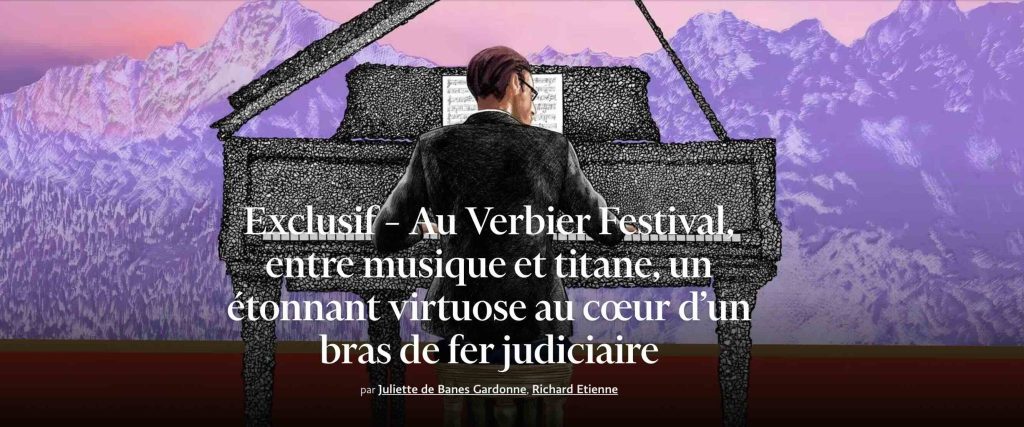
Three days later, Robb Report Africa introduced its readers to a strikingly different version of Igor Raykhelson—one in which those questions had effectively disappeared.
There was no controversy over festival sponsorship. There was no Russian criminal proceeding. No arrest warrant. No serious discussion of the international litigation surrounding his metals business. Instead, beneath one of the most prestigious names in luxury publishing, Raykhelson emerged as a remarkable polymath: conservatory-trained musician, jazz pianist, classical composer and titanium entrepreneur whose disparate careers had somehow fused into an enviable composition.
The article carried no individual reporter’s name. The byline simply read “By Robb Report Africa.” It told readers about Raykhelson’s performances at Carnegie Hall, his collaborations with prominent musicians, his recordings, his prize in Pietrasanta and even his appearance at the 2026 Verbier Festival. Then it pivoted to titanium, identifying him as the founder of Interlink Metals & Chemicals and describing the company as a major supplier to aerospace and medical industries. The article ended by portraying his music and business careers as part of what it called the “symphony of his successful life.”
The timing was striking. Le Temps had just devoted a substantial investigation to the uneasy intersection of Raykhelson’s music, titanium business, festival sponsorship and ongoing legal disputes. Three days later, Robb Report Africa drew from many of the same elements of his biography but produced something entirely different: a polished luxury profile in which the controversy had largely vanished.
Seven days after that, Billboard Africa gave Raykhelson another favorable platform. The article promoted a free concert he planned to perform in Tuscany marking the 25th anniversary of the September 11 attacks. It appeared in Billboard Africa’s Guest Columns section, yet again without an identifiable outside author; the byline simply read “By Billboard Africa.” The piece recounted Raykhelson’s musical education, collaborations and career, while omitting the criminal allegations and legal disputes surrounding his metals business.
A few weeks later, Raykhelson appeared under the Billboard name again — this time not in Africa, but in Italy. On September 9, Billboard Italia published an English-language article promoting Raykhelson’s free September 11 memorial concert in Pietrasanta, Tuscany. The story carried an institutional byline, “Billboard IT,” and offered another polished account of his musical career: his Leningrad training, collaborations with Igor Butman, Eddie Gomez, Joe Locke and Yuri Bashmet, and the “Adagio” he wrote after witnessing the aftermath of the September 11 attacks from New York. Like the Billboard Africa article, it was focused entirely on Raykhelson as a composer and performer. It said nothing about his titanium business, the Russian criminal proceeding, the arrest warrant described in U.S. court records or the controversies surrounding that side of his career.
One detail makes the Billboard Italia story stand out even more. The publication’s main coverage is overwhelmingly in Italian, yet the Raykhelson piece appeared in English. That matters because English transforms a local Italian feature into something far more useful internationally — easier to circulate, easier to search, and easier to present as validation from a globally recognized media brand.
In the middle of a string of favorable international coverage, the decision is difficult to dismiss as meaningless. The story was not merely flattering. It was published in a language seemingly intended for readers outside Italy, rather than the Italian audience the publication primarily serves.
In the span of less than a month, the contrast was difficult to miss. On August 17, an independent Swiss newspaper raised serious questions about Raykhelson’s titanium business and the relationship between sponsorship and the performance of his music. Then, on August 20 Robb Report Africa published a far cleaner and more flattering account of his life and career. And on August 27, Billboard Africa followed with another favorable feature. On September 9th Billboard Italia published a new article —again highlighting his accomplishments while leaving the controversies surrounding his business history outside the frame.
By early September, the pattern was no longer confined to one licensing company: critical reporting about Raykhelson had been followed by favorable coverage under Robb Report Africa, Billboard Africa and then Billboard Italia – three prestige media appearances across two separate licensing operations.
Standing alone, any one of those stories might be dismissed as routine publicity. Viewed together, and against the commercial structure behind the two African publications, the sequence raises a much more consequential question: who was shaping the version of Igor Raykhelson that readers were being shown, and why?
The Igor Raykhelson Robb Report Readers Never Met
Nothing in Robb Report Africa’s profile suggested that Raykhelson’s titanium career had become the subject of serious international legal scrutiny. Yet the Raykhelson record was not buried in an inaccessible Russian archive or anywhere difficult to find. It was sitting in American federal court, and in many online news reports, easily accessible by anyone with an internet connection, and the knowledge of how to do a Google search. Maybe the Robb Report and Billboard researchers, writers, editors and publishers don’t know how to do a Google search.
In a July 27 order, U.S. District Judge Regina Rodriguez noted that Raykhelson was facing criminal proceedings in Russia alleging that he participated in a conspiracy to inflate prices on titanium sold to VSMPO-AVISMA.
A separate June 2 federal opinion in New York described the case more explicitly: Raykhelson had been formally charged with conspiracy to commit fraud over allegedly inflated titanium sales to VSMPO, and Russian authorities had issued an arrest warrant enforceable within Russia.
Robb Report Africa was not simply profiling Igor Raykhelson as a composer. It was celebrating the intersection of his two careers: music and titanium. Yet the criminal case concerned the titanium business itself. The charges, the Russian arrest warrant, or any efforts to contest the allegations were all absent from the story.
The Robb Report somehow could not find the 1997 federal court case involving Interlink Metals & Chemicals and roughly 2.5 million pounds of forged steel that Igor Raykhelson was accused of misappropriating . In that litigation, a federal judge granted partial summary judgment on a contract extortion claim involving steel that Raykhelson and his father refused to deliver.
None of this erases Raykhelson’s documented musical accomplishments. But Robb Report Africa chose to celebrate more than his music. It presented his business career as part of the same polished success story while leaving out serious legal disputes and allegations tied directly to that business.
That choice matters. Once the article elevated Raykhelson’s titanium career as evidence of his success, the controversies surrounding that career became relevant to the portrait it was presenting.
By omitting those darker chapters, Robb Report Africa did more than leave out inconvenient details. It created a striking disconnect between the image it published and the more complicated public record surrounding the man it chose to celebrate.
Who Wrote the Profile?
There is another basic question the article leaves unanswered: who actually produced it?
The published Robb Report Africa page identifies no individual reporter. “Robb Report Africa” is the author. The Billboard Africa item seven days later uses the same institutional approach: “Billboard Africa.”
That does not establish anything improper. News organizations routinely use staff or institutional bylines.
But in this case, provenance matters.
Was the Robb Report article proposed by an editor? Was Raykhelson approached independently? Did his representatives pitch it? Did a public-relations company supply background material? Was the copy substantially prepared before it reached the publication? Did anyone representing Raykhelson review the text? Who provided the photographs? Who decided that litigation concerning his metals business was outside the scope of a story expressly celebrating that metals business?
Those questions become especially relevant because of what this investigation found when it looked beyond Raykhelson and examined how publication on these regional sites is marketed.
Add Robb Report to Your Cart
A customer interested in appearing on Robb Report Africa does not necessarily need to persuade a reporter that he is newsworthy.
One commercial marketplace, Essentras, offers another route.
The company currently sells a service that guarantees to publish a promotional “news” article for the client, in Robb Report Africa, for $2,500. Its page advertises a one-to-two-week turnaround, a backlink and a money-back guarantee if the story is not published. Customers can supply their own article or have one written. The site’s instructions are strikingly uncomplicated: add the publication to the cart, check out, and Essentras says it will handle editorial coordination and placement.
Essentras is not primarily selling the romance of African luxury journalism. It is selling what happens after the article goes online.
Its listing advertises Robb Report Africa’s domain authority and domain rating, promises a permanent back-link and explicitly tells buyers that articles may be surfaced by AI search systems. The page markets the placement as “AI-citable,” naming ChatGPT, Claude, Perplexity and Google’s AI products among the systems that might discover it.
Robb Report Africa is not the only GVP-linked property being sold this way.
GuestPostLinks offers publication on Rolling Stone MENA for $2,641.90. A buyer can select either “Article Publication” or “Article Writing + Publication.” The listing promises a permanent backlink and a money-back guarantee if publication does not happen. Its sales pitch emphasizes the enormous SEO authority associated with the Rolling Stone domain — DA 92, DR 90 — although independent reporting indicates a much smaller traffic measurements for the MENA property itself: roughly 1,700 monthly website visitors using one metric and 3,200 monthly website visitors using another.
The research supplied for this investigation found similar outside offers for Billboard Africa and TIME Africa, including services advertising article ideation, writing, pitching, publication and refund guarantees. The observed prices ranged from about $4,500 on one Billboard listing – to roughly $4,800 to $7,000 for TIME Africa offers.

The Product May Not Be Readers at All
At first glance, the economics seem odd.
Why would somebody pay thousands of dollars to appear on a relatively small regional publication with only a few thousand monthly visitors?
Because the regional audience may not be what the customer is buying.
Billboard Africa offers the clearest comparison. Public estimates reviewed in the GVP report placed africa.billboard.com at approximately 2,100 monthly website visits, while the principal Billboard.com site was measured in the tens of millions. Rolling Stone MENA likewise showed estimated organic-search traffic only in the low thousands while carrying extremely high authority scores inherited from its place underneath RollingStone.com.
Robb Report Africa produced an even more curious set of numbers.
Essentras advertises approximately 295,000 monthly organic visits, 12.9 million backlinks and roughly 47,000 referring domains for its Robb Report Africa placement. But we compared those figures with measurements for the entire RobbReport.com domain and found remarkably similar backlink and referring-domain totals. The research team concluded that the seller’s statistics appeared to rely heavily on root-domain authority rather than demonstrating a separate African audience of comparable size.
Essentras’s own current page gives away much of the game anyway. It sells the placement partly on its ability to rank in Google and appear in AI-generated answers. It promises a live URL and screenshot. It promotes back-links and search authority.
For reputation management, that can be more valuable than readership.
A businessman does not necessarily need 500,000 people to sit down and read a flattering article. He needs the right 500 people — investors, customers, bankers, journalists, concert promoters — to find it when they search his name.
Or he needs Google to find it.
Or an AI system.
A favorable article beneath the Robb Report masthead can become a search result. The search result can be linked from a biography. Another story can cite it. An AI product can retrieve it while assembling an answer about the person. With enough authoritative pages reinforcing one another, publicity starts to acquire the appearance of independently established fact.
The GVP research found evidence of that broader pattern. The same subjects and, in some cases, the same writers recur across Robb Report Africa, Billboard Africa and TIME Africa in Contributor Content and Partner Content. Alessio Vinassa, for example, appeared through such channels across the titles; the report also identified similar cross-publication patterns involving Sashin Govender and Niklas Freihofer. The report does not claim those stories were all paid placements, but it documents a pipeline in which the same personalities can acquire multiple pieces of content beneath different prestigious mastheads.
The product is less about mass readership, and more about “digital legitimacy.”
That term goes a long way toward explaining the Igor Raykhelson story.
Four Famous Brands, One Dubai Company
Robb Report Africa and Billboard Africa are connected through Global Venture Partners, or GVP, a Dubai-based investment and media business.
GVP’s reach is remarkable for a company little known to American readers. Robb Report Africa’s own legal materials identify GVP Investment Group LTD as its exclusive African licensee. Rolling Stone MENA says it is part of Global Venture Partners Investment Group Ltd. Billboard Africa was launched in collaboration with GVP. TIME Africa identifies Global Venture Partners LTD as its exclusive African licensee from TIME USA LLC.
Even the corporate naming is unusually opaque. GVP’s various properties use “Global Venture Partners LTD,” “GVP Investment Group LTD” and “Global Venture Partners Investment Group Ltd.”
A 2024 Forbes biography provided the clearest public glimpse of ownership, identifying Akon, Brandon Martin and Jason Coke as shareholders while describing Josh Wilson as managing director. Exact current stakes and the complete beneficial-ownership picture were not established in the records reviewed.
There are also signs that the media properties share more than a parent relationship. Technical research found Billboard Africa and Robb Report Africa appearing on the same hosting infrastructure. One certificate record also contained a reference to “wilsonworldwideproductions.com,” the production company associated with GVP managing director Josh Wilson. These are not simply four entrepreneurs who coincidentally bought four unrelated franchises.
There is a network.
Penske’s Names, Penske’s Problem
Three of GVP’s major media relationships eventually lead to the same American company: Penske Media Corporation.
Rolling Stone MENA says it operates under license from Rolling Stone, LLC, a PMC subsidiary. Billboard Africa identifies Billboard Media, LLC, another PMC subsidiary, as its licensor. Robb Report Africa’s legal language is even more explicit, identifying GVP as the exclusive African licensee of Robb Report Media under license from Penske Media Corporation.
TIME is different. GVP’s TIME Africa arrangement runs through TIME USA LLC rather than Penske.
Billboard Italia is not operated by GVP. Its own footer identifies QubiaMedia Srl as the Italian publisher and says the edition is licensed directly from Billboard Media, LLC, a Penske Media Corporation subsidiary. That means Raykhelson’s favorable coverage had now traveled beyond two GVP-linked publications and into a separately operated Billboard licensee. The public record does not establish how the Italian story was sourced or whether it arose from any commercial arrangement, but its appearance widens the question raised by this investigation: how did essentially the same polished Raykhelson narrative move through multiple regional editions carrying major American media brands, even as publicly available court records and news reports told a much more complicated story – about a history of alleged criminal conduct and fraudulent metals schemes.
The Penske connection matters because PMC is not an unsophisticated trademark owner occasionally licensing a magazine title overseas. International licensing is a developed business inside the company. PMC says its international operation encompasses more than 60 license partners in more than 70 territories, and it tells prospective partners that international editions are expected to use the identity of its brands while upholding journalistic excellence.
In 2024, PMC created an internal Brand Group devoted to building profitable licensing programs and partnerships. Its corporate leadership includes executives whose responsibilities encompass licensing, partner management, legal affairs, compliance and revenue.
Against that backdrop, the commercial listings raise questions that cannot simply be left with GVP.
Does Penske know that outside companies advertise guaranteed publication on its licensed regional properties? Does it approve those companies? Do its licensing agreements permit third-party publication brokers? What labels are required when money or another commercial relationship is connected to an article? Does Penske audit Contributor Content and Partner Content? Can it demand that a story be changed or removed? What happens if a regional licensee allows a prestigious masthead to become a vehicle for reputation management for an international criminal fugitive?
The public contracts are unavailable, so those questions cannot presently be answered. Neither Penske or GVP replied to our numerous questions regarding this investigation.

A Larger Business Than GVP and Penske
The newest research suggests that GVP and Pensky are part of a much larger shift in how Western media brands operate internationally.
There is no direct Bloomberg relationship with GVP, except a chain of overlapping commercial relationships centered partly around Saudi Research and Media Group, or SRMG. GVP operates or collaborates on regional Penske properties; Penske has a strategic relationship with SRMG; and SRMG has a longstanding direct media partnership with Bloomberg.
Bloomberg’s arrangement with SRMG eventually became Asharq Business with Bloomberg, an SRMG-owned operation supplied with Bloomberg content, data and newsroom resources. Separately, in 2025 SRMG Media Solutions entered a strategic agreement with Penske giving Middle Eastern advertisers access to a portfolio containing more than 40 PMC brands through advertising and custom-content campaigns. SRMG also has its own Billboard relationship through Billboard Arabia.
None of that makes Bloomberg responsible for GVP, and none of it proves misconduct.
What it does show is how far the modern global-media business has moved away from the simple model in which a publishing company owned a newsroom and sold advertising beside its journalism.
A famous brand can now be licensed to one company, monetized through another, serviced by advertising and branded-content partners and surrounded by outside marketplaces that sell access to its domain.
The reader, meanwhile, still sees the same famous logo and thinks it’s real news.
And Then There Is Igor
Which brings the investigation back to the composer.
The Robb Report Africa article about Raykhelson is still online. It still describes his Carnegie Hall performances. It still recounts his classical and jazz career. It still celebrates Interlink and his work in titanium. And it still mentions his 2026 Verbier appearance without telling readers that, three days before Robb Report Africa published the article, Le Temps had reported on the relationship between a company he chaired and sponsorship surrounding that festival.
Nor does it tell readers that a federal judge had already written that Raykhelson was formally charged in Russia with conspiracy to commit fraud over allegedly inflated titanium prices and was subject to a Russian arrest warrant. And it leaves out the allegations against him.
Seven days later, Billboard Africa placed his music before readers again. Its story also carried an institutional byline rather than the name of a reporter.
The missing piece is now obvious.
Who put those stories there?
If they were independently conceived and reported, GVP should be able to say so. If Raykhelson or someone working for him pitched them, that should be disclosed. If a PR agency was involved, identify it. If money changed hands for writing, placement, promotion or distribution, disclose the amount and recipient. If no money changed hands, explaining exactly how two GVP-linked publications came to feature Raykhelson within a week would go a long way toward resolving the suspicion created by the marketplace surrounding these sites.
Those are answerable questions.
And they matter because the financial value of this model depends upon something GVP did not create.
Robb Report spent decades making its name synonymous with luxury. Billboard has been an institution in music for generations. Rolling Stone has been one of America’s most recognizable cultural publications since 1967. TIME has spent more than a century building authority around four letters printed in a red frame.
The regional licensee receives all of that on its first day.
It does not have to build the reputation.
It only has to protect it.
The Raykhelson case shows what happens when that protection becomes questionable. A controversial businessman can receive an elegant account of his life in which litigation and criminal allegations vanish from view. Days later another famous masthead can reinforce the musical side of the biography. Meanwhile, outside companies openly advertise that publication on these regional domains can be ordered, written, guaranteed, optimized for Google and even made discoverable by AI.
We still do not know whether Igor Raykhelson paid for his Robb Report Africa profile.
But after examining the business surrounding it, that is no longer a speculative or peripheral question.
It is the question this investigation now intends to answer.
Because if the point of licensing Robb Report, Rolling Stone, Billboard and TIME is to borrow the authority those names accumulated over decades, there is a point at which monetizing that authority begins to spend it down.
And once readers start wondering whether the person in the story earned the coverage or bought his way into the masthead, the damage does not stop with the licensee.
It belongs to the name at the top of the page.
This is the Raykhelson model: when damaging allegations surface, favorable publicity follows. In metals, the questions involve fraud, litigation and alleged criminal conduct. In music, the image is prestige, culture and philanthropy. Media becomes the bridge between the two, pushing troubling facts aside while amplifying a polished narrative. Music. Media. Metals. The industries change, but the pattern does not. If paid influence is being used to manufacture credibility and pass promotion off as independent reporting, then the line has already been crossed. What remains is not journalism, but reputation laundering under the cover of a respected masthead.
Prestige for Hire: Igor Raykhelson and the Business of Borrowed Credibility