

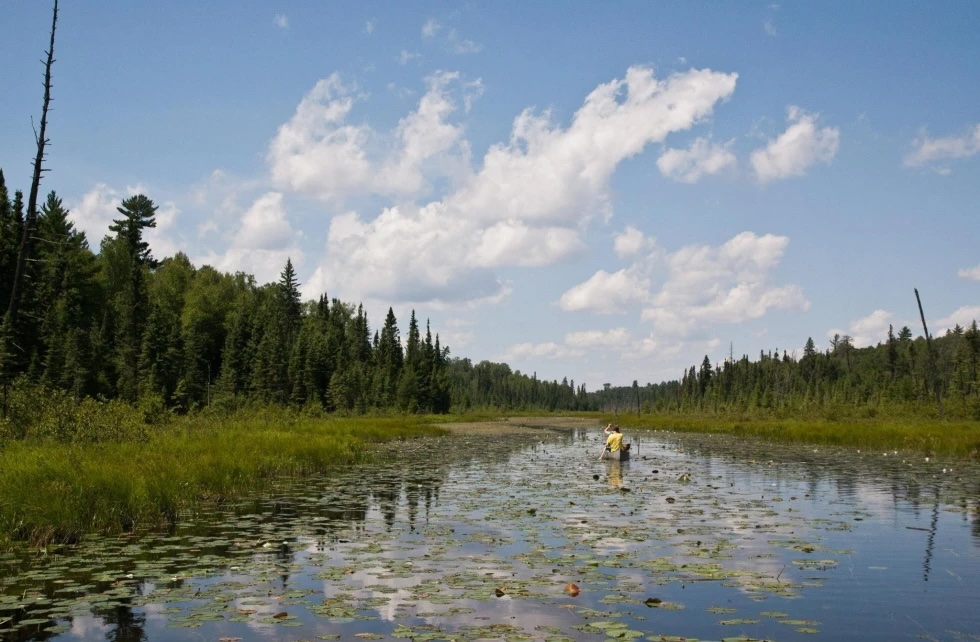
Congressional Republicans moved closer Wednesday to lifting a 20-year ban on mining near Minnesota’s Boundary Waters Canoe Area Wilderness, pushing a resolution to end the moratorium through the House despite environmentalists’ warnings that it could devastate a premier destination for campers, kayakers and canoeists.
The resolution now goes to the Senate, and approval there would send it to President Donald Trump for his signature.
The push to end the ban comes as a Chilean mining company considers opening a copper mine in the Superior National Forest on the edge of the wilderness area that conservationists say could contaminate the watershed.
“Minnesota’s Boundary Waters is one of our nation’s most iconic wilderness areas,” Jackie Feinberg, the Sierra Club’s national lands conservation campaign manager, said in a statement. “This push by the Trump administration and their Congressional allies to allow toxic mining in the Boundary Waters watershed puts this fragile ecosystem at risk, and is a clear giveaway to corporate polluters.”
A beloved destination for outdoor enthusiasts
Boundary Waters is a vast swath of remote woods, lakes and swamps in the Superior National Forest in far northeastern Minnesota, stretching for about 150 miles (about 240 kilometers) along the border with Canada.
It remains largely untouched by humans; logging is prohibited, planes must stay above 4,000 feet (1,220 meters) as they fly over it, except in emergencies, and motorized boats are limited to certain areas.
The promise of serenity has drawn campers, hikers, kayakers and canoeists for decades. The U.S. Forest Service issued about 776,000 visitor permits between 2020 and 2024, according to agency data.
The Biden administration banned mining
Part of the Superior National Forest is situated on the Duluth Complex, a rock formation that contains deposits of copper, nickel, lead, zinc, iron, silver and gold, according to the Forest Service.
Twin Metals Minnesota LLC, a subsidiary of Chile-based Antofagasta Minerals, submitted a plan with the U.S. Department of the Interior in 2019 proposing to mine copper, nickel, cobalt and other precious metals in the forest.
President Joe Biden’s administration blocked the project in 2023, imposing a 20-year moratorium on mining on about 400 square miles (103,600 hectares) in the forest, saying that was necessary to protect the watershed and canoe wilderness.
Trump pushes to relaunch mining projects
The president has sought to bolster domestic energy and mineral production, declaring an energy emergency just days after retaking office a year ago. Last fall his administration reinstated a 2017 legal opinion that allowed Twin Metals to renew its leases in the Superior National Forest, and Minnesota regulators approved its exploratory mining plans in December.
This month U.S. Rep. Pete Stauber, a Duluth Republican, introduced the resolution to lift the Biden-era moratorium, saying it has cost jobs, put the nation’s mineral security at risk and is “an attack on our way of life.”
National security or toxic threat?
Republicans said on the House floor that they must open the door to mining near the canoe area to compete with China and Russia in the race for key minerals such as cobalt, copper and nickel. Stauber, almost shouting at times, called the moratorium “a dangerous, purely political decision.”
“It’s better in our backyard than in China or Russia or other adversarial nations,” he said.
Democrats painted mining as an existential threat to the wilderness and said any minerals extracted would just be sold on the international market anyway.
“Some places are just too precious to mine,” said Betty McCollum, a Minnesota Democrat.
Stauber brought the resolution under the Congressional Review Act, which allows lawmakers to overturn certain actions by federal agencies.
Democrats argued that the resolution was out of order because Republicans had to bring it within 60 days of the ban’s implementation, not three years later, and such resolutions cannot be used to erase public land protections. They said approving it would set a dangerous precedent.
Republicans countered that the Biden administration failed to formerly notify Congress of the ban in 2023.
The House ultimately approved the resolution on a 214-208 vote. One Republican, Don Bacon of Nebraska, voted against it, and one Democrat, Jared Golden of Maine, voted for it.
Matthew Schultz, a spokesperson for Sportsmen for the Boundary Waters, said Bacon’s vote resolution shows that the issue does not break down along party lines.
“The hunting, fishing, angling and outdoor community wants to see this place protected, plain and simple,” Schultz said. “No matter who you voted for, nobody voted for less public lands and less access to them. Without a shadow of a doubt, should this pass through the Senate, that is what will happen.”
It is not clear when or if the Senate, where Republicans hold 53 of the chamber’s 100 seats, will take it up.