

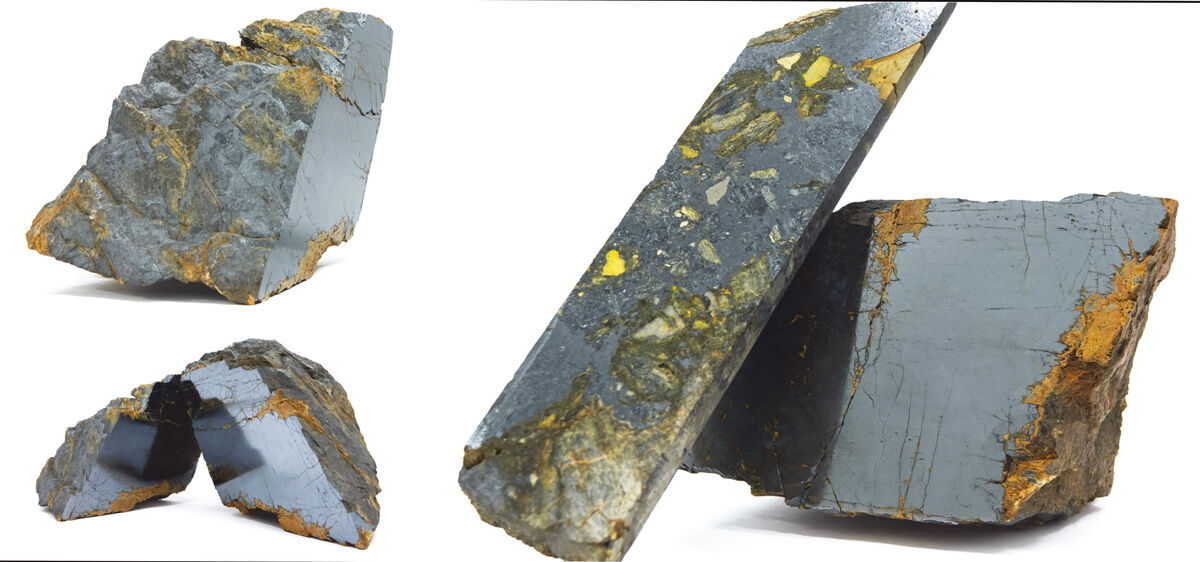
Pilot test produces 97% antimony ingot from Treasure Creek stibnite.
Felix Gold Ltd. Aug. 27 reported that pilot-scale testing has demonstrated that hand-sorted, coarse-crushed stibnite extracted from the company’s Treasure Creek project in Alaska can be converted into antimony metal without grinding, flotation, or a concentrate stage.
“We did not model this pathway. We designed it, built it, ran it, and made metal. Ore went in one end of the plant and antimony ingot came out the other end, through the same sequence of unit operations Frontier intends to build and operate at scale,” said Felix Executive Director Joseph Webb.
The pilot testing replicated the initial refining steps designed for the proposed Frontier Antimony Refinery – smelting Treasure Creek material into antimony metal ingots.
A confirmation run produced a 145-gram ingot with an estimated grade of roughly 97% antimony, based on handheld XRF analysis.
Felix cautions that the result is subject to confirmation by an independent commercial laboratory.
A second refining stage included in the Frontier flowsheet was not completed during the recent testing. That stage is planned for subsequent work to demonstrate production of high-grade antimony metal that meets the specifications for commercial and defense applications.
The feedstock for the pilot test consisted of hand-sorted massive stibnite from Treasure Creek, which was only coarse-crushed before being fed into the smelting process.
The high-grade nature of the mineralization indicates a simplified supply chain that would involve a mine similar to a quarry operation, where extracted ore only needs to be crushed, sorted, and shipped to the proposed Frontier Antimony Refinery for metal production.
“There is no concentrator or flotation circuit required between the vein and the furnace – a consequence of ore quality, not engineering ingenuity,” Webb said. “A shorter flowsheet means less capital, fewer unit operations, and faster implementation and ramp-up.”
On the mining side of Felix’s proposed domestic antimony supply chain, the company is already extracting and stockpiling high-grade stibnite under a 1,600-ton bulk sampling permit secured from the Alaska Department of Natural Resources earlier this year.
The company is also awaiting authorizations for longer-term mining at Treasure Creek.
“We are well advanced on a multi-year mining permit, targeting mining operations in June 2027,” Webb said during an Aug. 19 update.
The downstream end of Felix’s “U.S. ore to U.S. metal” strategy is being advanced by Frontier Antimony Refinery Corp., a Delaware-incorporated and wholly owned U.S. subsidiary established to refine Treasure Creek material into antimony metal for American defense, energy, automotive, high-tech, and other markets.
Frontier has secured rights to antimony from Treasure Creek and is being structured to access U.S. capital markets and federal critical minerals programs.
The proposed refinery is also tied to Felix Gold Alaska Treasure Creek Inc.’s recent selection for up to $18 million in funding from the U.S. Department of Energy.
Felix says the U.S. refinery being developed by Frontier is the facility contemplated in the funding application, and any money ultimately obligated by DOE is intended to help cover its capital cost.
The funding has not yet been awarded, and the amount, scope, and other terms remain subject to negotiations with DOE.
Before Frontier can complete feasibility work and establish capital and operating cost estimates for the refinery, however, it must select a U.S. site.
A site-selection and permitting study completed by Worley and SLR has narrowed the search to priority locations, according to Felix. Once a location is selected, site-specific infrastructure, permitting, logistics, and other costs can be incorporated into the feasibility work.
“With ore secured, U.S. site selection advanced, engineering progressing and seed funding underway, Frontier is moving from technical proof toward commercial execution,” Webb said.
Felix is targeting the first half of 2028 to have the proposed U.S. refinery operational, which would anchor the downstream end of the ore-to-metal antimony supply chain that begins at the Treasure Creek project about 15 miles north of Fairbanks, Alaska.