

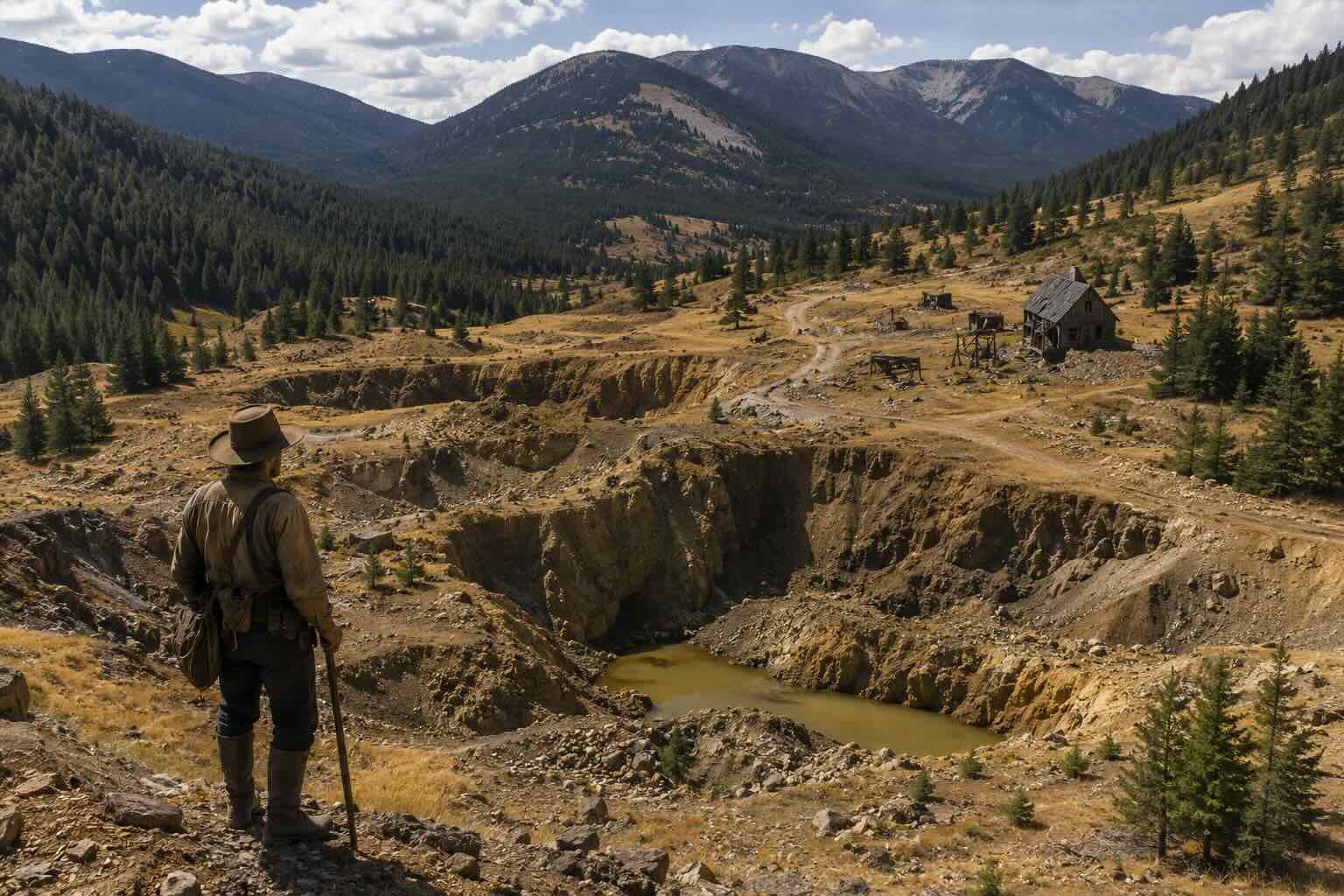
West-central Montana’s Little Blackfoot Drainage produced some 300,000 ounces of gold during the 19th and 20th centuries, when the Treasure State was awash in prospectors and miners. Evidence of that earlier period persists today in the Conestoga wagon-sized holes that pock the land, and in hints of the stagecoach route that once connected Helena to Blackfoot City, the commercial hub of a valley that was lauded as a “true American Switzerland” before it faded into a ghost town.
But the sought-after minerals that shaped the region have not been exhausted. Recent geological sampling by Falcon Copper Corporation, paired with geochemical analysis and helicopter-enabled magnetic surveying, suggests that sizable deposits of copper, tungsten, zinc, gallium and germanium remain beneath this forested and wild-rose-speckled expanse of the Helena-Lewis and Clark National Forest.
These critical minerals just won’t be easy to get to, says Phillip Nickerson, Falcon Copper’s vice president of exploration. “All of the low-hanging fruit is gone,” Nickerson told Montana Free Press on a recent tour of Blue Copper, Falcon Copper’s flagship project. He estimates that there is a 1-in-1,000 chance the company’s exploratory drilling will transition to a full-scale mine.
Nonetheless, the samples the company has already analyzed, paired with surging demand — and prices — in the copper market have encouraged Falcon Copper CEO Travis Naugle to pursue an exploratory mining permit for Blue Copper. Naugle, a Montana Tech-educated mining executive and engineer based in Fort Collins, Colorado, owns mining claims and a cabin near the Blue Copper site.
The effort to drill down as far as 7,000 feet to extract hundreds of samples across as many as 127 drill pads is part of a larger push to revisit old mining claims with an eye to extracting minerals like copper, which Nickerson describes as essential to national security initiatives, data-center development and the buildout of renewable energy.
Roughly 90 miles to the southwest of Avon, another project involving critical minerals has landed before the U.S. Forest Service for review. Over several years, U.S. Critical Materials has been working on a rare-earth element project south of Darby called Sheep Creek, which involves minerals used in smartphones, semiconductors and thermostats.
The Forest Service’s handling of Blue Copper and Sheep Creek provides a window into the federal government’s approach to mining 18 months into President Trump’s second term in the White House. The emerging picture is relatively opaque, and one that includes abbreviated comment periods — and plenty of frustrated locals.
Although Blue Copper and Sheep Creek are distinct projects led by companies with different reputations, Montanans living near the exploratory mining sites told MTFP that they’re hungry for more information on potential impacts to their communities and livelihoods. They’re also frustrated by Forest Service decisions not to extend comment periods to give them a better opportunity to understand and weigh in on the proposals, which span thousands of acres of national forest.
Nearby landowners described the Forest Service’s handling of these projects as rushed and “sneaky” in recent interviews with MTFP. They wondered aloud if the projects’ inclusion on the “FAST-41” list has given the agency less latitude to mitigate potential environmental harms — or to use its discretion to deny the projects altogether. And potential impacts to groundwater and surface water are a deep-seated concern. Both projects are situated in the headwaters of iconic western Montana rivers.
Stakeholders told MTFP that the Fixing American Surface Transportation Act, a law Congress passed in 2015 to “improve the transparency and predictability for federal environmental reviews,” hasn’t made it easier for them to learn about the projects’ environmental impacts. They argue that it appears that these projects, which have been facilitated by the ballooning list of minerals deemed critical to national security and the U.S. economy, are receiving less scrutiny from the Forest Service than they warrant.
Julie Michelle Klinger, a University of Wisconsin-Madison geography professor who studies rare earth-element mining in the U.S. and internationally, told MTFP in a recent interview that mining for materials on the lengthy list of critical minerals increases a project developer’s “social and political capital,” which can facilitate investment.
“There is a lot of money to be made, a lot of different ways for money to change hands,” she said. “Being on the critical minerals list can help that.”
Adrian Van Rythoven, a geologist who teaches at Montana Tech and works for the Montana Bureau of Mines and Geology, echoed that sentiment. He says the pursuit of viable deposits abound despite the uncertainty about the size and accessibility of the subsurface minerals mining companies are targeting.
Exploratory mining tends to draw a variety of actors with varying degrees of reputability. Van Rythoven said not all companies are committed to the “winning of hearts and minds,” but the serious ones understand the importance of early and frequent community engagement.
“Most modern mining companies understand that you can have all the legal rights you want,” he said, “but if the community is dead-set against you starting a mine, it’s probably not going to happen.” He added that, having visited both the Blue Copper and the Sheep Creek sites, there is plenty of evidence that those areas hold the minerals Falcon Copper and U.S. Critical Materials are searching for. The critical questions, Van Rythoven says, are how much exists and whether neighboring communities will back the projects.
“It’s kind of like trying to figure out what’s behind a sheet. It could be an elephant behind the sheet. But you can only poke little holes in it and try to figure out what’s going on,” he said. ”You can’t see the whole thing all at once.” Van Rythoven went on to describe exploratory mining as “only a little bit more certain” than betting on a horse race.
We’re all complicit in the demand for metals like copper, added Van Rythoven, who specializes in critical minerals. “If you use electricity, you need metals.”
BLUE COPPER: EXPLORING FOR HEAVY METALS IN LITTLE BLACKFOOT DRAINAGE
Longtime Powell County residents Grant and Diane Loeffler learned about the Blue Copper project two weeks before the comment period closed on July 2. They haven’t seen any outreach from the Forest Service, which has been faulted for failing to hold a single public meeting on the proposal and for limiting the comment period to 30 days. Rather, they learned about the project through the grapevine.
The Loefflers scrambled to submit comments, and helped facilitate a June 26 community meeting in nearby Avon, complete with a court recorder — a last-minute addition designed to increase the likelihood that the Forest Service would consider landowner concerns about the project. Falcon Copper and Forest Service representatives attended the meeting but didn’t make their presence known, Grant Loeffler said.
“We had a real feeling that it was sliding along quietly,” he said of the agency’s handling of the project. “If they grant the permit based on the [environmental assessment], there’s going to be a lot of upset in the community. We’re all asking for an environmental impact statement.”
An EIS is a more rigorous analysis under the National Environmental Policy Act, the country’s 56-year-old law designed to give the federal government a look-before-you-leap framework for evaluating projects with significant environmental repercussions. When federal agencies like the Forest Service prepare an EIS, they evaluate a project’s anticipated effects on water, soil and wildlife as well as its social and economic implications. An EIS also includes a collection of possible alternatives.
MTFP contacted local Forest Service officials to discuss the agency’s environmental review of Blue Copper. A Helena-Lewis and Clark National Forest spokesperson responded that the agency is not considering interviews about the project at this time, and directed MTFP to Falcon Copper and the agency’s Blue Copper project page for details.
Water is one of the biggest concerns for the Loefflers, who support the local agricultural economy by growing hay and leasing ground to nearby cattle ranchers. “This area is headwaters for three different streams that feed a lot of hay ground,” Grant Loeffler said. “It’s not a big snowpack drainage — it’s all spring-fed. I think the concern is, at least with the exploration, this much drilling [could affect] all of these different springs for the cattle.”
Grant Loeffer is more concerned about a full-scale mining operation, but even the exploratory drilling in the Little Blackfoot drainage has provoked uncertainty. “The long-term implications of five years of drilling back in this country is a pretty darn big deal,” he said. “For something to operate 24/7, 365? It’s incredible to me — that you could be back in that country in the middle of the night in winter.”
An influx of up to 65 workers straining local services is another point of concern for the Loefflers, as is the threat of increased traffic, particularly on stretches of the Helena-Lewis and Clark that are leased for cattle grazing.
Nickerson, with Falcon Copper, took MTFP to a drill site the Forest Service authorized in 2024 under a categorical exclusion, a perfunctory review reserved for proposals that involve minimal ground disturbance, typically fewer than 12 drill sites. Drilling equipment had been removed, but Nickerson pointed to the silver dollar-sized spot where the geological sample had been extracted. The drill pad — this one located off an existing, four-wheel-drive-only road — was about 20 feet by 40 feet, roughly the size of a campsite. (Although many of the up to 127 sites Falcon has eyed for a drill pad are located along existing roads, the company says it might need to build three miles of new roads to facilitate site access.)
Sitting near the partially rehabilitated drill pad were small pieces of turquoise-colored rocks that hearken to the project’s name. Copper can take on a teal color when it oxidizes, Nickerson said, adding that oxidation is what gives the Statue of Liberty its distinctive patina.
Other comments submitted to the Forest Service highlighted recreational impacts and concerns about a lackluster analysis of the effects on grizzly bears, wolverines, lynx, bull trout, elk and other wildlife. Gayle Joslin, a member of Helena Hunters and Anglers and retired state wildlife biologist, offered a 24-page comment decrying the “inadequacy” of the analysis and the “bias” with which it was prepared. Like the Loefflers, Joslin urged the Forest Service to extend the comment period, a request that the agency denied.
Asked about the Forest Service’s process for reviewing the application, Nickerson said the agency has a fair bit of discretion. It’s ultimately up to the district ranger to decide to greenlight a project, reject it, order more environmental analysis, or allow it to move forward with accommodations to reflect environmental concerns, Nickerson said. The authority to extend the comment period also rests with the agency, he added.
Nickerson said Falcon anticipates a decision on the environmental analysis in July of 2027, with work starting later that year.
SHEEP CREEK: PROBING FOR RARE EARTH ELEMENTS IN WEST FORK HEADWATERS OF BITTERROOT RIVER
Located about 90 miles to the southwest of Avon as the crow flies, the West Fork drainage of the Bitterroot River is a forested, steep and generally quiet pocket of the Bitterroot Basin popular with anglers and elk hunters. It’s also ground zero for a proposed rare-earth element mine generating a groundswell of local opposition due to a variety of concerns, ranging from polluted waterways to the potential that radioactive waste would be transported along a key travel corridor.
Last December, an estimated 700 people packed into a meeting the Ravalli County Commission held to discuss the Sheep Creek project. Opposition to U.S. Critical Materials’ proposal was so intense that within four days of the meeting, U.S. Rep. Ryan Zinke and U.S. Sen. Tim Sheehy did something members of Montana’s all-Republican federal delegation rarely do: they urged the federal government to pump the permitting brakes.
“Montana knows better than anyone there’s a right and wrong way to mine,” Zinke said in a statement following the county commission meeting. “Fast tracking a mine with overwhelming public opposition and bypassing the mechanisms that allow for transparency and accountability is the wrong way to do it.”
Zinke and Sheehy argued Sheep Creek isn’t a good fit for the FAST-41 list given opposition from the Ravalli County Commission and other Bitterroot Valley residents. Still the project remains on the list, which confounds Philip Ramsey, manager of MPG Ranch and the unofficial point person for scientific analysis of the Sheep Creek project.
According to Ramsey, much of the local opposition can be traced back to where the Sheep Creek project is located and how U.S. Critical Materials has interacted with the community.
The most recent iteration of the U.S. Critical Materials plan, released earlier this month, calls for sampling or drilling at four sites, two of which will require explosives, and two of which will use existing adits, or horizontal mine openings. One of the most notable changes from an earlier proposal that U.S. Critical Materials withdrew in March involves the use of helicopters to service the sites. Drills, excavators, generators, air compressors and chainsaws will also be used to facilitate the sampling.
Scott Osterman, CEO of U.S. Critical Materials, says the company shifted to accessing the site with helicopters and large ATVs to allay some of the concerns Ravalli County residents voiced about the project’s footprint.
Still, Ramsey, an ecologist by training who maintains a personal interest in mines and mining, describes the project as the “worst spot for a rare earth-element mine” given the drainage’s topography and its location at the uppermost headwaters of the West Fork. “It’s perfectly positioned to contaminate the entire Bitterroot and Clark Fork [rivers],” he said.
Running parallel to that critique is Ramsey’s insistence that there are other avenues to secure the rare earth elements U.S. Critical Materials is seeking — minerals like gallium, samarium, scandium, neodymium, praseodymium. One of those is the infamous Berkeley Pit, which Ramsey described as a win-win in terms of securing the materials that are indispensable to smartphones and other technology, and the potential to clean up legacy mine waste in the process.
“The same rock that they want in Sheep Creek is sitting there in Butte,” Ramsey said. “If they’re so worried about national security, [let’s look at Butte] rather than destroy pristine national forest.”
Ramsey is also concerned about levels of thorium, a radioactive material that’s subject to federal oversight and used in electric vehicles and nuclear submarines.
“The stuff that they actually want to transport down the road is the high-grade and high-end material,” he said. “And that stuff is hot. They’re saying, ‘Oh, don’t worry about it.’ But that’s against the data.”
These are points Ramsey has made over and over again, at dozens of meetings he’s spoken at since he first learned about the surface sampling U.S. Critical Materials initiated four years ago. Although he remains skeptical of U.S. Critical Materials’ motivations and track record, as well as the company’s frequent leadership changes, local pushback appears to have played a role in the company’s decision to relocate their headquarters from Salt Lake City to Darby, Montana.
According to a June 29 press release, Darby will become the company’s “permanent corporate home” to “reinforce USMC’s long-term commitment to the Bitterroot Valley.”
But Ramsey said he hasn’t seen evidence that anyone is actually staffing the office located in an Old West-themed building that formerly housed a candy shop and an antique retailer. “They just give lip service to public engagement and doing things right and environmentally safe,” said Ramsey, describing Sheep Creek as a “proposal to mine cloaked as a proposal to explore.”
For his part, Osterman emphasizes the need for the type of heavy rare-earth elements U.S. Critical Materials hopes to extract. He also highlighted the size of the deposit he believes is there, describing it as “one of the most significant” deposits of its kind in the U.S. A few beats later, he tempers his optimism for the project’s future.
“This is still exploration,” he said. “I know that there’s a lot of concern about there being a mine, but our job in the exploration phase is to do two things. One is to demonstrate that there is an economic and viable deposit that’s worth pursuing. And two is ensuring that it can be done safely in an environmentally sound way that becomes a benefit to the community.”
Ramsey gives the Bitterroot National Forest credit for keeping the community at least somewhat informed on the proposal, but remains mystified by Sheep Creek’s continued inclusion on the FAST-41 list given inconsistencies in the company’s application, the federal delegation’s reservations about the project, and the huge amount of pushback the project has generated.
In a July 16 conversation with MTFP, Ramsey said he was similarly baffled by a change to the Sheep Creek entry on the FAST-41 dashboard. The environmental assessment is now marked as canceled, and Ramsey wondered aloud if U.S. Critical Materials intended to use its revised mining plan to push the project forward with a categorical exclusion.
On July 27, he got his answer: the Bitterroot National Forest announced that it is evaluating Sheep Creek’s new proposal under a categorical exclusion. The agency’s press release noted that it might revise that plan “if the analysis indicates that the proposed activities warrant additional NEPA review.” A comment period is expected to start in August.
But other questions linger, including how Sheep Creek made it on to the FAST-41 list to begin with.
“I’ve tried to figure out who put it on there, why it’s on there, who’s pulling the strings,” Ramsey said. “It’s so hard to find out anything about a project that’s supposed to be transparent.”