

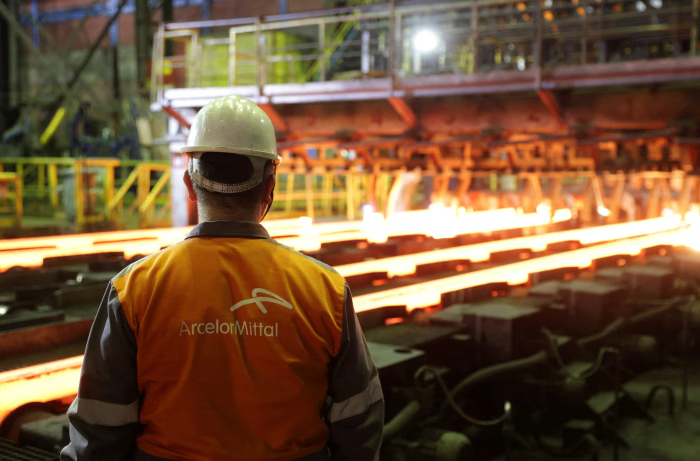
A $100-million fine against a global mining giant for contaminating water in Quebec’s Côte-Nord marks the highest-ever infraction of its kind, but experts say the settlement with the federal government also shows the immense challenges in regulating the country’s mining sector.
Court documents state that ArcelorMittal “illegally immersed, discharged, or permitted the immersion or discharge of a harmful substance” into vulnerable, fish-bearing waters surrounding its mining operations near Fermont, Que., between 2014 and 2022.
The company pleaded guilty to 100 counts of violating the federal Fisheries Act, and will pay a $1-million fine for each count, most of which will go toward the Environmental Damages Fund.
Experts say the case illustrates the difficulty in overseeing Canadian mines and ensuring their compliance with government regulations, even as Prime Minister Mark Carney seeks to fast-track critical minerals projects across the country.
“These types of fines are sort of like reactionary measures,” said Sara Ghebremusse, an assistant professor who specializes in mining governance at the University of British Columbia’s Allard School of Law.
“Presumably, this type of pollution should not have happened in the first place.”
Infractions dating back to 2011
The Mont-Wright mine, which has been in operation since the 1970s, covers 24 square kilometres, making it the largest open-pit iron mine in Canada, according to the company.
Documents show ArcelorMittal has a record of non-compliance at the site.
In 2022, the mining giant was ordered to pay $15 million for infractions between 2011 and 2013.
During the course of that investigation, officials found deposits of toxic substances had been released into the watershed. The company was also found guilty of having made “false and misleading statements” to federal environmental officers.
Émile Cloutier-Brassard, who monitors mining companies for the environmental group Eau Secours, said news of the settlement left him with mixed emotions — somewhere between “the happiness of seeing the government doing its job,” and “the fact that the fine remains kind of small in regard to the profit of the company.”
In 2025 alone, the Luxembourg-based ArcelorMittal generated $61 billion US in revenue globally, with $3.15 billion US in profits.
Protecting the Moisie River
The charges in the most recent case relate to the “deposits of deleterious substances” by the Mont-Wright mining complex, as well as the nearby Fire Lake mine, into “several streams and lakes” in the Fermont region, according to Environment and Climate Change Canada.
These streams and lakes ultimately connect to the Moisie River, a vital spawning area for Atlantic salmon in the ancestral territory of the Innu Nation.
Known in Innu-aimun as “Mishta-shipu,” or “The Great River,” the river has been the focus of a sovereign conservation push.
Last year, Chief Jonathan Shetush and the Innu Council of Uashat mak Mani-Utenam (ITUM) formed the Mishta-shipu Watershed Protected Area — the first Indigenous Protected and Conserved Area in Quebec.
The initiative was launched in an attempt to shield the land from industrial degradation and protect local wildlife.
ITUM said ArcelorMittal’s recent $100-million fine underscores why the community is fighting for the long-term conservation of the watershed.
“The corrective measures put in place by ArcelorMittal must guarantee that such discharges will not happen again,” Shetush said in a statement, adding that the community intends to work closely with the federal Environmental Damages Fund to ensure a significant portion of the fine is devoted to the area.
The court also ordered the mining company to reimburse the cost of the investigation, nearly $250,000, and produce an environmental plan by February 2027.
Sarah Seck, an associate professor specializing in environmental law at Dalhousie University’s Schulich School of Law, said “environmental vigilance takes time.” Usually, the government tries to get a company to fall in line before pursuing prosecution, she said.
“It really does take a big effort for these things to come to court, which goes to the importance of having enough in budgets to make sure compliance and prosecution are well-funded,” Seck said in an interview.
“If there is a fast-tracking mentality going on, it can’t also come at a time of cutting of budgets for compliance and enforcement because companies don’t always comply.”
Ghebremusse said the federal government has in place regulations to “prevent events like this from happening.”
“So if the regulations fail, then you wonder, where are the shortcomings in the regulatory process?”
Company says it’s committed to improvement
ArcelorMittal said it has already invested in infrastructure to improve the situation on site, including a water treatment facility.
The company said in a statement it has invested more than $400 million in “long-term water control and treatment infrastructure to address operational and environmental water challenges both on site and in the surrounding areas.” Those improvements were completed in 2023, the company said.
In an email response to CBC, a spokesperson for ArcelorMittal Mining Canada acknowledged the settlement was to some extent “a continuation of the previous issues between 2011 and 2013.”
Developing and building large-scale infrastructure at the site is a “complex, expensive, and time-consuming process,” Annie Paré said, citing the remoteness of the area, harsh weather and labour challenges.
“The project must also address the legacy and environmental history of a 52-year-old mine site, while navigating extensive regulatory and permitting approval processes,” Paré said.
“We are now focused on the future and demonstrating to our stakeholders, including local communities, that protecting the environment is a priority for us, with the settlement marking the end of this issue.”
By – https://www.cbc.ca/news/canada/montreal/quebec-mine-arcelormittal-fine-9.7208362