

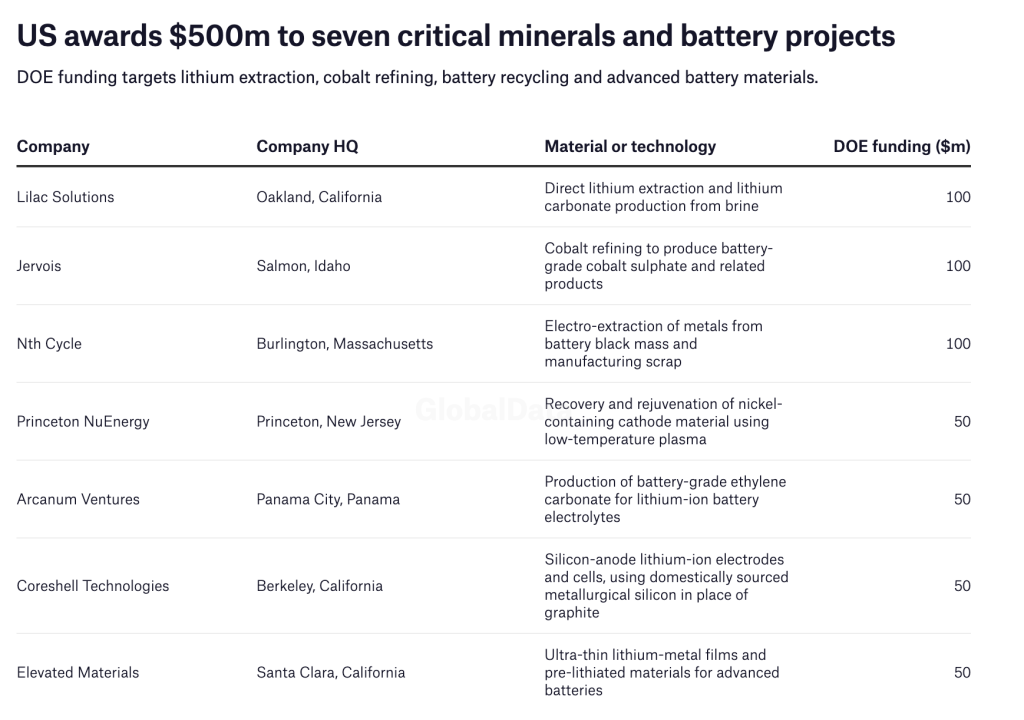
The US Department of Energy (DoE) has awarded $500m to seven companies developing domestic critical minerals processing, battery recycling and advanced battery-material projects, according to a DoE press release and reporting by Reuters.
The announcement comes as the US administration seeks to expand domestic supply chains for materials used across energy, industrial and defence applications.
The funding, announced on 20 August, is the third round of grants under the DoE’s Battery Materials Processing and Battery Manufacturing and Recycling programmes. The department said the selected projects would expand US processing and recycling capacity while reducing reliance on foreign sources.
The awards come as President Donald Trump has called for the US to become the world’s “minerals superpower” and reduce its dependence on China for critical materials. Reuters reported that the administration has been using loans, grants and government investments to encourage domestic mining and processing projects.
Audrey Robertson, Assistant Secretary at the DOE, told Reuters that hundreds of applications had been received for the latest funding round. The selected projects, she said, were those considered “most promising” and offering the highest potential return in areas of the battery supply chain identified as priorities.
Lilac Solutions will receive $100m to develop a commercial lithium extraction and refining facility on the Great Salt Lake in Utah. The project will use direct lithium extraction (DLE) technology and is set to produce battery-grade lithium carbonate. The DoE documents put the first-phase capacity at 5,000t per year, with first production targeted for 2028.
Robertson said that DoE scientists “firmly believe” the project could provide a beneficial domestic source of lithium carbonate. Lilac has previously received backing from BMW and is developing its ion-exchange DLE technology for brine resources, Reuters said.
Jervois will also receive $100m to develop a cobalt refinery in the US. The facility is intended to produce battery-grade cobalt sulphate and related materials, establishing domestic refining capacity for a metal used in batteries, electronics and defence applications. The DoE said the project would use established refining technology.
Jervois controls the Idaho Cobalt Operations and was taken private in 2025 following a pre-packaged bankruptcy restructuring. Robertson said cobalt remained strategically important despite weak market conditions and that the proposed refinery could eventually process material from deep-sea nodules, according to Reuters.
Battery recycler Nth Cycle will receive $100m for a facility in the south-eastern US to process black mass from end-of-life lithium-ion (Li-ion) batteries and manufacturing scrap. The DoE said the project would use Nth Cycle’s electro-extraction technology to produce high-purity metals and battery-grade materials.
The award follows the Trump administration’s decision earlier this month to block exports of black mass. Robertson said the funding was not linked to that decision but said the US “needs to and will build the ecosystem” to recycle and process batteries and black mass domestically.
Four further projects will each receive $50m. Princeton NuEnergy will use the funding for a demonstration facility in Georgia to recover and rejuvenate nickel-containing cathode material from battery manufacturing scrap using a low-temperature plasma process.
Coreshell Technologies will receive $50m to establish US manufacturing capacity for silicon-anode Li-ion electrodes and cells, replacing imported graphite with domestically sourced metallurgical silicon. The project combines Coreshell’s silicon-anode technology with dry-coating cathode technology and is intended to establish the first US gigafactory dedicated to silicon-anode battery production. The DoE says the approach is intended to reduce costs and improve battery safety while increasing domestic use of metallurgical silicon.
Arcanum Ventures will develop a US Gulf Coast facility producing battery-grade ethylene carbonate, a component of Li-ion battery electrolytes. Coreshell Technologies will establish US manufacturing capacity for silicon-anode Li-ion electrodes and cells, using domestically sourced metallurgical silicon in place of graphite.
The seventh recipient is Elevated Materials. The DoE is awarding it $50m for a US facility producing ultra-thin lithium-metal films and pre-lithiated materials intended for higher-energy and faster-charging batteries.
The latest awards add to around $40bn in provisional US Government funding for mineral projects since 2022, according to the Financial Times, spanning grants, loans, equity investments and other forms of support.
The DoE said the first two funding rounds had already awarded $1.82bn to 14 projects covering lithium, graphite, battery components and recycled materials.