

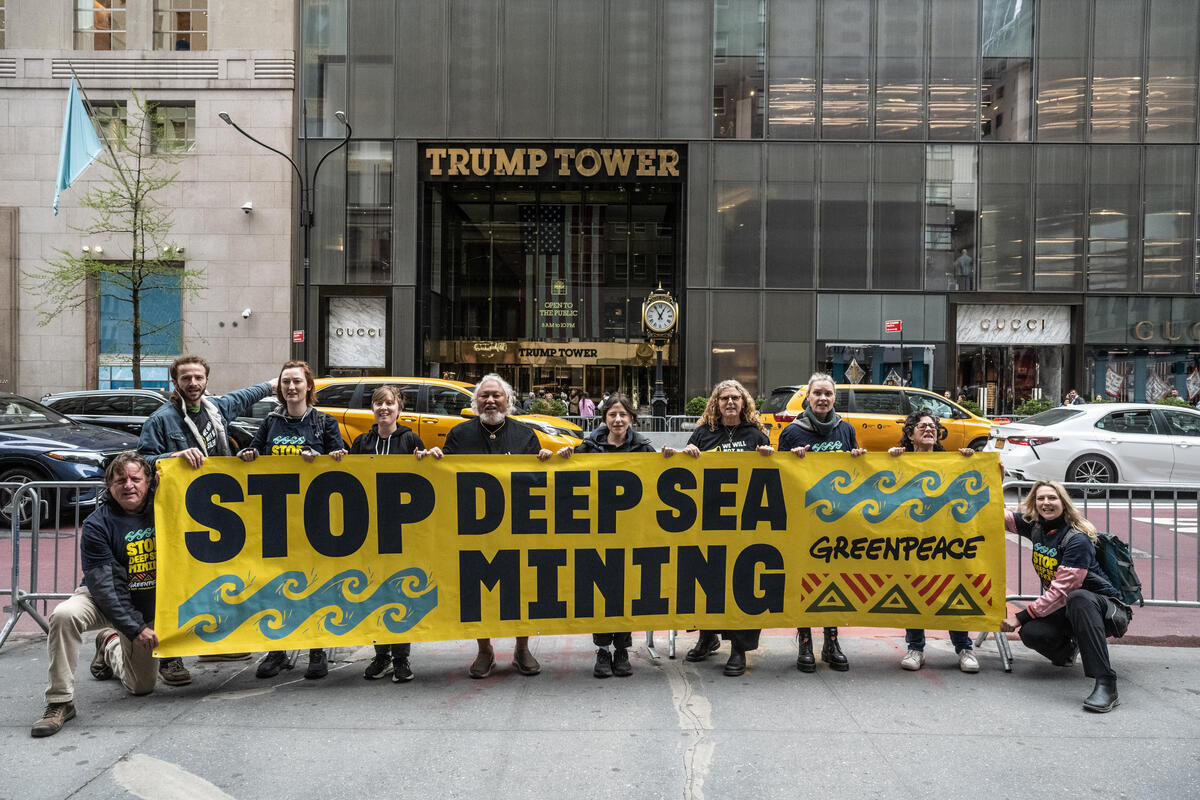
Governments must defend international law
As governments gather this week for the latest Council session of the International Seabed Authority (ISA), evidence submitted by Greenpeace International raises questions about whether The Metals Company (TMC), its subsidiaries, and subcontractors may have breached the regulator’s exploration contracts. The developments come as governments continue negotiating rules that would govern commercial mining of the international seabed, while industry pressure to begin extraction grows.
Greenpeace International is urging member states to investigate the allegations and take firm and swift action if breaches are confirmed.
Arlo Hemphill, Greenpeace USA Oceans Are Life Campaign Lead, said: “If the ISA’s rules mean anything, member states must ensure they are enforced. Deep sea mining threatens one of the planet’s most important and fragile ecosystems with large-scale and irreversible destruction. Governments should be strengthening ocean protections, not opening the door to a free-for-all on a system already under pressure or giving companies with unresolved compliance questions a greenlight to mine.”
The ISA opened an inquiry at its last Council meeting in July 2025 after TMC USA sought unilateral deep sea mining licences from the Trump administration under the Deep Seabed Hard Mineral Resources Act (DSHMRA), raising concerns about efforts to pursue mining in international waters outside the ISA framework. TMC USA has also recently filed the first consolidated deep sea mining application under a newly streamlined U.S. permitting process created under the same law.
Many legal scholars argue that such U.S. actions would conflict with international law and could place companies that take this approach in breach of existing exploration licenses issued by the regulator, which operates under the United Nations Convention on the Law of the Sea (UNCLOS). Under the treaty, seabed minerals in international waters are considered the “common heritage of humankind.”
Evidence submitted by Greenpeace International to the ISA Secretary-General Leticia Carvalho, in support of the body’s ongoing inquiry into deep sea mining contractors, focuses on TMC’s subsidiaries—Nauru Ocean Resources Inc. (NORI) and Tonga Offshore Mining Ltd. (TOML)—as well as Blue Minerals Jamaica (BMJ), a company linked to Dutch-Swiss offshore engineering firm Allseas, one of TMC’s subcontractors and largest shareholders. The submission argues that the cohort’s activities, taken together, may violate core contractual obligations under UNCLOS.
Greenpeace International has urged the ISA to consider taking action, including not renewing the exploration contracts of NORI and TOML, which expire in July 2026 and January 2027, respectively, if these claimed breaches are confirmed.
Louisa Casson, Campaigner, Greenpeace International, said: “In July, governments at the ISA sent a clear message: rogue companies trying to sidestep international law will face consequences. Turning that promise into action at this meeting is far more important than rushing through a mining code designed to appease corporate interests rather than protect the common good. As delegations from around the world gather today, they must unite and confront the U.S. and TMC’s neo-colonial resource grab and make clear that deep sea mining is a reckless gamble humanity cannot afford.”
The Greenpeace International analysis found that:
- Following TMC USA’s application to mine the international seabed unilaterally, NORI and TOML have amended their agreements to provide payments to Nauru and Tonga, respectively, if U.S.-authorized commercial mining goes ahead. This sets up their participation in a financial mechanism predicated on mining in contradiction to UNCLOS.
- NORI and TOML have signed intercompany intellectual property and data-sharing agreements with TMC USA, and the data obtained by NORI and TOML under the ISA exploration contracts has been key to facilitating TMC USA’s application under U.S. national regulations.
- Just a few individuals hold key decision-making roles across TMC and all relevant subsidiaries, making claims of independent management ungrounded. “NORI, TOML, and TMC USA, while legally distinct, are managed as an integrated corporate group with a single, coordinated strategy under the direct control and strategic direction of their parent company [TMC].” (analysis, p. 2)
Letícia Carvalho has recently publicly advocated for governments to finalize a streamlined deep sea mining code this year and has expressed her own concerns with the calls from 40 governments for a moratorium. At a time when rogue actors are attempting to bypass or weaken the international system, Greenpeace believes that establishing rules and regulations that will allow mining to start is falling into the trap of international bullies. A mining code would legitimize and drive investment into a flagging industry, supporting rogue actor companies like TMC and weakening deterrence against unilateral mining outside the ISA framework.
Casson added: “Rushing to finalize a mining code serves the interests of multinational corporations, not the principles of multilateralism. With what we know now, rules to mine the deep sea cannot coexist with ocean protection. Governments are legally obliged to only authorize deep sea mining if it can demonstrably benefit humanity—and that is non-negotiable. As the long list of scientific, environmental, and social concerns with this industry keeps growing, what is needed is a clear political signal that the world will not be intimidated into rushing a mining code by unilateral threats and will instead keep moving towards a moratorium on deep sea mining.”