

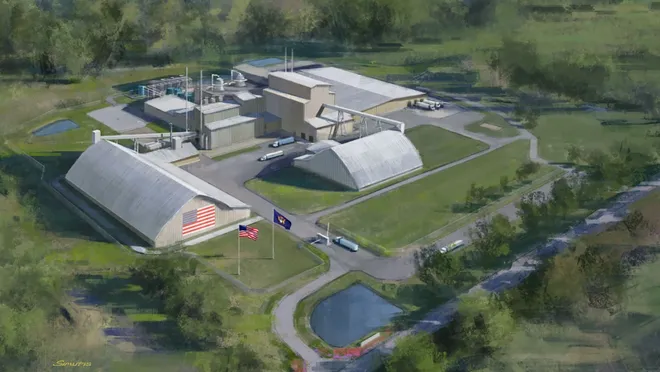
The company behind a $2 billion mining project for table salt and the mineral potash proposed for Osceola and Mecosta counties near Evart is asking the U.S. Environmental Protection Agency to approve changes to two proposed injection wells, and to add three additional injection wells, to dispose of its brine and other fluid wastes deep underground.
Michigan Potash & Salt Co. seeks to use solution mining — injecting brine water thousands of feet underground to dissolve potash and bring it to the surface, where it would then be dried and reconstituted. The operation would also generate marketable, table-grade salt. Brine water waste would then be disposed of deep underground via the injection wells.
The company plans to produce up to 800,000 tons of potash per year, and up to 1 million tons per year of salt.
The Michigan Department of Environment, Great Lakes, and Energy (EGLE) — then known as the Michigan Department of Environmental Quality — approved the proposed mine’s request to use up to 725 million gallons of groundwater per year, almost 2 million gallons of groundwater per day. That’s more than five times the groundwater withdrawal by Nestlé North America’s Ice Mountain bottled water operation only a few miles away that raised public controversy.
Michigan Potash is seeking to modify permits approved by EPA in 2017, to include “fluid injection into an additional rock formation, and a lower maximum injection pressure calculated from the depth of injection,” according to EPA documents. The company also seeks permits for three additional injection wells.
Potash is a heavily used agricultural fertilizer that the Trump administration in 2018 included on a list of critical minerals of “vital importance to agriculture and national security.” The Biden administration removed the designation in 2022, and Trump restored it to the list in 2025.
Around 80% to 85% of the potash used by U.S. agriculture comes from Canada. Though exempted from tariffs against Canadian goods imposed by the Trump administration, as trade tensions escalated and the U.S. imposed 50% tariffs on a range of Canadian goods, some Canadian politicians, such as Ontario Premier Doug Ford, floated the idea of restricting potash exports or levying export taxes to pressure Washington.
Michigan Potash & Salt Co. CEO Theodore Pagano, in an email to the Free Press, said the requested injection well changes and additions “help alleviate execution risk and the permitting timelines associated with EPA rigor.”
“It has taken five years of additional EPA regulatory review for three wells,” he said. “In that time, potash supply chains have been disrupted by a pandemic, intentional weaponization of potash has occurred on two occasions, resulting in human death, stressed farming economies, additional foreign control, less U.S. competitive growers to Brazilian growers; trade threats on potash. And our most vulnerable, those that can’t afford groceries and the children that rely on school food programs, have limited relief in sight.”
Though Michigan Potash & Salt Co. officials have given repeated assurances that their project will not impact wetlands, surface water and groundwater aquifers in the rural farming and residential community, some area residents remain concerned.
“[I am] 100% against this and any wells, water waste [disposal] and anything else that has to do with this potash factory that has destroyed my property investment and value,” area resident Melanie Lain said in a comment to EPA on the proposed injection well permits. “I don’t believe any of their claims stating this is safe and won’t affect the water table or ecosystem; how can it not? NO.”
Marco Menezes, who lives about 1 mile from the proposed potash and salt mine, manages the Michigan Potash Watch Facebook group.
“This project is going to use five times as much water as the Nestle bottled water project that raised so much concern over the years — primarily to dispose of their salt waste,” he said. “That means not only are they taking the fresh water out of the aquifer, but then they are contaminating it and putting it out of the hydrogeological cycle forever.”
Countered Pagano, “Let’s not forget that Michigan is the wettest place on the planet surrounded by Earth’s largest volume freshwater, and further that this is roughly the amount of water needed for 1-2 irrigation pivots or 320 acres of farming.”
EPA staff, in its review of the injection well permits, found “no significant environmental impacts should result from issuing the three permits and modifying the two others.”
Potash, salt mine getting a big boost from government funding
Michigan Potash & Salt Co., in the waning days of the Biden administration in January 2025, received a conditional commitment from the Department of Energy for a loan guarantee of up to $1.26 billion to build its mining operation and processing center in Osceola County’s Evart Township. That came on the heels of the U.S. Department of Agriculture also providing an $80 million grant to Michigan Potash in December 2024. The state of Michigan in 2022 approved a $50 million subsidy and tax-exempt bonding for the company.
Pagano said of the $2 billion in capital needed to make the mining and processing facility operational, about $350 million in capital remains to be raised.
“The company is in process with J.P. Morgan and Goldman Sachs seeking strategic partners and investors on a pre-IPO round,” he said.
The mining proposal has been designated as a federal “FAST-41 project” to streamline the federal permitting and environmental review process under Title 41 of the Fixing America’s Surface Transportation Act [FAST Act]. passed by Congress in December 2015.
All may not be well with historic, closed wells nearby
Michigan Potash seeks to inject its brine water fluids approximately 4,000 feet below the surface. The federal Safe Drinking Water Act requires EPA to regulate the injection of fluids through wells to protect the quality of underground sources of drinking water.
“There are adequate confining layers between the injection zone and the deepest source of drinking water to prevent the movement of injected fluids into underground sources of drinking water,” EPA staff said in an overview on Michigan Potash’s injection well permit requests. Staff added that the drinking water aquifer in the injection well areas is at 620 feet below the surface.
EPA in the permit consideration, has set limits on the pressures at which the company can inject its waste fluids underground via the wells, to prevent fracturing of rock formations in the injection zone.
An EPA review of the proposed area for Michigan Potash’s injection wells found two historic wells “that appear to have been completed or plugged and abandoned in a way that might transmit fluids outside the permitted injection zone.” The agency is requiring Michigan Potash, as a condition of its permits, to attempt to properly plug the historic wells and report back to EPA on whether their efforts were successful. If unsuccessful, the agency will reduce Michigan Potash’s fluid injection pressures to mitigate for potential fluid escapes.
Pagano, however, said the historic wells “are adequately plugged and abandoned and protect all sources of underground drinking water.”
“The wells of concern are in immediate proximity of an existing operation that has operated without incident for over 35 years, and is still operating today,” he said.
EPA’s requirements include installing monitoring wells near the two abandoned wells in question to look for potential contamination as Michigan Potash & Salt Co.’s injection wells operate.
Menezes questioned how many historic wells in the vicinity Michigan Potash’s proposed injection well sites were physically checked for integrity as opposed to “paper checks … where somebody years ago wrote down on a paper record that was filed with DNR that, yes, we plugged this well.”
Michigan Potash & Salt Co.’s proposed brine water injection wells are classified as non-hazardous wells, but Pagano said the company “is being held to hazardous waste standards despite handling food-grade brine.”
Menezes took issue with that argument.
“If you sprinkle food-grade salt on the ground, crops don’t grow,” he said. “If you put enough of it into water, it kills the micro-organisms, both in the groundwater and the surface water. Things begin to die up the food chain.”
By – https://www.freep.com/story/news/environment/2026/09/06/michigan-potash-injection-wells/91565208007/