

North Atlantic Titanium Corp., a Canadian exploration company focused on advancing the Everett titanium project in Quebec, acknowledges the recent launch of Canada’s first Defense Industrial Strategy by Prime Minister Mark Carney to strengthen security, create prosperity, and reinforce strategic autonomy. This is a strategy to transform Canada’s defense industries by prioritizing Canadian suppliers and materials, investing in Canadian innovation and commercialization, and streamlining procurement to give businesses consistent and predictable demand.
The Defense Industrial Strategy is an investment of over half a trillion dollars in Canadian security, economic prosperity, and sovereignty.(1) By 2035, the Canadian government aims to invest 5% of annual GDP in defense spending as part of the North Atlantic Treaty Organization (NATO) Defense Investment Pledge.
- $180 billion in defense procurement opportunities and $290 billion in defense-related capital investment opportunities in Canada over the next 10 years
- $125 billion in anticipated downstream economic benefit by 2035
- 125,000 new jobs
- 50% increase in defense exports
- 70% share of defense acquisitions awarded to Canadian firms
- 240% increase in Canadian defense industry revenues
- Raise maritime fleet serviceability to 75%, land fleets to 80%, and aerospace fleets to 85% to bolster Canadian defense within 10 years
Key sovereign capabilities for which the Defense Industrial Strategy shall prioritize include aerospace (aircraft, helicopters, satellites, unmanned aerial vehicles (UAVs), ammunition (common ammunition; battle-decisive munitions; small arms; missiles and bombs), digital systems, in-service support, personnel protection, sensors, space, specialized manufacturing, training and simulation and unscrewed and autonomous systems (Government of Canada).
Titanium’s Essential Role in High-Value Industries
Titanium is a silvery, grey critical metal which is high-strength, light-weight and low-corrosion. It is as strong as steel but 45% lighter which makes it vital for the aerospace and defense industries. In addition, key industries for titanium include medical, energy & renewables, consumer products and pigments. Titanium’s total market size in 2024 was US$28 billion with a forecasted CAGR of 6.5% from 2025 – 2034 (Precedent Research).
Titanium is a NATO designated defense metal, with identified high supply risk for the following military applications: fighter aircrafts, tanks, missiles, submarines, and ammunition. Global titanium sponge production is largely controlled by China, requiring the need to build domestic production capability to strengthen Western supply chain. Titanium sponge price is at a 15 year high, +22% since 2020 in the US and exempt from US tariffs (US Geological Survey).
North Atlantic Titanium’s Everett Project in Quebec
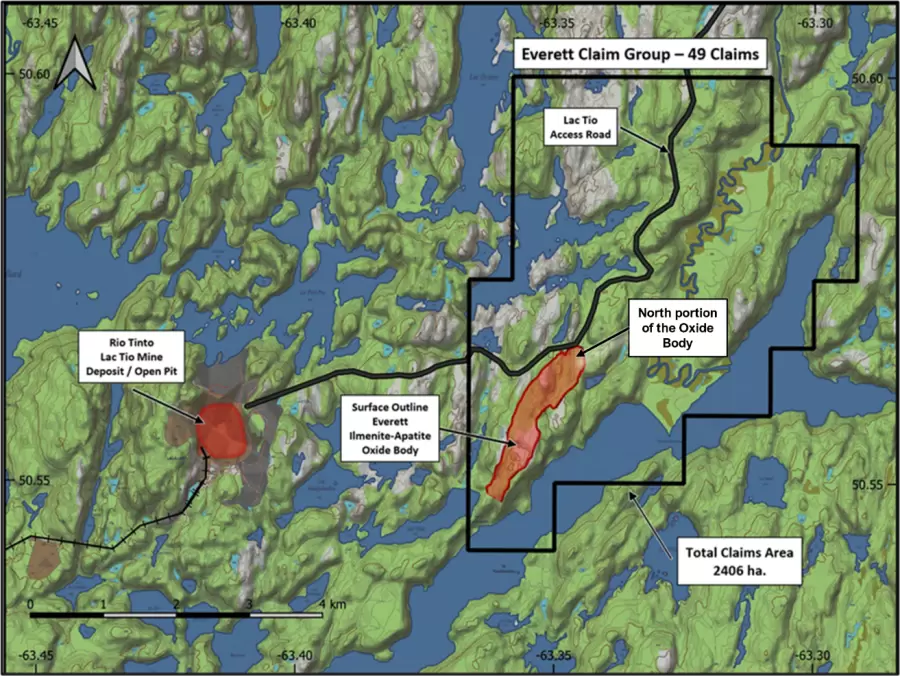
The Everett Property comprises 49 mineral tenures covering 2,406 ha (5,946 acres) (See Figure 1). Early in the Everett Property’s history, 34 diamond drill holes defined a significant historical mineral resource. Later, 71 closely -spaced sites and two bulk sample sites were sampled on the surface of the Everett Property, with assay and metallurgical samples obtained over a 3.5 km of outcrop. Numerous historical mineralogical studies and metallurgical process tests conducted by commercial and university research laboratories have demonstrated very high recoveries of Ti, Fe, and P to the concentrates.
The Everett Property spans the eastern margin of the Proterozoic Havre-Saint-Pierre anorthosite massif. Anorthosite massif deposits are of significant economic interest for critical mineral commodities, including Fe–Ti oxide minerals (for titanium, vanadium, and iron), and apatite minerals (for phosphorus, often including rare earth elements).
The Everett Property is recognized by the USGS and the Quebec Geological Sciences Service as one of the most significant hard-rock ilmenite (FeTiO3) deposits in the world, alongside producing deposits at Lac Tio, Quebec (Rio Tinto Fer et Titane Inc.) and Tellnes, Norway (Kronos Worldwide Inc.). The Everett Property is situated 3 km east of the world’s largest hard-rock ilmenite deposit, Lac Tio. The deposit at Lac Tio is not necessarily indicative of the grades and tonnes of the adjacent Everett Property. Still, the two deposits share a closely similar mineralogy and are both hosted by mafic intrusions of the Havre-Saint-Pierre anorthosite massif.
Everett Historical Mineral Resource Estimates
An Engineering Report by Lees (Lees, J. Everett, 1972, Engineering Report on Gulf Titanium Ltd., GM58981) cited a historical resource of 234 million tonnes of 10.8% TiO2, 17.9% Fe and 2.8% P2O5* based on drilling in the 1950’s and 1968. The 1968 program comprised more definitive drilling and assaying of the northern extremity of the Everett oxide body. It defined a separate 340 m strike length of that historical resource (1/10th of the surface oxide exposure length) of the Everett oxide body of 50.8 million tonnes of 14.1% TiO2, 23.3% Fe, and 2.8% P2O5(1) within the larger tonnage reported.*
*These “resources” are historical in nature and should not be relied upon, neither treated as current estimate. It is unlikely they conform to current NI 43-101 requirements or follow CIM Definition Standards, and they have not been verified to determine their relevance or reliability. Originally reported in long tons as 230 million long tons with a grade of 10.8% TiO2, 17.9% Fe and 2.8 % P2O5, it is here converted to 234 million metric tonnes with a grade of 10.8% TiO2, 17.9% Fe and 2.8 % P2O5. Similarly, the 50 million long tons are converted to 50.8 million tonnes. These historical “resources” are reported without any specific categories, which is not conform to current NI 43-101 requirements, and any comparison is not a valid comparison. A qualified person (QP) has not done sufficient work to classify the estimate as current, and the Company is not treating the historical estimate as a current mineral resource.” Results are presented for exploration targeting only. Additional work is required to verify the historical mineral estimate and to upgrade the historical estimate to a current mineral resource. Such work is expected to include the verification of historical analytical results through twinning of historical sampling and drilling, as well as the completion of a staged diamond drilling program. Until such verification and additional exploration work has been completed, the Company cautions readers that the historical estimate should not be relied upon as a current mineral resource or mineral reserve.