

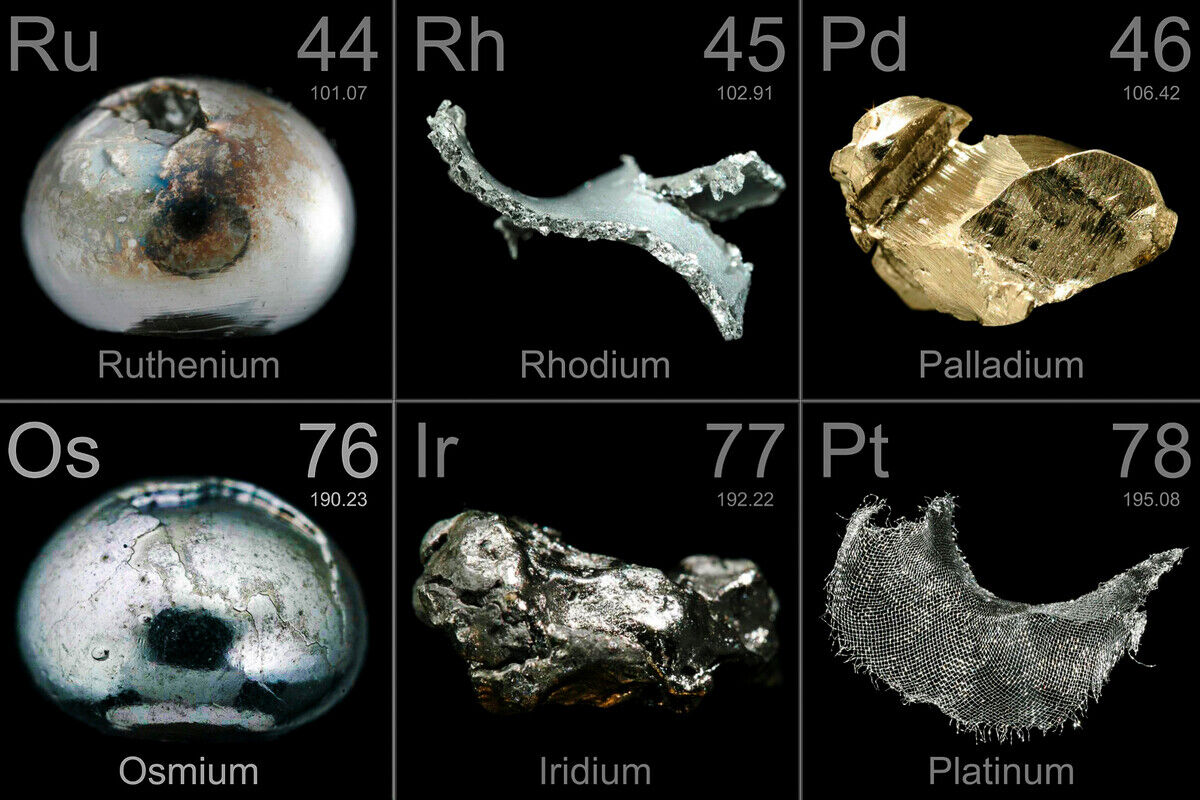
From jewelry and fountain pens to catalytic converters and hydrogen fuel cells, platinum group metals are an assemblage of six scarce and similar elements that are solidly positioned at the intersection of precious, industrial, and critical metals.
“These metals are foundational to U.S. automotive manufacturing, emissions compliance, aerospace systems, chemical catalysts, and fuel cell and electrolyzer development,” Amanda Van Dyke, founder of the Critical Minerals Hub, wrote in a Substack post. “Any disruption in PGM supply would immediately ripple through U.S. production lines, regulatory compliance obligations, and high-value manufacturing.”
That importance to U.S. supply chains, coupled with most global mine production coming from a small group of countries led by South Africa, Russia, and Zimbabwe, lands this group of durable and catalytic elements high on the United States’ critical minerals list.
“This is one of the most geographically concentrated mineral supply chains in the world,” Van Dyke wrote.
The six PGMs – platinum, palladium, rhodium, ruthenium, iridium, and osmium – are almost always found together in nature, but not in equal measure or equal economic importance. Platinum and palladium dominate mine output and market attention, while rhodium, ruthenium, and iridium are scarcer co-products with specialized, difficult-to-replace applications in the automotive, energy, and high-tech sectors. Osmium, used more narrowly in scientific and specialty applications, is the only one of the six PGMs not included on the 2025 list of minerals critical to the United States.
The U.S. Geological Survey’s assessments of which mined commodities to include on the newest critical metals list underscore a vulnerability as supply and demand dynamics shift with the energy transition and the buildout of AI infrastructure – this group of metals is mined as a basket, and the demand for one impacts the supplies of others.
A data center boom cannot simply summon more ruthenium needed for high-density hard drives. A transition to clean energy cannot immediately scale the supply of iridium for hydrogen production. A shift away from internal combustion engines – and the platinum and palladium-enabled catalytic converters that scrub their emissions – weakens the economic driver for producing the PGM co-products needed in the next generation of energy and digital technologies.
Tailpipes matter
For the past five decades, cleaning the exhaust of the fossil-fueled economy has been the largest industrial driver of PGM demand.
While EVs account for a growing share of new U.S. vehicle sales, catalytic converters for internal combustion engine vehicles continue to be the largest domestic use for PGMs, according to the USGS.
This is followed by their uses in the production of chemicals, petroleum refining, hydrogen production, medical devices, computer hard disks, integrated circuits, multilayer ceramic capacitors, glass manufacturing, investment, jewelry, and laboratory equipment.
The energy transition and technological advances are creating unusual tension in PGM markets. Battery EVs do not need catalytic converters, which puts long-term pressure on palladium and rhodium demand. Yet the decline is not linear. Hybrid vehicles, tighter emissions standards, and slower EV adoption are demand catalysts that are offsetting some of the loss of demand for platinum and palladium.
A 2026 PGM report by Johnson Matthey reflects this split market. The British chemicals and technologies company expects platinum demand to exceed supply this year, even as EV production rises. Palladium, after years of deficit, could move into a small surplus as gasoline vehicle production declines and recycling improves.
In other words, the tailpipe story is not over. It is in a transitional stage where climate policy, vehicle technology, recycling, and emissions standards are pulling the PGM market in different directions.
Hydrogen opens a new chapter
The same catalytic properties that allow PGMs to scrub exhaust from fossil fuel tailpipes also make them valuable to hydrogen technologies.
Platinum is widely used as a catalyst in fuel cells that convert hydrogen into electricity, with water and heat as byproducts. Iridium is especially important in proton exchange membrane (PEM) electrolyzers, which use electricity to split water into hydrogen and oxygen. Ruthenium, palladium, and other PGMs can also play roles in catalysts and hydrogen-related chemistry.
This is the clean-energy upside for PGMs. Heavy-duty trucks, buses, trains, ships, stationary power, industrial heat, and green hydrogen production all offer potential growth pathways.
PEM electrolyzers are especially intriguing because they can respond quickly to intermittent renewable power, making them a potential partner for wind and solar generation. Their promise, however, comes with a material constraint.
Iridium is one of the rarest metals on Earth, and it is largely produced as a byproduct of other PGM mining. If PEM electrolyzers scale faster than efforts to thrift, substitute, or recycle iridium, the tiny market for this element that sells for around $7,500 per ounce could become a hard limit on one pathway for green hydrogen.
Johnson Matthey expects iridium to remain in deficit in 2026, with the first commercial-scale use of iridium in PEM electrolysis for green hydrogen emerging this year.
Hydrogen, however, may not be the most intriguing chapter of the PGM story. A digital plot twist has opened a new chapter that market analysts were not anticipating.
Enter AI data centers
AI is typically discussed as an energy story, a water story, a chip story, or a copper story. While all four are important parts of the AI revolution, data storage connects the buildout of data centers to the coming era of PGM demand.
The International Energy Agency projects global data center electricity consumption to roughly double from 485 terawatt-hours in 2025 to 950 TWh in 2030. AI-focused data-center electricity use is expected to grow even faster, tripling over the same period.
While pairing data centers with green hydrogen is a PGM demand subplot, the main character in this section of the market is hard disk storage.
AI training and cloud computing are often associated with semiconductors and solid-state memory, but hyperscale data centers still rely heavily on hard disk drives for high-volume, lower-cost storage of the enormous datasets feeding cloud and AI systems.
Ruthenium is used in the magnetic layers of hard disk drives, helping improve data storage density and performance. Platinum is also important to advanced hard drive technologies, including magnetic recording layers capable of storing more data in a smaller space.
For these reasons, Johnson Matthey expects data center construction to be a positive demand driver for both PGMs, but especially for ruthenium.
The market is already reacting. Reuters reported in March that ruthenium prices had climbed to around $1,750/oz, up from $560 a year earlier, as AI, cloud computing, and data storage demand tightened a market constrained by byproduct supply. Metals Focus projected a 203,000-oz ruthenium deficit for 2026.
This does not mean AI data centers will consume PGMs in the same bulk quantities that power grids consume copper or that batteries consume graphite, lithium, and nickel.
With a global market valued at around $45 billion, on par with lithium and nickel, PGMs are high-value metals that belie their small-volume supply story. And in small markets, even modest shifts in demand can move prices, expose supply risks, and change the way manufacturers think about critical materials.
Hard disks are only one part of the data center and the broader technology story.
PGMs are also found in integrated circuits, multilayer ceramic capacitors, electrical contacts, sensors, and specialty components where durability, conductivity, corrosion resistance, and stability under harsh conditions matter.
Ruthenium’s conductive properties and durability make it useful in wear-resistant electrical contacts. Rhodium and iridium help harden and strengthen alloys, while palladium is used in capacitors and chemical processes that require hydrogen exchange.
These high-tech applications help explain why PGMs belong in the critical minerals conversation even as the automotive sector changes.
Origin story points to future risks
The supply side of the PGM story is as concentrated as the demand side is diverse.
In 2025, USGS estimated that South Africa produced 70,000 kilograms of palladium and 120,000 kg of platinum, while Russia produced 84,000 kg of palladium and 20,000 kg of platinum. Zimbabwe added 15,000 kg of palladium and 18,000 kg of platinum. Combined, these three countries accounted for more than 90% of mined PGM supply.
The U.S. has a much smaller domestic footprint. USGS reported that one company in Montana mined and processed PGMs in 2025, while small quantities were recovered as byproducts of copper-nickel mining in Michigan and exported for refining. After factoring in the high rate of catalytic converter recycling, U.S. net import reliance sits at around 57% for palladium and 89% for platinum.
Recycling is a bright spot in the PGM origin story.
Unlike many battery materials that are still waiting for large volumes of end-of-life products to return to the system, PGMs have a mature recycling pathway through spent catalytic converters. As gasoline and diesel vehicles age out of the fleet, their converters become a significant secondary source of platinum, palladium, and rhodium.
USGS estimates that about 140,000 kg of palladium and platinum were recovered globally from new and old scrap in 2025, including about 50,000 kg of palladium and 8,600 kg of platinum recovered from catalytic converters in the U.S.
This secondary supply does not eliminate the need for mining, nor does it answer the call for the scarcer and higher-valued PGMs like iridium and ruthenium. It does, however, provide a domestic and allied source of material that can soften supply shocks, reduce waste, and lower the environmental burden of meeting new demand.
As PGMs move deeper into clean energy and high-tech applications, e-waste, fuel cells, specialty electronics, and industrial catalysts represent future sources of secondary supply.
Like the recycling of most critical minerals, the challenges are collection, separation, and economics – the opportunities lie in circularity and security of supply.
Catalysts for the next chapter
The coming chapter for PGMs is being defined by the tension of markets pulling this group of precious metals in two directions at once.
The slow migration away from ICE vehicles threatens the demand for catalytic converters, which have anchored platinum, palladium, and rhodium markets for five decades. At the same time, hydrogen systems, advanced electronics, and AI-driven data centers are opening new demand channels for the same family of metals.
The convergence of plotlines – declining legacy uses, rising high-tech demand, co-production, and concentrated supply – is creating a complex storyline for PGMs.
They are no longer just the metals that cleaned the exhaust of the 20th century. They are catalysts for the hydrogen systems, electronics, and data storage infrastructure that is helping to define energy, technology, and the economy in the 21st century.