

ASU researchers develop ways to stabilize waste from mining activities and recover critical minerals across Arizona
Arizona State University researchers are testing ways to turn one of mining’s biggest environmental liabilities into a potential resource for American businesses and consumers.
While the waste created from mining activities carries contaminants that can potentially make their way into nearby waterways, it may also contain critical minerals that could be sourced to strengthen U.S. domestic supply chains.
As part of the ASU Mining Innovation Initiative, several projects at ASU are working on ways to stabilize mine waste, reduce environmental contamination and recover critical minerals across Arizona.
The work is led by Hamed Khodadadi Tirkolaei, an assistant professor of civil, environmental and sustainable engineering. He and his team are collaborating with ASU Regents Professor Ed Kavazanjian, Assistant Professor Emmanuel Salifu and Associate Professor Elham Fini to develop nature-inspired bio-based methods to achieve these goals.
Keeping mining waste from water supplies
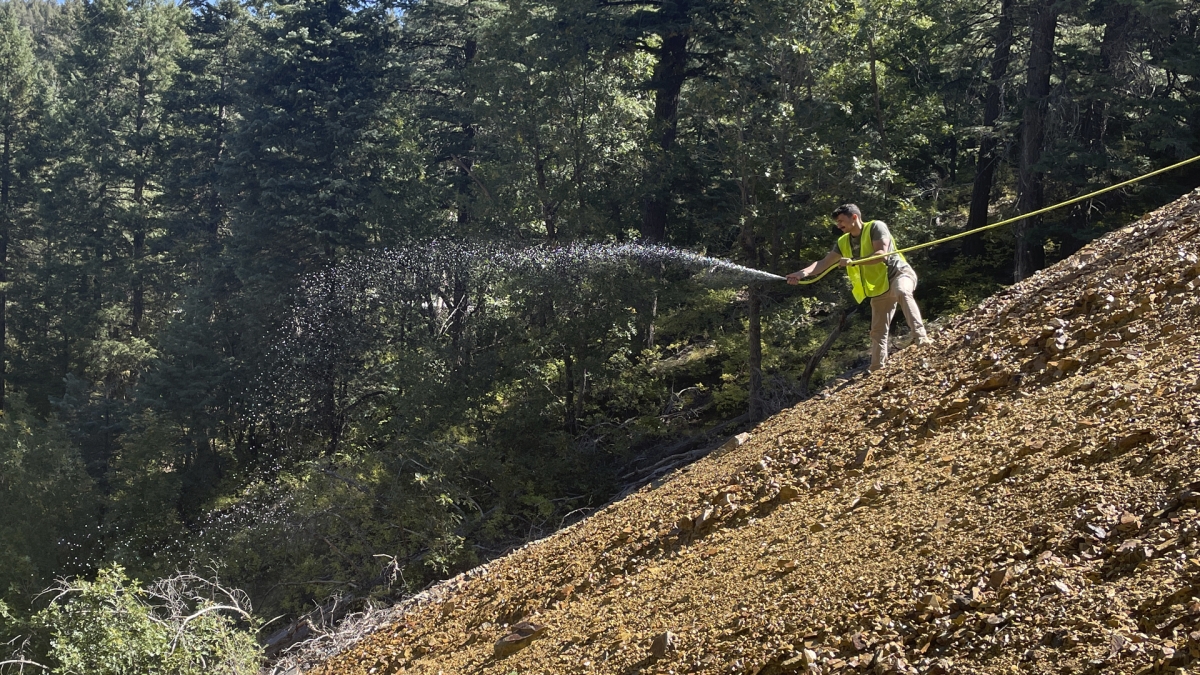
One ASU team has created an enzyme-based treatment to stabilize mining waste and reduce the erosion that could carry contaminants into nearby waterways.
Supported by the Arizona Department of Environmental Quality, the project is testing the treatment at Cash Mine, an abandoned mining site near Prescott, Arizona.
“By using an enzyme-based process to form natural mineral bonds within the soil, we can create a protective crust that helps limit erosion and dust generation while avoiding more chemically intensive treatments,” said Khodadadi Tirkolaei, who leads the ASU Mining Innovation Initiative and is with the School of Sustainable Engineering and the Built Environment, part of the Ira A. Fulton Schools of Engineering.
The process can immobilize environmentally harmful substances, preventing them from reaching nearby rivers. It also has more flexibility compared with other solutions.
“The treatment solution can be prepared on site and implemented without the need for specialized equipment or heavy machinery, making it readily deployable in remote areas, including many abandoned mine sites, where conventional solutions may be difficult or impractical to implement,” said Khodadadi Tirkolaei, who is also a senior Global Futures scientist with the Julie Ann Wrigley Global Futures Laboratory.
“We have also developed a plant-based biopolymer technology that can be used in situations where enzyme-based treatment may be limited, such as mine wastes with high concentrations of the heavy metals that could suppress enzyme activity.”
Advancing critical mineral production sustainably
Across the School of Sustainable Engineering and the Built Environment, researchers are also exploring environmentally friendly ways to recover critical minerals from mining waste.
One study is looking at whether mine tailings could become a new source of critical minerals.
“These tailings — produced in mining for copper — have been viewed as an environmental liability,” said Matthew Fraser, a professor of environmental engineering and associate director of the school, who is collaborating with Pierre Herckes, a professor in ASU’s School of Molecular Sciences, on the research.
“We are working to quantify the critical minerals that could potentially be extracted from these tailings to turn a liability into a resource.”
Crystal Davis, an analytical and environmental chemistry doctoral student in the School of Molecular Sciences, also works on the project. She, along with other ASU researchers, was invited to showcase this work during the Arizona Mining Association’s Mining Day at the Capitol, where researchers introduced students and policymakers to emerging approaches for recovering critical minerals.
As part of a separate project, Regents Professor Bruce Rittmann is exploring biotechnology approaches to recover critical minerals from water generated through mining, ore processing and recycling.
His team uses a Membrane Biofilm Reactor, or MBfR, to transform dissolved mineral ions into nanoparticles that can be recovered and reused. Inside the reactor, bacteria transform dissolved minerals — including lithium, copper, gold and rare Earth elements — into nanoparticles that can be harvested from the biofilm and processed for reuse.
“Periodically harvesting some of the biofilm recovers the valuable critical minerals in easy-to-process forms,” said Rittmann, who also serves as director of the Swette Center for Environmental Biotechnology.
In another study, Fulton Professor of Structural Materials Narayanan Neithalath is researching how mine waste and industrial byproducts can be safely incorporated into construction materials.
His work focuses on how the chemistry, microstructure and performance of cementitious systems could be enhanced while lowering the carbon footprint of infrastructure materials.
As attention to the supply chain of critical minerals grows, this work becomes even more important because it helps transform mining byproducts into valuable construction resources while supporting more sustainable materials production, Neithalath said.
Building industry partnerships
Mining professionals and companies have helped shape the ASU Mining Innovation Initiative by identifying needs in research, sustainability and workforce development.
“The work that ASU is doing to advance materials science, particularly in minerals processing and recovery, is a game changer,” said Adam Hawkins, director of Global External, a Phoenix consulting firm specializing in stakeholder engagement and public policy for the global mining industry.
When Travis Snider, vice president of sustainability and external relations at the Arizona Sonoran Copper Company, learned about Khodadadi Tirkolaei’s work through a colleague at ADEQ, he arranged a visit to tour the ASU researcher’s lab.
“Once he showed me how they were developing ways to reduce blown dust from tailings and haul roads, I knew that this was the right fit for our industry,” Snider says. “I have always hoped ASU would get more involved in supporting the mining industry we have here in Arizona. I am excited to see where they take this.”
The Mining Innovation Initiative connects with professionals from mining companies, consulting firms and technology providers who are interested in contributing to educational initiatives, according to Khodadadi Tirkolaei.
Faculty members have begun exploring the development of training programs through ASU’s Global Outreach and Extended Education that would align with the evolving needs of the mining and critical minerals sector.
The initiative also focuses on raising awareness among K–12 students about mining careers through outreach activities with industry partners at school and community events like ASU Homecoming or Mining Day at the Capitol.
The program Mining in the Classroom helps students connect mining to the materials used in phones, cars, energy systems and infrastructure while introducing career pathways in engineering, skilled trades, environmental sciences and other fields.
“Mining is an innovative, sustainable and developing industry that can play a huge role in our future,” says Carolina Navia Vasquez, a mine engineer with Freeport-McMoRan. “We are not just creating careers for future generations. Today, we are making decisions for the future of sourcing the raw material necessary to run our planet.”
By – https://news.asu.edu/20260610-science-and-technology-rethinking-how-we-treat-mining-waste