

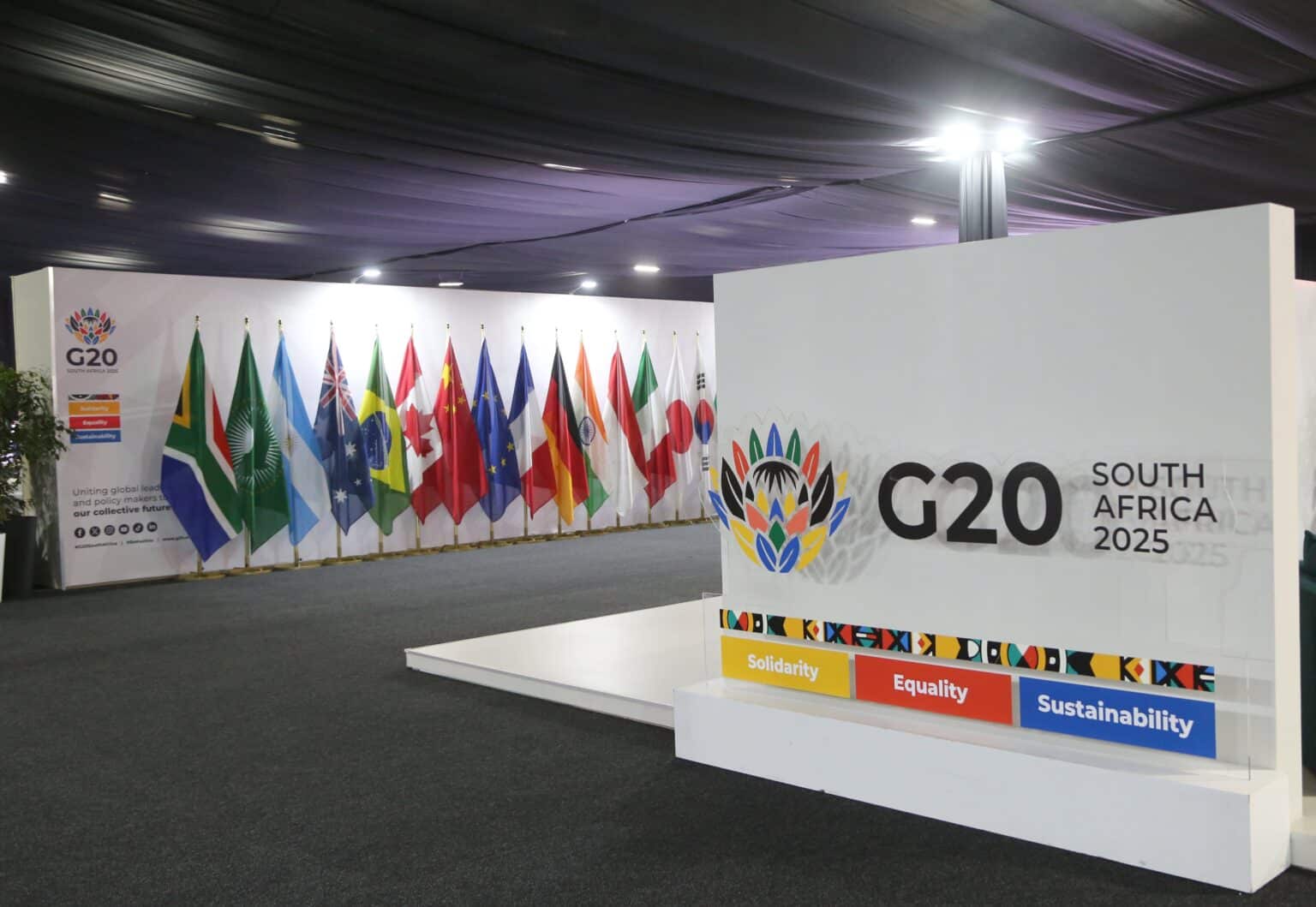
As global leaders land in Johannesburg for the first G20 summit on African soil, hundreds of climate protesters took to the streets to demand leaders give ordinary people more control over the continent’s coveted critical minerals.
Several mineral experts and African leaders agree with the protesters: the G20 global leaders summit is an opportunity to call for these minerals like lithium and cobalt to benefit the continent where they are found.
“It’s important to have a G20 that includes communities so proper conversations can be had about the development of Africa,” said Lazola Kati, campaign manager of Fossil Ad Ban, an initiative by climate group Fossil Free South Africa, on the sideline of the protest.
“We are so rich in resources. What this can look like is job creation, skills transfer… our own energy sector,” said Kati as protesters from Uganda to Zimbabwe sang and held up placards.
Africa is home to 30% of the world’s critical minerals needed for the transition away from fossil fuels to clean technology, as well as the digital infrastructure for AI data centres.
But for centuries Africa has endured what has become known as the “resource curse” – a paradox where abundant natural resources lead to conflict, corruption and slower economic growth.
The G20, which gathers leaders representing 80% of the world’s economy together, is being hosted in Africa for the first time. The African Union became a permanent member in 2023.
Policy experts believe that this gives African governments more leverage to call for global investment into local mineral processing to create jobs, as demand surges.
“Think of it this way: selling raw cobalt is like exporting flour when you could be exporting bread,” said Maxwell Gomera, United Nations Development Programme (UNDP) resident representative in South Africa during a speech at a Johannesburg event this month
“The world is in a new scramble for Africa’s minerals” he added. “We must make sure the new green order doesn’t become the old colonial order.”
INDUSTRIALISATION MESSAGE
The continent needs to negotiate as a bloc to leverage its mineral bargaining power, said Deprose Muchena, programme director at the Open Society Foundations (OSF), a human rights funding organisation.
“The African Union is a member of the G20 now, which means even when South Africa is off the stage, the AU remains to continue the powerful industrialisation message,” said Muchena.
The Africa Green Minerals Strategy, endorsed by the African Union in 2025, aims to promote mineral-related industrialisation across the continent.
It outlines responsible mining practices, the needs for skills development and attracting investment for local mineral processing, or beneficiation.
More than a dozen African nations, including the Democratic Republic of Congo (DRC), Nigeria and Namibia, have restricted such exports intermittently, or banned them outright to promote beneficiation, according to World Bank research.
Zambia and the DRC are creating special economic zones to manufacture batteries using local minerals, the U.N. says.
One of the three main themes for the South African G20 summit is the future of critical minerals for Africans.
But the continent captures less than 5% of the value generated from energy technologies, according to The International Energy Agency, a global energy institution.
South African President Cyril Ramaphosa signed a critical minerals deal with the European Union on Thursday that he called “unprecedented”. He said South Africa intended to increase mineral processing to “move up the value chain”.
“RESOURCES ARE FINITE”
But key political players will not be visiting South Africa for the G20, including U.S. President Donald Trump and Chinese President Xi Jinping.
Both countries have key interests, capital and investments in global critical minerals.
“It is better when Trump and the like are not there,” said Kati from Fossil Free South Africa.
“This is the time where we can define development and investment, so when they come back we are ready with an African-defined programme,” she said.
But mining is only one element of Africa’s development, said OSF’s Muchena.
Despite the G20 emphasis placed on critical minerals, it is important to remember that mining has a limited time span, he said.
“We know resources are finite and at some point the demand for critical minerals will go down due to potential technologies that could replace the need for these resources, the same way diamonds are being replaced by synthetics,” he said.
The financial benefit of these resources had to be used wisely during the mines’ lifespans.
Muchena estimates that between 2023 and 2024, Africa exported close to $250 billion worth of revenue from its critical minerals, with $1.6 trillion expected in the next 25 years.
“If these are the numbers, they should be finding their way back into the communities to transform them, to provide energy directly,” he said, referencing the 600 million Africans without reliable electricity.
At the mineral protest, Congolese bishop and activist Raphael Bahebwa from the Congolese Solidarity Campaign took the microphone to speak about mining abuses in his home country, where roughly 70% of the world’s cobalt is found.
“Everyone carrying a cellphone is carrying the blood of our people,” said Bahebwa, referring to the exploitative mining practices behind the cobalt found in most cellphones.
“When mining companies come with their contracts, the people must be honoured on their land so that they can benefit as well,” he said.
https://www.cnbcafrica.com/2025/africa-g20-hosts-bid-to-become-mineral-powerhouse