

A new mining agreement provides no benefits for Mexico and fails to address health and environmental impacts.
The U.S. and Mexico have established a mining agreement which has Indigenous and other residents of the Sierra Norte mountains, as well as activists around Mexico, worried.
Announced on February 4, the U.S.-Mexico Action Plan on Critical Minerals aims to guarantee the U.S.’s supply of minerals for its arms industry, technology like data centers and smartphones, and the so-called energy transition. It sets out price floors, identification of mining projects, geological mapping coordination, and mineral location identification for the U.S., but provides no benefits for Mexico and fails to address health and environmental impacts.
“They want us to show these gringo companies where the minerals are and then go and hand over everything, all without a fuss,” said Miguel Sánchez Olvera, a Totonac man from the Sierra Norte region who has been at the forefront of struggles that have expelled mines from the area. “That’s concerning, because where does it leave us, as Mexicans? Basically, they are going to keep stealing from us.”
The beautiful Sierra Norte — teeming with rivers and sprawling forests, and where a majority of people speak Indigenous languages — has massive amounts of minerals that the U.S. has identified as “critical,” such as manganese, gold, silver, and copper.
According to NATO, manganese is one of 12 minerals critical for the weapons industry; it is used in submarines, fighter aircraft, tanks, and torpedoes. For Mexico, however, manganese is a source of distress before it is even processed. In the lush Sierra Norte cordillera, stark black mountains of manganese ore and slag piles are set off by smoking chimneys from a plant run by Autlán, a major Mexican mining company. Homes nearby are drenched in black stains. Residents describe mornings of black clouds along the ground and black dust covering their windows.
Autlán operates four electric furnaces in its Teziutlán plant to smelt manganese ore, producing ferroalloys. Manganese is also on the U.S.’s critical minerals list and aside from weapons, it is vital to batteries and other steel applications.
Mexico as a whole is the top silver-producing country, and among the top producers of copper, lead, and zinc — all on the U.S.’s list. Silver is vital for new weapon systems, hypersonic missiles, bombs, fighter jets, satellites, torpedoes, radar systems, AI data centers, electric vehicles, 5G infrastructure, and smartphones. Demand for copper for munitions is skyrocketing as the U.S. restocks its arsenal, and it is essential for armor and electronics. Copper supply problems can cause significant weapon production delays, and supply chain vulnerabilities for weapons manufacturers.
The U.S. is home to 6 of the top 10 global arms companies and 13 of the top 15 global tech companies. The White House’s 2027 budget includes over 18 billion U.S dollars for the Department of Defense to stockpile minerals that are critical to the military industry. That figure is up from the current 2 billion U.S. dollars.
A few days before the U.S.-Mexico plan was signed, the White House had also announced Project Vault, which will establish a public-private partnership to stockpile critical minerals for U.S. businesses. These moves “imply hyper-extractivism — or basically, renewed extractivism,” César Enrique Pineda, a researcher and professor of geopolitical and capitalist intersections with the environment at the José María Luis Mora Research Institute, told Truthout.
An Open-Pit Mine for the U.S.
Autlán is the largest manganese producer in Central and North America. Like other mining companies in Mexico, it exports much of what it produces, including to the U.S. In late March, the environmental protection agency Profepa temporarily shut down one of its furnaces in the Teziutlan plant after finding that it was operating without an emissions filter. Locals told Truthout they had complained about the resulting harsh black clouds for more than six months, but Autlán did nothing.
Autlán continues to accumulate massive mountains of slag rock, a byproduct of metal smelting, in open air. Exposed slag can release small particulates that can lead to respiratory or skin problems. Too much manganese in the body can affect the nervous system, and another potential component, hexavalent chromium, can cause cancer. Leachates — toxic liquid runoffs — spill onto nearby land and eventually into the water system.
Before the fourth furnace was shut down, Gisela Macias Dionisio, a local water activist with Servicios Ambientales Amelatzin Hualactoc, told Truthout, “the dust was like snow. You couldn’t even sweep it up. They tell us babies are being born with gestational cancer.”
“Nobody speaks up, nobody says anything out of fear. A doctor told me that 50 percent of his patients have cancer,” said another woman who lives just behind the mine but who requested anonymity out of fear. “My house is covered in black dust, even the dishes have black dust on them, the trees are covered in it too. Our fruit used to be nice and big and now it’s small and rots quickly. The sound (from the plant) never stops.”
Pollution Doesn’t Squash Mining Companies’ Excitement
Nevertheless, the Mexican government is already promoting the critical minerals action plan as an investment opportunity, and companies here are using the plan to demand relaxation of regulations. The mining industry chamber, Camimex, said it sees the U.S.’s focus on securing strategic minerals as a moment to push for mining interests after the reforming of the 2023 mining law, which was a result of years of movement struggle.
The law was “a historic achievement,” said Beatriz Olivera Villa, an industrial engineer and a founder of Cambiémosla Ya — a coalition of communities and organizations campaigning around the mining law. The reformed law made environmental assessments and informed consent from affected communities obligatory, “and now they aren’t handing out concessions, at least not like they used to,” she said.
Now, with the critical minerals action plan, “we’re worried, because the economy secretary [of Mexico] has been speaking with the mining companies … and they are talking about modernizing the mining law to recover the privileges they lost,” Olivera said. “With the demand for critical minerals … it seems like they would increase extraction at any cost.”
“Trump’s administration doesn’t just represent extractive capital, but also an authoritarian approach that disregards any kind of regulation. Therefore, we should expect significant pressure to ensure, at any cost and regardless of our laws, that the mining industry’s needs are met with this plan,” Pineda said.
Nobody Benefits From Weapons Except Weapons Companies
But while the mining industry is being heard, the mines bring no economic benefits to the country or to nearby communities.
“I very much doubt that Mexico would benefit economically from this plan because it has never been that way with mining projects. Extraction only contributes 0.9 percent to the GDP, for example,” said Olivera. “Mining represents just 0.66 percent of formal employment, and in terms of taxes, they contribute very little.” There are 22,247 active mining concessions in Mexico, with a total surface area of 10.2 million hectares, or 5.2 percent of Mexico’s territory.
“Towns like Guadalupe y Calvo in Chihuahua (state) are among the top producers of gold and silver, but it is one of the poorest towns in Mexico,” Olivera said. In Fresnillo, another top global silver producer, 40 percent of the population lives in poverty, and in Eduardo Neri, a key gold producer, 65 percent do. Across Mexico, mining regions have very high poverty rates, “and a lack of access to services like water or electricity,” she added.
Meanwhile, arms producers are breaking revenue records, with 679 billion U.S. dollars in 2024. Increased production requires more minerals. “There is a militarization of these resources. The U.S. is considering securing minerals for war as part of its national security strategy,” said Olivera.
And as minerals flow from Global South countries like Mexico to the Global North for manufacturing and sales, so do the profits. Mining took off “in an intense way” after the signing of the North American Free Trade Agreement in 1994, which served U.S. and Canadian markets, Olivera says, calling it a “legalized plundering.” In 2024, Mexico exported 42.3 billion U.S. dollars in minerals, making it the 24th-largest exporter. Its main destinations were the U.S. ($17.7 billion), China ($6.31 billion), and Spain ($4.58 billion). Mexico exports 70 to 80 percent of its copper production.
Mining’s Legacy of Environmental Disaster
The U.S.-Mexico action plan “benefits investors, but it doesn’t benefit us at all,” said Urbano Córdova Guerraas, a local resident and also a member of Servicios Ambientales Amelatzin Hualactoc as we chatted in a small eatery near the Autlán plant. To extract copious amounts of manganese, Autlán has destroyed whole mountain tops in nearby Hidalgo state, buying off local politicians in order to do so. In Zoquitlán, Autlán chopped down 77 hectares of forest for a hydroelectric plant.
Communities in the Sierra Norte have successfully resisted various hydroelectric, fracking, and mining projects in their region. In 2022, they managed to cancel mining concessions in Ixtacamaxtitlán, Cuetzalan, Tlatlauquitepec, and Yaonáhuac, including for the Canadian gold-mining company, Almaden Minerals. Sánchez, a member of the land movement Makxtum Kalaw Chuchutsipi (Everyone United as a People), along with various movements in the region, including Masuel Indigenous communities, shut down three of Autlán’s gold, silver, and copper concessions last year.
“Our territory isn’t a resource. It’s our body, our memory, our spirituality,” the Maseual Altepetajpianij Council wrote to the court at the end of their 11-year battle. The council, made up of 35 Indigenous and small-farmer communities in the Sierra Norte, defends the region against mines.
“(Autlán) had just finished the exploration stage and was about to start exploiting, but with the strength of women and men here, they left the Sierra very pissed off because they had bought 1,000 hectares of land,” said Sánchez.
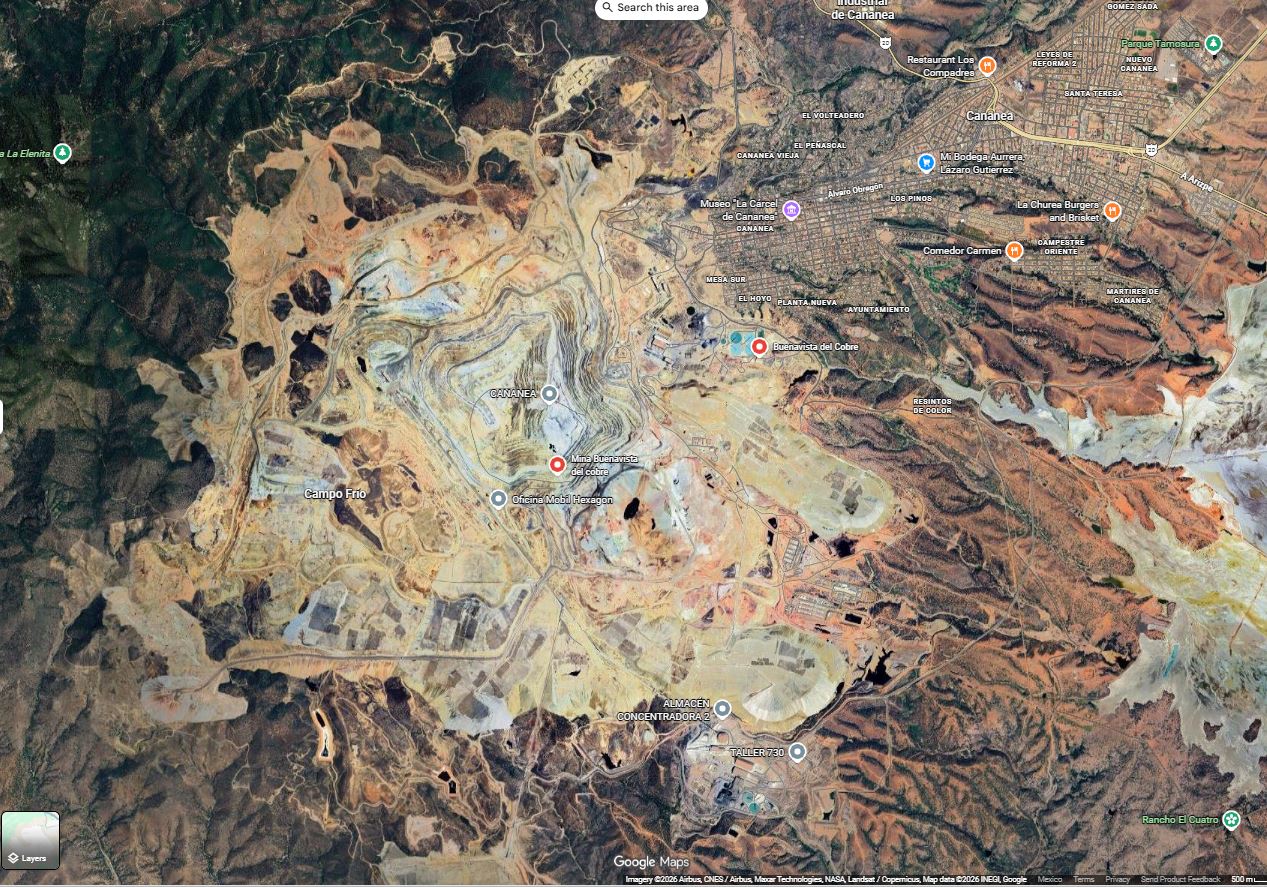
Meanwhile, in the north of the country, the U.S. consul general in Mexico, Michelle Ward, visited the country’s Buenavista copper mine on March 25, stressing that it is one of the top copper mines globally. She said that with the joint action plan, the U.S. government wants to strengthen its presence in the region. Ward omitted that the mine was the site of Mexico’s worst environmental disaster, when in 2014, a leaching pool collapsed, spilling 40,000 cubic meters of copper sulfate into the Sonora River, eventually reaching wells that supplied the city of Hermosillo.
Over a decade later, according to Olivera, members of the Sonora River Basin Committee say “their demands haven’t been met and the damage hasn’t been repaired, the skin problems are ongoing due to high levels of arsenic. They’re still finding arsenic in their urine and blood.” Even before the spill, authorities had found copper, arsenic, aluminum, cadmium, iron, manganese, and lead in the water supply.
Pineda lists off more negative impacts from mines in Mexico, including displacement of communities, water scarcity, contamination of tributaries and aquifers, heavy metal contamination, health harm, and toxic dust. “These are not things you can negotiate with the mining companies. You can’t negotiate if water is contaminated or not … so communities typically demand the closure of mines,” he said.
To mine just one ounce of gold, 40 kilograms of explosives and 200,000 liters of water are used, and 650 kilograms of carbon dioxide are emitted.
Imposing Destruction
In order to operate without disruption, mining companies in Mexico are often involved in the disappearance of activists and with organized crime. The top minerals that attract organized crime groups are the same critical minerals that Mexico plans to supply to the U.S.
In 2022, Indigenous activists Ricardo Lagunes and Antonio Díaz, who had opposed a Ternium mine, were forcibly disappeared; they are still missing. The year before, anti-mining activist Higinio Trinidad De la Cruz and another activist were kidnapped by organized crime members and told to stop their activism, then released. Trinidad De la Cruz was killed the following year.
Autlán too has reportedly used violence, intimidation, death threats, buying people off, sowing community division, and attacking activists — including burning a bus that activists were in after a protest against one of Autlán’s hydroelectric plants — in order to get its way. In 2018, Sergio Rivera Hernández disappeared after opposing Autlán’s Coyolapa-Atzalan hydroelectric project.
There is a similar logic of control in the U.S. plans to funnel Mexico’s critical minerals its way. “With this plan, the U.S. government is taking advantage of Mexico’s deep economic dependency on it in order to impose a new instrument of subordination,” wrote the Mexican Network of those Affected by Mining in a statement.
“Mexico isn’t in a position to negotiate on equal terms,” said Pineda. “This plan doesn’t just mean communities losing control over their ecosystems, but that the whole country loses control over its ecosystems.”
Of course, Mexico isn’t alone. The U.S. has made an alarming deal with the Democratic Republic of the Congo, exchanging “security” support for access to its minerals, while threatening to cut off Zambia’s aid if it doesn’t increase the U.S.’s mineral access. A trade deal with Indonesia in March also paves the way for the U.S.’s access to minerals, with few environmental safeguards.
“The environmental impact stays in the (Global) South, and the raw materials head to the North … at a scale that is unsustainable,” said Pineda.
Over the years, thousands of organized communities have declared themselves “mining-free territory” to legally prohibit mining in their territory.
Stopping mines after the fact is much harder, but many communities are willing to wage the legal and organizational battle. Even after victory, the struggle continues.
“We want to clean our rivers, so that the Sierra Norte de Puebla can be a paradise again,” said Sánchez.
By – https://truthout.org/articles/us-mining-plan-will-sacrifice-mexicos-environment-for-weapons-and-tech/