

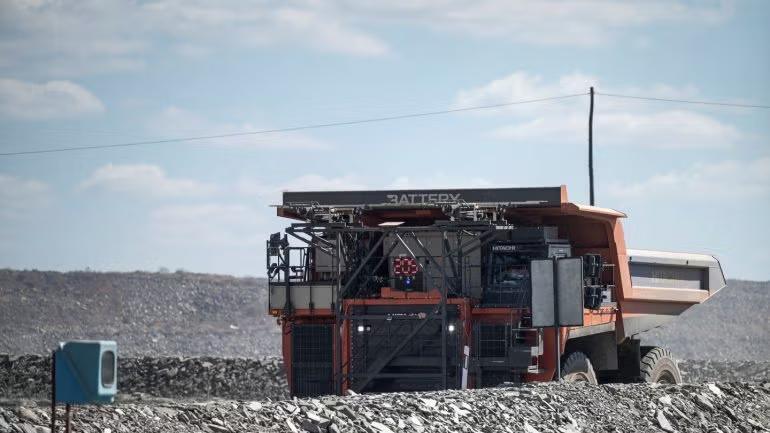
Mining Technology reports from FQM’s Kansanshi mine in Zambia, where Hitachi Construction Machinery’s world-first full battery electric dump truck is undergoing real-world testing.
At the edge of the open-pit mine, a massive dump truck rounds the corner. Without stopping, it raises two pantographs and connects seamlessly to the overhead trolley lines, much like a tram, before powering its way uphill under full load. At the crest, it disconnects just as smoothly and continues across the mine, all in one fluid motion.
For a machine of its size, it is surprisingly quiet, especially against the constant noise of the surrounding mine site. The entire operation takes just a few minutes, but what is happening here marks a major step forward in mining technology.
This truck is Hitachi Construction Machinery’s EH4000AC-3 full battery rigid dump truck, seen in action by Mining Technology during a July visit to First Quantum Minerals’ (FQM’s) Kansanshi copper-gold mine in Zambia. It is a world-first prototype truck, the only one of its kind.
Canadian copper producer FQM, in partnership with Hitachi Construction Machinery, has been trialling this ultra-large full battery dump truck with integrated trolley-assist technology at Kansanshi since June 2024.
The trial is focused on testing the truck’s ability to handle full-scale rock haulage under real-world conditions, while also assessing the performance of its dynamic battery charging and discharging cycles.
The EH4000AC-3 dump truck design
The EH4000AC-3 full battery rigid dump truck is an ultra-large, zero-emission haul truck developed as a technological testbed based on Hitachi Construction Machinery’s existing EH4000AC-3 model platform. It features a trolley charging option and currently supports a test payload capacity of approximately 200 tonnes (t), with plans to match the capacity of its diesel counterpart in future iterations.
As the Japan-based company explained to Mining Technology, charging performance depends on conditions, but the truck is built to charge efficiently while hauling uphill under a trolley/catenary line, as demonstrated at the Kansanshi mine.
The trolley battery dump truck draws power from overhead lines via a pantograph, allowing it to travel and charge simultaneously. Additional energy is recovered through regenerative braking using the retarder system.
Testing under real-world conditions
“The aim of the proof of concept (POC) trial is to test the truck under ‘real-world’ conditions to ensure that it operates as it should on an actual mine site before we move to commercialisation of the product,” a Hitachi Construction Machinery spokesperson told Mining Technology.
According to the company, the Kansanshi mine is a perfect testing ground for the full battery trolley dump truck. The site already runs a large fleet of EH4000AC-3 and EH3500ACII trucks and has the kind of real-world conditions needed for serious field trials: long haul roads, elevation changes and an established trolley system.
Hitachi Construction Machinery is also working closely with FQM, whose hands-on experience with pit electrification and its own Quantum Electra-Haul setup make it possible to trial the new truck without disrupting production.
As Hitachi Construction Machinery explains to Mining Technology: “The landscape and electricity sources in Zambia, as well as FQM’s experienced trolley truck operational implications and our long-standing partnerships, were key decision-making aspects for us.”.
The company also pointed out that the current POC matches the speed of standard diesel trucks, with future development targeting performance equal to trolley diesel trucks, while maintaining charging capability.
From diesel to full electric battery
Battery design began in 2020, with official development launched in 2021 following a partnership agreement with ABB. Based in Switzerland, ABB is a global technology leader specialising in electrification, automation, robotics and industrial digitalisation. In the mining sector, it plays a key role in providing trolley-assist systems for electric haul trucks, as well as battery technologies and charging infrastructure.
With ABB’s advanced battery technology, Hitachi Construction Machinery is able to convert its haul trucks from diesel-powered to fully electric, battery-driven machines.
ABB incorporates lithium titanate oxide (LTO) technology into its battery portfolio, offering key advantages for high-demand applications like trolley-assist systems.
“LTO batteries deliver exceptionally high power density, enabling rapid charging at rates of up to 10C, which is particularly beneficial for dynamic charging environments,” Thierry Jenelten, global segment manager mobile e-Power at ABB, explains to Mining Technology. A 10C rate means the battery can be fully charged (or discharged) in 1/10th of an hour, or six minutes.
“With a long cycle life of up to 40,000 full charge-discharge cycles, LTO batteries also ensure a low total cost of ownership over their lifespan. Additionally, ABB uses the safest cells available on the market, with no risk of thermal runaway, making them ideal for safety-critical applications such as mining, rail, marine and electric public transport,” Jenelten adds.
According to Hitachi Construction Machinery, the battery has the potential for extended life depending on managed haul circuits and battery usage patterns such as state of charge and depth of discharge.
As ABB outlines, the battery technology used in this project wasn’t developed exclusively for this truck. Instead, it is already proven in other demanding applications such as railways, electric buses, marine vessels and stationary storage systems.
Learnings from electric trolley truck trial
After more than a year of trials at Kansanshi, Hitachi Construction Machinery and ABB are starting to draw conclusions. A Hitachi spokesperson outlined two key insights: “First, the regenerative electric brakes provide more energy than previously expected, and how the truck is operated during this time can make a significant impact to free energy supply.” This energy recovery is now shaping how the truck is optimised in real time.
“Second, a variation to charge and drive percentages will be made in the future to allow for shorter-distance charging routes and provide more versatility to customer’s operations,” they added, pointing to greater adaptability across different mine layouts.
When it comes to advantages, Hitachi highlights the battery’s safety and fast-charging capability: “The Super Charge ion Battery is known for its rapid charging capabilities… [It] offers a significant advantage in charging speed and safety compared to other lithium-ion technologies,” the spokesperson explains.
ABB also points to real-world performance. “The main advantage of this battery is its exceptionally high-power density and C-rate, which enable charging while the truck is in operation under the trolley line,” Jenelten explains.
The result: a battery that charges quickly, runs safely and meets the heavy-duty demands of mining, all while keeping the truck in motion.
There are still challenges, however. ABB notes: “The main challenge lies in balancing battery capacity, truck autonomy and payload to achieve the lowest possible cost per tonne moved.”
Hitachi adds: “Although ideal for trolley applications, increasing the performance of the power management will allow for static and shorter dynamic line requirements on other customer operations.”
In short, making the system efficient across a variety of mine conditions, without compromising cost or performance, remains a key focus.
What’s next for Kansanshi?
The truck is expected to remain at Kansanshi until at least the end of 2025. “Future arrangements are to be discussed with FQM as our partners for this POC,” Hitachi Construction Machinery says.
In August, FQM launched its $1.25bn (C$1.73bn) Kansanshi S3 expansion in Zambia, extending mine life and supporting the country’s goal to triple copper output by 2030. With Cobre Panamá idle since November 2023, Zambia has become FQM’s main revenue source. The company also operates in Mauritania, Australia, Turkey, Finland and Panama, with projects under way in Argentina, Peru and Spain.