

The federal government is moving forward with leasing thousands of acres of land in west Alabama for coal mining, a move that will drastically increase coal exports from the state.
The move could nearly double Warrior Met Coal’s projected output, create hundreds of jobs and millions of dollars in revenue, both for the mining company near Tuscaloosa and for the Port of Mobile.
But the mining will take place in the Black Warrior River watershed, which advocates say could jeopardize endangered species, including a rare, elusive salamander found only in a few streams in northwest Alabama
“We’re just creating additional spaces that are much less inhabitable,” said Nelson Brooke, who leads Black Warrior Riverkeeper, an environmental advocacy group. “It’s a cumulative effect where so much of the Black Warrior basin has been mined and cultivated.”
Warrior Met Coal is proposing the expansion of two of its mines in Tuscaloosa County, according to the Bureau of Land Management. Earlier this month, the federal government announced it would move forward with leasing the land, and next Tuesday bidding will be held for the leases. In total, the new mining leases encapsulate around 14,000 acres of land.
Warrior Met Coal did not respond to AL.com’s requests for comment.
The federal government estimates that there is around 53.2 million tons of federally owned coal to be mined. In addition, there is an estimated 49.9 million tons of privately owned coal that could be mined through this expansion.
The coal to be mined is metallurgical coal, or met coal, which is used in the production of steel. It is primarily exported to steel manufacturers in Europe and Asia.
If Warrior Met Coal wins the leases for these two expansions, in particular the lease for Blue Creek No. 1, it could dramatically increase its volume: the company’s nameplate capacity, or total projected output, is expected to increase by 75% from 2024 to 2027, according to a company report from February.
The Blue Creek mine is expected to create $1.3 billion in incremental revenues, according to a report from Business Alabama.
While the federal government just decided to move forward with the leases, locals say they’re already seeing impacts on Little Yellow Creek, according to Brooke. Black Warrior Riverkeeper submitted comments to the federal government opposing the expansion.
The surface infrastructure for this mine expansion is already under construction, he said, and locals have reported to Brooke’s group that they’re seeing mud and cloudy water in the creek.
“These are tributaries to the Black Warrior River,” Brooke said. “A lot of people have homes there; they’re concerned about their drinking water and swimming water.”
Little Yellow Creek feeds into Big Yellow Creek, which feeds into the Black Warrior River.
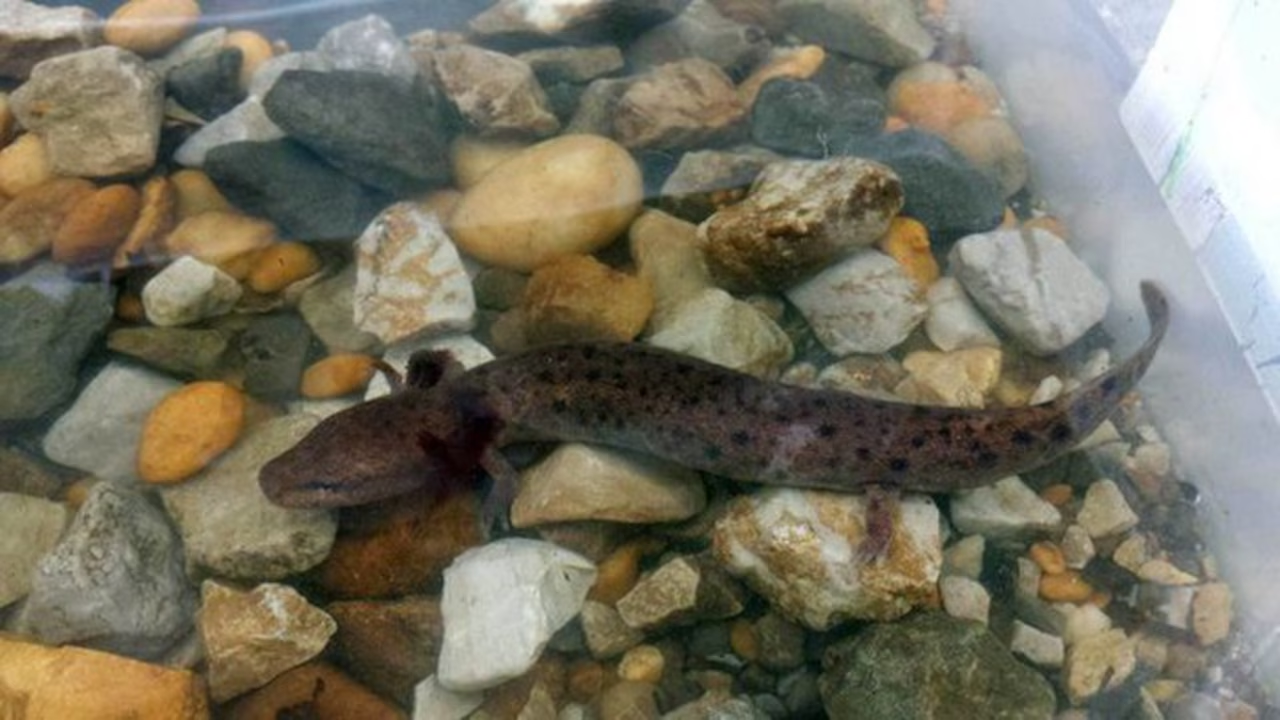
One of the many species that calls the Black Warrior watershed home is the Black Warrior waterdog, also known as the Alabama mudpuppy. The waterdog is a spotted salamander with feathery red gills and is found in only a few creeks in the Black Warrior River Basin.
The waterdog was listed as an endangered species in 2018. Its critical habitat is the Sipsey Fork, Blackwater Creek, Locust Fork, and Yellow Creek in Tuscaloosa (different from Big Yellow Creek).
With its external gills, the waterdog is especially vulnerable to poor water quality, and its health is an indicator of the health of the river system as a whole, according to the U.S. Fish and Wildlife Service. Runoff from mining and other development is believed to be the cause of the waterdog’s decline.
Brooke argues that the expansion of these mines threatens the waterdog, as well as other threatened species like the flattened musk turtle, which lives solely in the upper Black Warrior River Basin.
“These feeder streams are incredibly diverse, it’s incredible how much biodiversity is there,” Brooke said. “Every one of these critters is very important to the ecosystem.”
In its analysis, the bureau of land management said the mining “may affect but is not likely to adversely affect” the waterdog and the turtle. Of the 16 endangered or threatened species the federal government assessed, it ruled that the mine would have “no effect” or “no likely adverse effect.”
Mining at Mine No. 4 and Blue Creek will be longwall mining, which largely takes place underground. Longwall mining is a practice where a machine cuts a large block of coal from the wall; the block is then pulled to the surface.
Underground mining can have major effects on water, both underground and on the surface. Water containing sulfuric acid and heavy metals can leach into groundwater and surface waters, like rivers and lakes, according to the U.S. Geological Survey.
Water from mining can contaminate drinking water and degrade water quality, negatively affecting plants and animals.
But Warrior Met Coal is not the only one who could benefit from the mining expansion. In an August 27 meeting, Rick Clark, deputy director of the Alabama State Port Authority, said it expects 3 million additional tons to move through McDuffie Coal Terminal at the port due to the “new mine in Tuscaloosa.”
In comments to the federal government supporting the expansion, the port authority said Warrior Met Coal is its largest customer.
“In addition to supporting the exportation of clean and efficient met coal mining products, approval of this application will help support jobs and the economy,” the port said in its comment. “An economic impact study conducted during the 2021 calendar year showed that McDuffie Coal Terminal operations at the Port of Mobile created more than 2,000 jobs directly and a direct revenue impact of more than $350 million.”
Warrior Met will have to pay a royalty for the coal it mines. Those royalties will be received by whoever holds the “mineral rights” for the property: private landowners or the government. However, under the most recent congressional spending bill or “One Big Beautiful Bill Act,” the federal government reduced the royalty rate coal miners have to pay per ton of coal, from 12.5% to 7%.
Bidding for the leases to expand Mine No. 4 and Blue Creek Mine No. 1 will be held next Tuesday, Sept. 30, at the federal Bureau of Land Management’s Eastern States State Office in Falls Church, Va.
Brooke argues that the short-term economic gain is far outweighed by the long-term environmental damage that could come from the mine expansion. The Black Warrior River watershed is incredibly diverse, with 130 species of fish alone. That biodiversity is at risk, he said.
“It’s a steal for the company and a loss for the locals,” Brooke said. “It’s short-term gain for long-term pain.”