

Trump official disclosed millions of dollars of shares in Canadian mining company. Amid Prime Minister Mark Carney’s calls that the Canada-U.S. relationship is ruptured, Ottawa has committed $175 million to a mining project in northern Quebec whose major U.S. investor is closely linked to the Trump administration.
Energy and Natural Resources Minister Tim Hodgson says the Carney government’s support for the rare earth mine is necessary to protect Canadian jobs and the economy.
“We’re doing things that are exceptional because we are in exceptional times,” Hodgson told the fifth estate in an interview.
I’ll go back to what the prime minister said: We are in a hinge moment. We are in a rupture. We need to respond to that.”
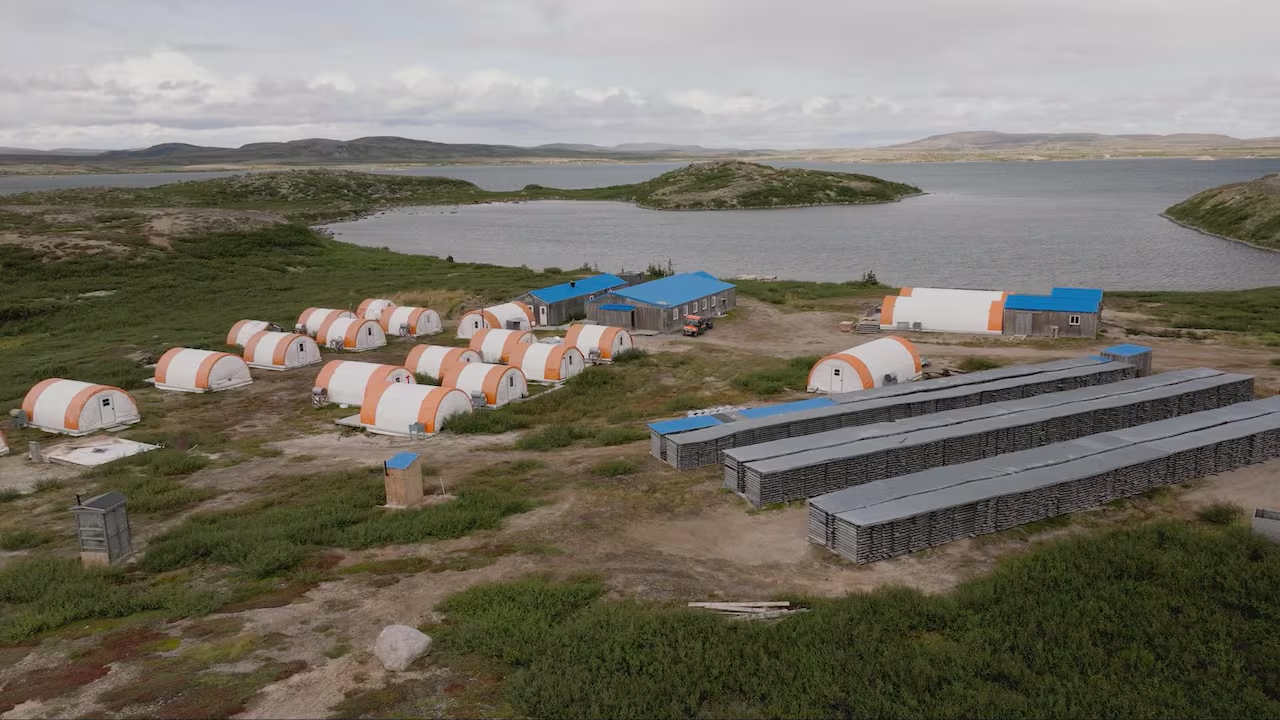
The proposed mine is near Lac Brisson in Nunavik, approximately 235 kilometres northeast of Schefferville, Que., on the Labrador border.
Montreal’s Torngat Metals says its mine, called Strange Lake, will extract up to 13 million metric tonnes of material a year for 30 years. The company wants to cut a 170-kilometre road to the Labrador coast and ship the elements about 1,700 kilometres to a proposed French-owned processing plant in Sept-Îles, Que.
“The vision with Strange Lake is to build in Canada, in Quebec in particular, an extraction-to-refined-value chain that would make Canada and Quebec unique as the main alternate source to the Chinese monopoly, something the Western world is eagerly awaiting,” Torngat’s CEO at the time, Yves Leduc, told the fifth estate in late February.
On March 17, Torngat announced that Leduc, who was hired as CEO last year, had “decided to step down.”
1st of its kind
What makes the Strange Lake deposit so enticing to governments and private investors is the presence of heavy rare earth elements, most notably dysprosium and terbium, which are key to the magnets used in everything from electric vehicles to fighter jets and missiles.
One of the federal government’s lending arms — Export Development Canada (EDC) — has highlighted the fact that Ottawa has never before committed to financing a mine at such an early stage.
In a media release last June, EDC president and CEO Alison Nankivell called their $110-million Torngat loan “unprecedented.”
“This is a first-of-its-kind transaction for EDC, reflecting our commitment to taking strategic risk for sectors of strategic interest,” Nankivell said.
At the same time, the federal government’s Canada Infrastructure Bank provided an additional $55 million to “to further advance the next stage of the project.”
The federal government’s Critical Minerals Infrastructure Fund had already committed $10 million to the project in December 2024.
Luis Juez, from Milei’s La Libertad Avanza party, voted for the 2010 protection. Last month he voted to weaken it, telling activists he described as “ecological terrorists” that the change poses no threat, that it will create jobs.
“Today it’s as if everyone lives in an igloo in the middle of a glacier surrounded by penguins,” he said.
Juez is among those who believe Argentina is on the verge of a copper boom. Last month, Australian-Canadian Vicuña Corp announced an $18bn plan to mine copper, gold and silver in San Juan.
The Anglo-Swiss multinational Glencore has plans to invest more than $12bn in two projects in the country’s north. For years the glacier law had helped stall one of these, El Pachón. The “rock glacier” in question was struck from the regional “safe” list after a study found it was not strategically important. This is disputed.
Four or five projects are ready to break ground if the law is modified, according to Viale. Huge investment, but at what cost, ask critics.
They cite vanished glaciers on the other side of the mountains in Chile, the rate at which glaciers are melting worldwide, polluted Argentinian rivers. In 2015, more than a million litres of cyanide solution – used to extract gold from rocks – leaked into rivers near Barrick Gold’s periglacial mining site in Veladero, San Juan. The company was fined $9.3m. More spills have happened there since, one caused by falling ice.
In 2013, Chilean authorities fined Barrick Gold more than $16m for environmental offences at its Pascua Lama project on the border with Argentina. The country’s environment agency found arsenic and sulphates in the groundwater. Eventually the pit was closed.
More warnings come from Brazil, another of Argentina’s neighbours. Two years ago BHP and Vale paid £23bn in compensation after a 2015 disaster at a mining site killed 19 people and polluted the Doce River for 420 miles, all the way to the Atlantic. Brazilian president Luiz Inácio Lula da Silva said: “I hope the mining companies have learned their lesson.” Argentina will be hoping the same.
Back in Buenos Aires, thousands of comments flooded the public audience livestream: Los glaciares no se tocan (hands off the glaciers); El agua no es un negocio (water is not a business).
Milei offers his own ideas about water. If it is abundant and nobody owns it, “companies can pollute it all they like”, he said. “Its value is zero.”
Mining companies have been perforating Latin America for 500 years. Viale has a simple message for them: “Leave the southern territories in peace. Stop turning us into zones of sacrifice for your excessive profit.”
He pauses. “Argentina has in its genes a history of social struggle. We won’t be quiet. We’re going to fight.”
By – https://observer.co.uk/news/international/article/argentinas-mineral-rich-glaciers-on-menu-as-milei-seeks-to-melt-protections