

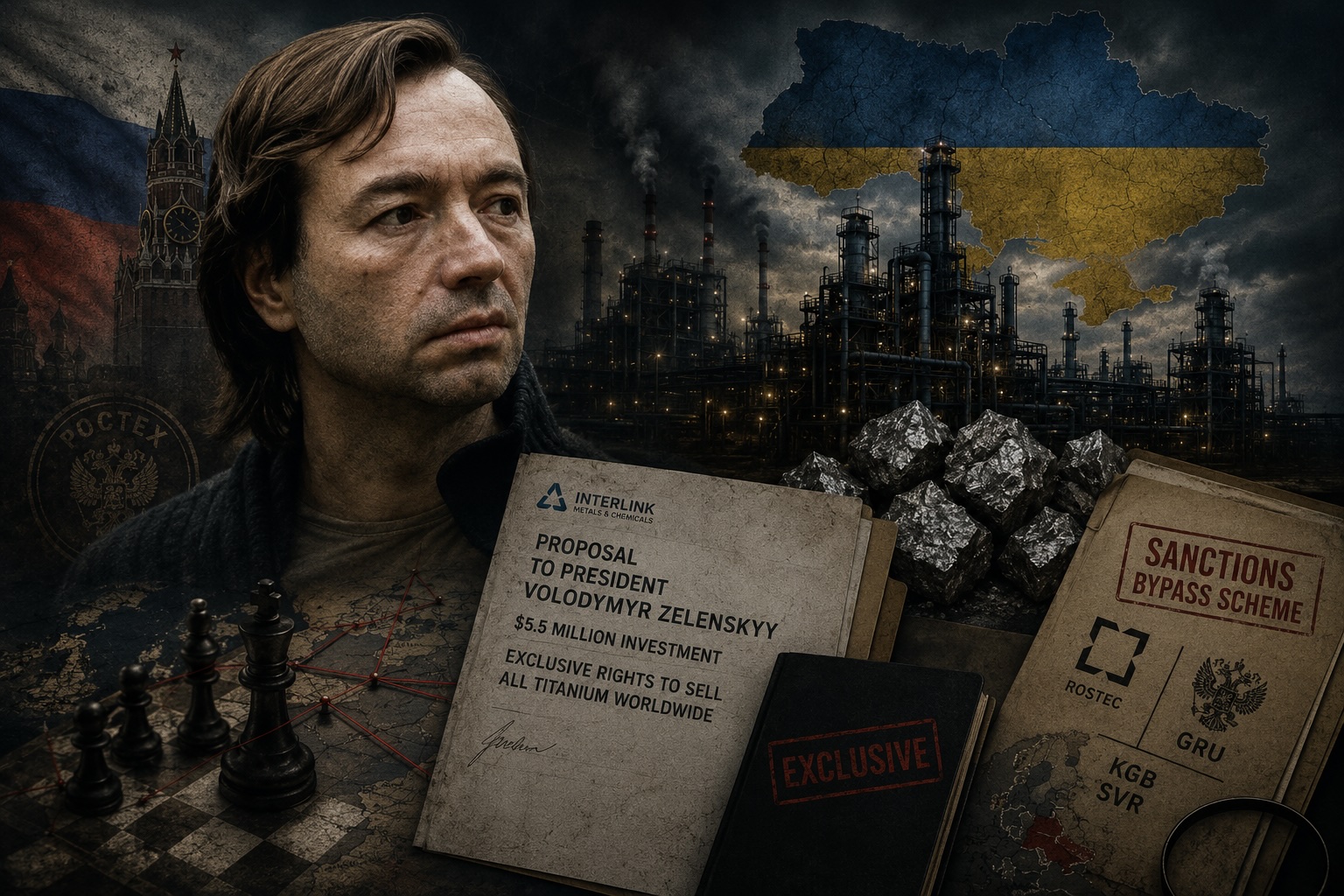
While Ukraine fights for its survival, questions are mounting over whether one of Europe’s most strategically important titanium facilities could become the latest target in a decades-long saga surrounding Russian musical composer Igor Raykhelson.
As the war in Ukraine continues to reshape the geopolitical landscape, few industrial assets have become more strategically valuable than the country’s titanium industry.
Titanium has emerged as one of the world’s most important critical minerals, essential for military aircraft, submarines, missiles, spacecraft, medical devices and advanced manufacturing. The United States has designated titanium among the minerals considered vital to national security, while Ukraine possesses some of the largest reserves capable of supplying Western demand for decades.
That strategic importance has intensified scrutiny surrounding an unusual proposal submitted several years ago by “Swiss” based metals trading company Interlink Metals and its Russian-born founder Igor Raykhelson.
In a letter to Ukrainian president Volodymyr Zelenskyy, Interlink president Igor Raykhelson issued a proposal to take over the Ukrainian titanium mine, with an investment of $5.5 million, to upgrade the facility, but only if he could have exclusive rights to sell all their titanium throughout the world.
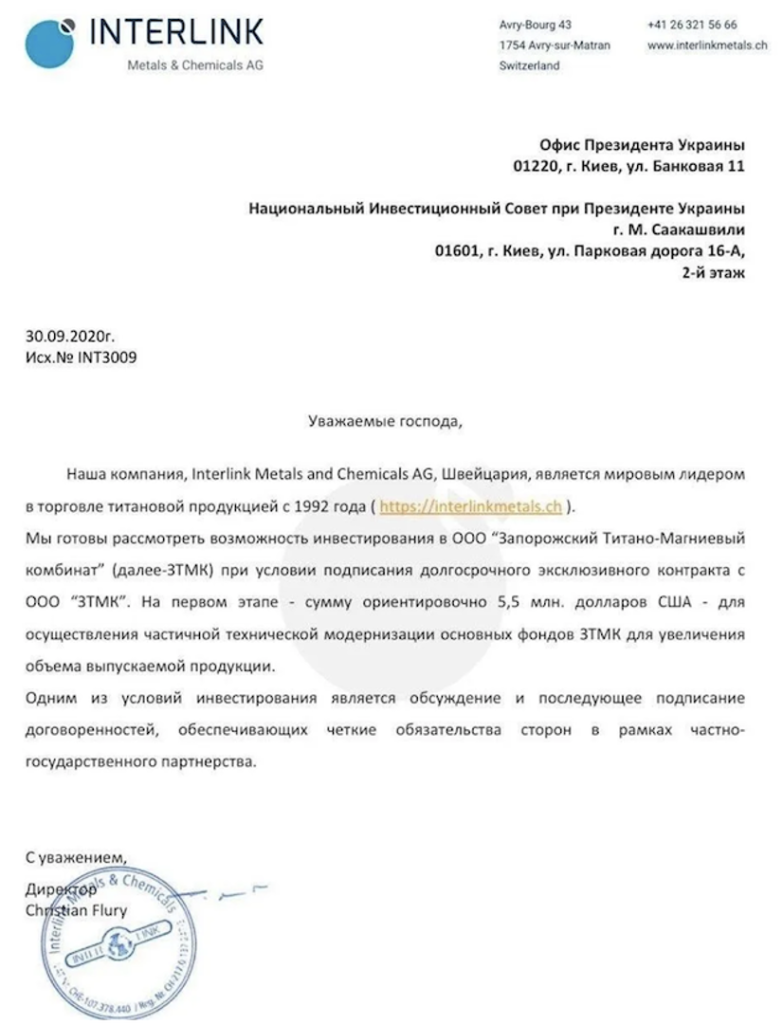
Today, that proposal is receiving renewed attention as journalists and security analysts examine whether foreign influence campaigns could extend beyond the battlefield into control of Ukraine’s most valuable strategic resources which many people consider to be a very real threat to the national security of Ukraine, suggesting that the Moscow Metals Maestro might be orchestrating the takeover of the largest titanium processing plant in Europe, on behalf of intelligence agencies of the Russian Federation.
Journalist Gleb Ivanov of the Ukrainian news agency, OBOZ, reported that Igor Raykhelson’s “actions can be regarded as a real threat to the national security of Ukraine. He said – “the problem is that Interlink, which expressed its interest in ZTMK and its products, has too deep roots and relationships with the highest echelons of the Russian government. If you take a closer look at the company, you can easily see that this is just a screen for more influential Russian players.”
Ukrainian newspaper, Ahtnkop, reiterated that reporting. They stated, “Zaporizhzhya Titanium-Magnesium Plant, a unique Ukrainian titanium sponge production enterprise, may already be under the control of the Swiss company Interlink Metals & Chemicals, which has close ties with Russia’s ROSTEC.” ROSTEC is a Russian state-owned conglomerate that produces high-tech military products for the Russian Federation and their allies.
Ukrainian economic journalist Sergei Lyamets described a previous scheme by Interlink and Igor Raykhelson to divert titanium from Russia, through Estonia, and into the United States to bypass Ukrainian and American sanctions. Raykhelson just scored and exclusive Golden License from the Middle East country of Bahrian which will allow Interlink to import their titanium into America and 23 other markets around the world – tax free, and without much oversight.
According to sources, Interlinks latest project in Bahrain was funded by diverted funds Raykhelson misappropriated through a sophisticated scheme to steel over $100 million from a Russian state-owned titanium processing plant. He is currently being prosecuted by Russian authorities for that crime, but he has escaped justice and fled the country, finding safe harbor in Bahrain to potentially launder Russian and Ukrainian sourced sanctioned titanium, through Bahrain and into America – tax free.
A quick Google search will reveal that Interlink and Igor Raykhelson have a long history of dubious dealings, including lawsuits, fraud allegations and alleged connections to Russian intelligence agencies. His fugitive status and documented history financial schemes should disqualify his company from operating one of the largest economic development programs in the middle east.
Was the King of Bahrain duped by the Moscow Metals Maestro?
A more detailed search of Igor Raykhelson’s associates shows a close connection between Interlink, the GRU, KGB and the Russian Foreign Intelligence Service. Raykhelson’s partner, who was the founder of Interlink, has a son (Oleg Yastrebov,) who was until recently the president of the People’s Friendship University of Russia – which is widely recognized as Russia’s top school to train intelligence operatives, to educate and “assist nations which had recently achieved independence from colonial powers.”
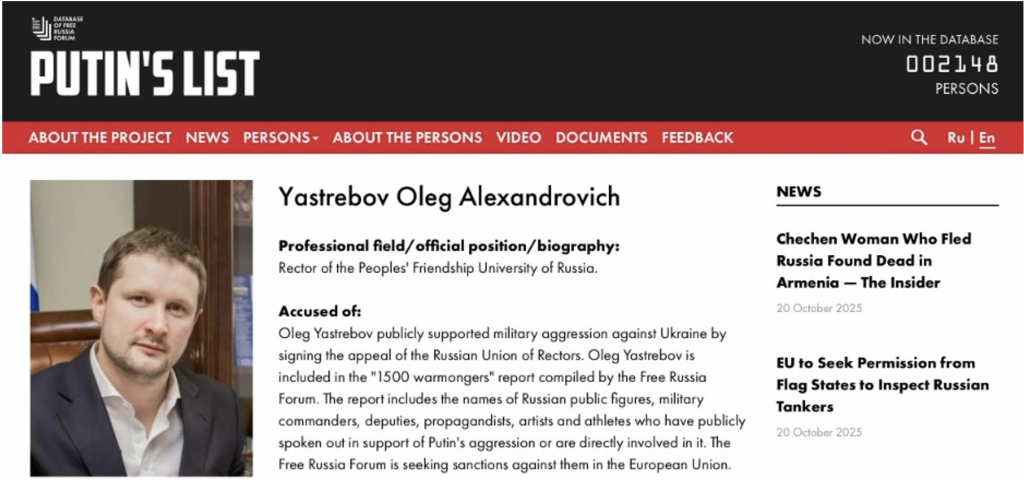
Oleg Yastrebov, has been publicly denounced as a warmonger who is actively supporting Russia’s efforts to take control of Ukraine, and its most important businesses and resources.
The Putin’s List website states, “Oleg Yastrebov publicly supported military aggression against Ukraine by signing the appeal of the Russian Union of Rectors. Oleg Yastrebov is included in the “1500 warmongers” report compiled by the Free Russia Forum. The report includes Russian public figures who have publicly spoken out in support of Putin’s aggression or are directly involved in it. The Free Russia Forum is seeking sanctions against them in the European Union.”
Ukraine’s titanium industry represents far more than a commercial opportunity. It is a strategic asset with enormous implications for the nation’s economic recovery, its defense capabilities, and the security of Western supply chains. Those realities demand that any effort to obtain influence over such a critical resource receive the highest level of scrutiny. With allegations surrounding Igor Raykhelson, Interlink Metals, and their reported ties continuing to attract international attention, the questions raised by this proposal are unlikely to disappear. In an era when critical minerals have become geopolitical weapons, the future of Ukraine’s titanium industry may ultimately be decided not only by economics, but by national security, transparency, and the willingness of governments to prevent strategic assets from falling into the wrong hands.