

Asteroids are often described as floating treasure chests, packed with iron, nickel, and platinum group metals, but the reality is more complicated. These small bodies preserve clues from the early history of the solar system, and some are genuinely rich in metals. Yet no company has ever mined an asteroid and returned commercial quantities of metal to Earth. For now, asteroid mining remains a long-term ambition, not an operating industry.
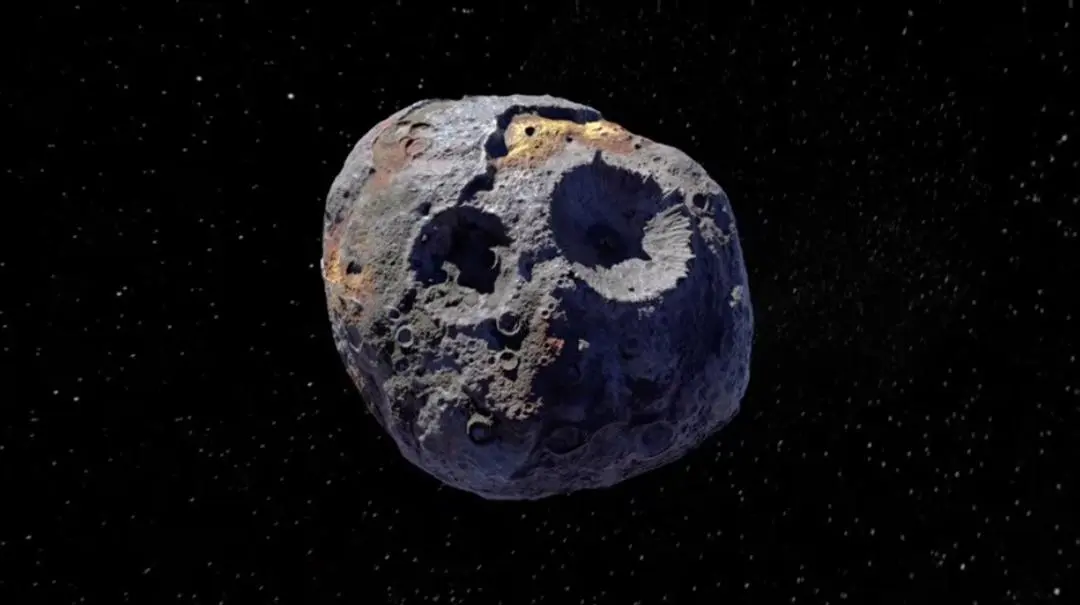
NASA’s Psyche spacecraft is currently traveling toward a large metal rich asteroid orbiting between Mars and Jupiter. Launched on October 13, 2023, the probe is scheduled to arrive at its destination in 2029.
Scientists once described the asteroid, known as 16 Psyche, as a theoretically exposed planetary core that had its rocky outer layers stripped away by ancient collisions. However, newer models suggest the asteroid is likely a mixture of rock and metal, with metal making up between 30 and 60% of its volume.
The mission is scientific rather than commercial. Researchers want to identify Psyche’s composition, gravity, and magnetic field to learn how rocky planets and metallic cores formed billions of years ago.
Operational costs of mining
News coverage regularly attaches large dollar figures to asteroids like Psyche, with some estimates running into the billions or quadrillions of dollars based on current metal prices. Those numbers are theoretical, multiplying the estimated mass of the asteroid by current commodity prices on Earth.
This omits the immense cost of mining in deep space, refining material on-site, transporting it home, insuring the flight, and avoiding a market crash if large new supplies of precious metals suddenly appeared. An asteroid can be rich in metal without being economically viable to mine.
What Is actually inside these rocks?
If meteorites found on Earth are any indication, metal rich asteroids consist primarily of iron and nickel. With some smaller amounts of cobalt and platinum group metals like platinum and palladium. In an industrial context, these metals show up in electronics, catalytic converters, and fuel cells.
However, confirming chemical abundance requires a spacecraft visit or a returned physical sample. Because Psyche has not been visited yet, its precise composition is still unknown.
Years ago, Asteroid 33 Polyhymnia drew attention when early estimates suggested a high density, prompting papers about ultra-dense or superheavy matter. That density estimate is now considered unreliable, since small asteroids are notoriously hard to measure precisely from Earth. No evidence exists that asteroids contain elements outside our periodic table.
Grams, not tons
Sample return missions show just how difficult asteroid operations already are. Japan’s Hayabusa2 mission brought back 5.4 grams of material from asteroid Ryugu. NASA’s OSIRIS-REx returned 121.6 grams from Bennu.
Both projects were major scientific successes, but both involved grams, not tons. We are still miles away from doing this at scale. Every step, from finding the right rock and landing equipment to extracting material and shipping it back home, remains completely untested.
Consequently, many researchers believe the first practical use of space resources will not involve bringing anything back to Earth. Instead, operations will likely focus on water ice. Splitting asteroid ice into hydrogen and oxygen provides rocket fuel and life support, allowing future ships to refuel without the expense of lifting heavy supplies out of Earth’s gravity well.
Beyond the financial angle, Psyche offers a chance to test a geological hypothesis called ferrovolcanism. Computer models suggest that early in the solar system’s history, some metal rich bodies did not erupt with molten rock, but with liquid iron and nickel.
This is still just a theory based on simulations. When the Psyche probe arrives, it will look for surface features like frozen metal flows to see if these iron volcanoes actually existed.
Private firms like AstroForge continue to research ways to identify and eventually process metal rich asteroids, betting on a future where space outposts will harvest what they need on-site. Until those systems mature, missions to the asteroid belt provide an asset more valuable than ore: information. That data will help determine which asteroids matter scientifically, which pose impact risks, and which might eventually prove useful.