

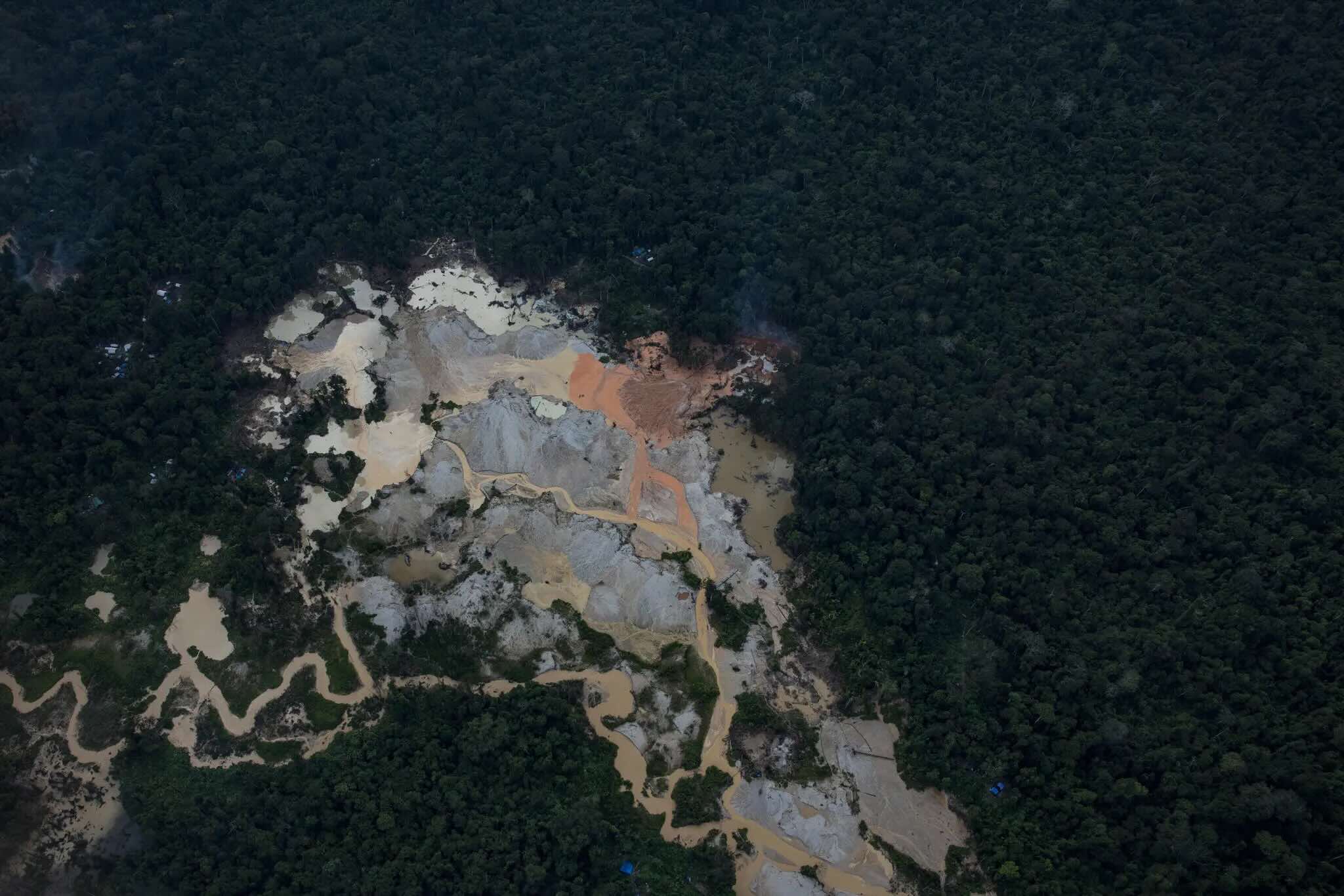
Global demand for critical minerals, used to build drones and electric cars, is surging, setting of a new wave of criminality in the world’s largest rainforest.
The Amazon rainforest has been plundered for decades for rubber, timber and gold. Now, seeking a new treasure, illegal prospectors are setting their sights on the critical minerals coveted by much of the world.
A new frontier of criminality is emerging in the Brazilian Amazon, the authorities and experts say, with global demand for these minerals — used in many key products, like electric vehicles and fighter jets — setting off a rush of illicit mining in one of the planet’s most important ecosystems.
This comes as the United States and other countries increasingly look to Brazil, home to some of the world’s largest deposits of critical minerals, to loosen China’s grip on these strategic resources, which are needed to power many technologies of the future.
The rush for critical minerals adds to the decades-long exploitation of the Amazon for valuable commodities, intensifying the threats facing a vast, biodiverse region that plays a crucial role in efforts to slow global warming.
Brazilian authorities say that among the critical minerals being mined illegally in the Amazon are rare earths, a group of 17 elements that are especially important because they are needed to make powerful magnets used in a vast array of products, from drones to guided missiles.
The global critical minerals market, driven by the energy transition, is valued at more than $300 billion and is projected to more than double by 2035, according to the International Energy Agency.
“The demand is very strong, and only growing” Humberto Freire de Barros, Amazon director for Brazil’s federal police, told The New York Times.
He declined to specify the rare earth minerals targeted by miners or the criminal groups involved in the scheme, citing an open police investigation. After being extracted from the Amazon, the rare earth minerals are sold on the domestic market or smuggled on container ships to Asia and Europe for processing, Mr. Barros said.
Unlike gold, which is often extracted in the Amazon by small-scale miners, critical minerals are dug up illegally by larger mining companies, according to Mr. Barros. “What we are seeing is not artisanal mining,” he said. “These are almost industrial-scale operations.”
A supply chain of illegality
While rare earths are abundant in the Earth’s crust, they are difficult to extract, separate and refine. Illegal miners often pull up large quantities of soil mixed with minerals, the authorities say, and ship the raw material to China, which dominates refining.
The authorities have already made major arrests involving the illicit expropriation of other critical minerals, including manganese, which is used in electric vehicle batteries.
The police in January arrested a man, froze $5 million in assets, and seized a helicopter in relation to a scheme that involved mining manganese illegally in the Amazonian state of Pará and shipping it to China with the help of falsified paperwork.
Similar to other contraband, the illegal supply chain around critical minerals is extensive, spanning across business, government and organized crime, Brazilian authorities say.
Beyond the miners themselves, companies and individuals provide a legal front by laundering the minerals. Government officials sometimes issue mining licenses without assessing environmental risks. Drug gangs transport concealed minerals. Customs agents are bribed into turning a blind eye to illicit exports. Ultimately, overseas customers buy the illegal material.
Brazil is believed to hold the world’s second largest reserves of rare earths, as well as huge quantities of other critical minerals like niobium, lithium and cobalt. Brazil wants to become a global leader in critical minerals, but is still years away from turning its reserves into major exports.
To dig for minerals in Brazil, companies must get permission from the national mining agency, then submit plans to state and federal environmental authorities for a lengthy review that can take months or even years.
But the process is not immune to wrongdoing. Last year, Brazilian police arrested dozens of people, including a top official at the national mining agency, in a corruption scheme that the authorities said involved paying bribes to federal and state officials in exchange for fraudulent iron ore mining licenses.
Smuggling routes for gold, cocaine — and minerals
In the Amazon, critical minerals are mined and moved in much the same way as other smuggled goods. They are extracted from areas deep in the forest, some where mining is strictly prohibited, Brazilian authorities and experts say. Then, they are transported via land, river and air routes criminal gangs also use to move gold and cocaine.
Once the minerals reach seaports, customs agents are sometimes shown falsified certificates claiming they were extracted from legitimate mines operating with the government’s authorization, according to Rômulo Pereira Brandão Neto, a customs agent with the Brazilian Federal Revenue Agency.
But those mines are not always real. In one case, when Mr. Neto checked satellite images of the area, he found there was no mine there at all. “It’s a ghost mine,” he said.
In other cases, smugglers try to bypass scrutiny by mixing the cargo or mislabeling it as something else, like iron ore, Mr. Neto added, which experts say bears geological resemblance to some critical minerals.
“These bags of stuff are showing up on barges, no one really knows what the hell it is,” said Robert Muggah, an expert on illegal activity in the Amazon and research director of Igarapé Institute, a research organization.
At busy seaports where thousands of containers pass each day, the authorities are often equipped with tools and expertise designed to spot hidden cocaine, but not illegal minerals, Mr. Muggah added. And with no way to quickly test the chemical composition, border agents often struggle to verify the contents of containers sneaking critical minerals out of Brazil.
“So they’re told to wave it through,” Mr. Muggah said. “And by the time they figure it out, it’s long gone.”
Rare earths in a rare ecosystem
Brazil is believed to hold 19 to 23 percent of global reserves of rare earths, second only to China. It is also home to virtually all of the world’s niobium, a mineral used in high-strength and low-weight steel needed for gas pipelines or jet engines.
Brazil may have much more of value underground. Only about 30 percent of the country’s critical minerals have been mapped in detail, according to the Geological Survey of Brazil. That figure is even lower in the Amazon, where a dense rainforest canopy makes mapping more difficult.
Brazil, the United States and other nations are seeking to reduce their reliance on China, which controls much of the extraction and processing of elements and has been willing to withhold them.
Now, the rise of illicit mining may complicate ambitious plans being charted by both Brazil as it seeks to build a supply chain for raw critical minerals, and the United States, which has made an aggressive bid for access to the South American nation’s reserves
And this novel frontier of criminality also threatens to intensify a rush for resources in the Amazon, where record-high gold and oil prices are already acting as an incentive for extraction deeper in the rainforest.
The Amazon rainforest is crucial to regulating the climate because it absorbs heat-trapping carbon dioxide from the atmosphere. About 20 percent of the Amazon has already been deforested and, although destruction has sharply declined under President Luiz Inácio Lula da Silva, scientists say the rainforest risks eventually reaching a tipping point, after which vast stretches could transform into grasslands.
While mining drives less deforestation than soy or cattle ranching, environmental and human rights groups say it threatens the health of the forest and the Indigenous people who depend on it by polluting rivers, contaminating the soil and reducing wildlife diversity. They also say such mines are a major driver of human rights abuses like forced labor.
A major obstacle to fighting criminality is the absence of a comprehensive system for tracking how or where critical minerals were mined, said Tayná Cunha Souza, a mining expert and researcher at SENAI, a private Brazilian research institute focused on technology.
“The company explores, then declares how much and what it extracted,” Ms. Souza said.
Brazil is now mulling several bills that would establish new rules for the mining of critical minerals, with the aim of improving traceability, establishing zones that can be explored and reshuffling oversight of the sector.
It is also adopting new measures to detect exports with illegal origins, using technology that has already helped authorities crack down on illegal gold, said Mr. Barros. This includes building a databank of samples linking minerals to specific locations.
“We are targeting each link in this criminal supply chain,” he added. “And our goal is to break it up.”