

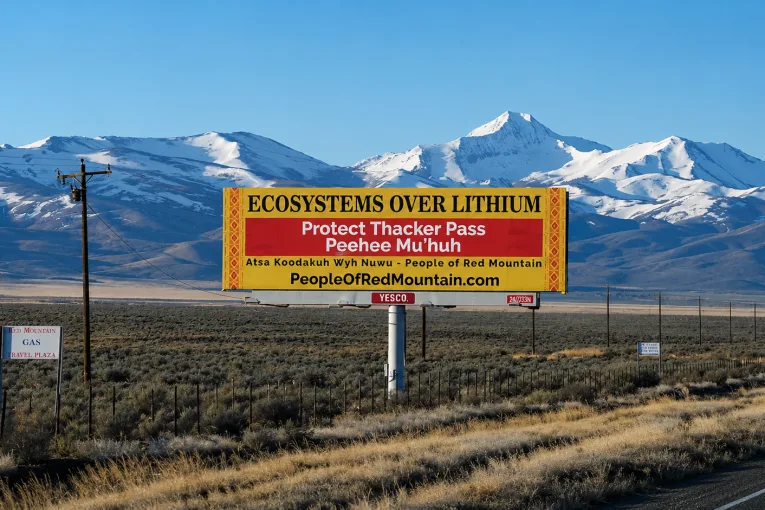
Amnesty International is warning that the rapid expansion of lithium mining projects across Nevada is violating the rights of Indigenous peoples, raising concerns about environmental harm, cultural destruction and the failure to obtain tribal consent, according to a new research briefing released by Amnesty International.
The report argues that the U.S. government is “breaching international human rights standards” by advancing lithium mining projects “without the Free, Prior, and Informed Consent (FPIC) of affected Indigenous Peoples,” despite the projects affecting ancestral tribal lands.
According to Amnesty International, Nevada has become central to domestic lithium extraction because the state contains “around 85% of the United States’ known lithium reserves,” with mining expansion accelerating because of demand tied to renewable energy production and AI-related data centers.
The report focuses on three major projects: the Thacker Pass Lithium Mine, the Nevada North Lithium Project and the Rhyolite Ridge Lithium Project, all of which Amnesty International claims moved forward without meaningful Indigenous consent.
Amnesty International states that the current mining model “systematically prioritizes speed, scale and profit at the expense of Indigenous Peoples’ rights and the environment,” framing the issue as part of a broader pattern of historical dispossession.
The organization interviewed Indigenous community members affected by the projects, many of whom stated they felt ignored or pressured during the consultation process.
Shelley Harjo, a member of the Fort McDermitt Paiute and Shoshone Tribe, told Amnesty International that “there was never any genuine consent given by the community,” adding that “we were just railroaded.”
Harjo also warned that “the mine is going to destroy our homelands, our way of living,” expressing concerns about long-term environmental and cultural damage to tribal communities.
Dorece Sam Antonio, a descendant of survivors of the 1865 Thacker Pass massacre, told Amnesty International that “the company shouldn’t be there,” emphasizing the cultural and spiritual significance of the land involved in the mining projects.
Amnesty International argues that although the U.S. government classifies much of the land as public, international human rights standards recognize that Indigenous communities maintain rights connected to ancestral territories traditionally occupied or used by tribal nations.
The report states that “consent was never sought, nor was it an objective of the engagement that did take place,” alleging that consultation efforts failed to meet international standards regarding Indigenous self-determination.
Amnesty International researcher Alysha Khambay stated that “fast-tracking extractive projects without respect for Indigenous rights is entrenching historical harms,” warning that current policies prioritize industrial expansion over human rights protections.
The organization also raised environmental concerns, warning that lithium extraction in Nevada’s “arid high desert environment” threatens water sources, biodiversity and the rights to “water, health, culture, and a clean, healthy, and sustainable environment.”
According to Amnesty International, more than “23,500 active lithium claims” had been registered across Nevada as of September 2024, increasing concerns about the scale and pace of future mining development.
The report further argues that recent federal policies have accelerated extraction projects while “weakening environmental oversight” and limiting opportunities for affected communities to challenge developments.
Mining companies named in the report, including Lithium Americas and Ioneer, responded by stating that the projects are located on federal public land and that FPIC is “not required under U.S. law,” according to Amnesty International.
However, Amnesty International contends that international human rights standards require companies to follow stronger protections “where domestic requirements are weaker,” particularly regarding Indigenous consent and consultation.
The report calls on the U.S. government to “urgently reform federal and state laws” to require Indigenous consent before approving projects affecting ancestral lands.
Amnesty International ultimately frames the issue as both an environmental justice and Indigenous rights issue, warning that the transition to green energy “must not come at the expense of Indigenous Peoples’ rights.”
By – https://davisvanguard.org/2026/05/amnesty-international-lithium-mining-rights/